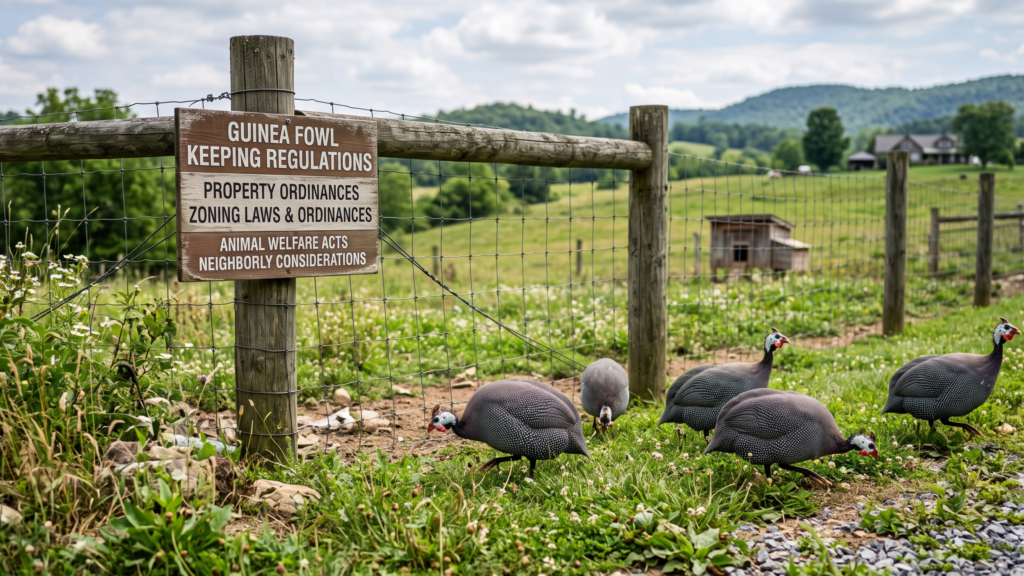
Local ordinances, not state law, usually decide whether you can legally keep guinea fowl on your property. Zoning classification, municipal noise codes, flock size caps, and setback requirements each play a role, and they vary block by block in many areas. This article walks through every category of rule worth checking, where to find it, and what happens if a property doesn’t comply.
Guinea fowl raise more legal questions than chickens because of their volume and roaming habits, so a few extra checks before purchase prevent costly conflicts later.
Rules to Verify Before Keeping Guinea Fowl
| Rule Category | What It Controls | Where to Check |
|---|---|---|
| Zoning classification | Whether poultry is allowed at all on the parcel | County or city planning department |
| Municipal animal ordinance | Flock size limits, coop setbacks, roosters/males | City clerk’s office or municipal code website |
| HOA covenants (CC&Rs) | Private restrictions beyond city law | HOA management company or board |
| Noise ordinances | Decibel limits and permitted hours | Municipal code, often under “nuisance” |
| Setback requirements | Minimum distance from property lines, homes, wells | Building or zoning department |
| State agriculture rules | Health certificates, sales, transport | State department of agriculture |
Every property sits inside overlapping layers of regulation, and guinea fowl can run afoul of any one of them even when they comply with the rest.
Start With Zoning, Not the Pet Store
Zoning classification is the first thing to confirm, because it determines whether poultry is legal on a parcel before any other rule matters. Land zoned agricultural or rural residential typically permits guinea fowl without restriction, while parcels zoned strictly residential or urban may prohibit poultry entirely or cap the number of birds allowed.
A property’s zoning designation appears on the county assessor’s website or the local planning department’s parcel lookup tool. Searching by address usually returns a code such as “R-1” or “AG,” and that code links to a use table listing what’s permitted, conditionally permitted, or banned.
Some municipalities distinguish between “backyard poultry” ordinances written for chickens and general “livestock” rules that guinea fowl fall under instead, since they’re technically a game bird rather than a domesticated fowl in some codes. That distinction can change which flock-size limits and permit requirements apply, so it’s worth reading the ordinance text itself rather than assuming chicken rules automatically cover guinea fowl.
Flock Size Limits and Permit Requirements
Municipal codes that allow poultry almost always cap how many birds a property can keep, and that cap is frequently tied to lot size. A quarter-acre residential lot might permit four to six birds, while properties over an acre often have no numeric limit at all.
Some cities require a permit or annual registration for any poultry flock, separate from zoning approval. This paperwork typically costs a small fee and may include a site inspection to confirm the coop meets setback and sanitation standards before birds are approved.
Municipal ordinances updated within the last few years increasingly write guinea fowl into the poultry definition explicitly, closing a loophole that once let flocks avoid chicken-specific caps. Checking the ordinance’s effective date matters, since an older code found through a general search may already be superseded.
Noise Ordinances Are the Most Common Point of Conflict
Guinea fowl are known for a loud, repetitive alarm call that can exceed 100 decibels at close range, and this single trait causes more code-enforcement complaints than any other aspect of keeping them. Even properties zoned to permit poultry can still violate a general noise ordinance if birds are audible past the property line during restricted hours.
Most municipal noise codes set quiet hours, commonly 10 p.m. to 7 a.m., and prohibit sound that’s “plainly audible” a set distance from the source, often 50 to 100 feet. Guinea fowl calling at dawn or in response to perceived threats can trigger a nuisance complaint even in areas where poultry itself is fully legal.
Coop placement, windbreaks, and keeping flocks smaller in noise-sensitive areas all reduce complaint risk, and pairing guinea fowl with quieter housing choices covered in guides to housing and equipment helps limit how far calls carry.
HOA Rules Often Override City Ordinances
A property can sit in a zone that permits poultry and still be barred from keeping guinea fowl if it falls within a homeowners association. HOA covenants, known as CC&Rs, are private contracts that frequently prohibit livestock and poultry regardless of what municipal code allows.
These restrictions are enforceable independent of city law, and violating them can result in fines or a legal demand to remove the birds, even if animal control has no complaint on file. Reviewing the CC&R document directly, rather than relying on a neighbor’s account of the rules, avoids surprises after birds are already purchased.
Some HOAs allow poultry with board approval on a case-by-case basis. Submitting a written request before acquiring birds, and getting approval in writing, protects against later disputes about what was actually authorized.
Setback and Coop Placement Requirements
Setback rules specify minimum distances between a coop or run and the property line, neighboring structures, wells, and sometimes public roads. A typical residential ordinance requires poultry housing to sit at least 10 to 25 feet from the property line and further from a neighbor’s dwelling.
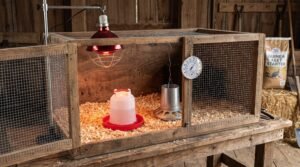
These distances exist to manage noise, odor, and runoff, and they’re usually listed in the same section of code that covers flock size. Coop plans that meet the housing and equipment basics for guinea fowl should be checked against local setback figures before construction begins, since a completed coop built too close to a boundary line can require costly relocation.
Rural properties without formal zoning still sometimes fall under county health department rules governing manure management and water source protection, which function similarly to a setback requirement even when the word “zoning” never appears.
Roaming, Free-Ranging, and Liability
Guinea fowl are natural free-rangers and tend to wander farther than chickens, which raises a separate legal question: what happens if birds cross onto a neighbor’s property or into a road. Most jurisdictions hold the animal’s owner liable for damage caused by free-ranging poultry, including garden damage or a vehicle collision.
Some municipal codes require poultry to be contained within a fenced area during daylight hours, particularly in denser residential zones, while rural agricultural zoning may impose no containment requirement at all. Fencing decisions should account for both the legal containment requirement and the practical reality that guinea fowl fly well enough to clear a low fence.
Owners considering free-ranging as part of their decision to raise guinea fowl, discussed further in the overview of guinea fowl pros and cons, should weigh the liability exposure against the pest-control benefits that make free-ranging appealing in the first place.
What Happens if a Property Isn’t Compliant
Code enforcement typically begins with a complaint, most often from a neighbor affected by noise or roaming birds, rather than proactive inspection. A first violation usually results in a written notice with a compliance deadline rather than an immediate fine, giving the property owner time to correct the issue.
Continued noncompliance can lead to escalating fines, and in cases involving HOA violations, a lien on the property is possible if fines go unpaid. Removal orders for the birds themselves are less common but do occur when a property is in a zone that prohibits poultry outright and no variance is granted.
Addressing a violation notice promptly and documenting any corrective steps, such as adding sound barriers or adjusting coop placement, generally resolves the issue faster than contesting the underlying ordinance.
Frequently Asked Questions
Can I keep guinea fowl in a residential neighborhood?
It depends on the specific zoning code and any HOA covenants that apply to the property. Many residential zones permit a small poultry flock, but guinea fowl’s noise level makes a written check of the local noise ordinance especially important even when zoning allows birds.
Do guinea fowl count as livestock or poultry under most codes?
Municipal codes vary, with some classifying guinea fowl as poultry alongside chickens and others treating them as game birds subject to separate agricultural rules. The distinction affects which flock-size caps and permit requirements apply, so the ordinance text itself should be checked rather than assumed.
Is a permit required to keep guinea fowl?
Some cities require a poultry permit or annual registration regardless of species, typically involving a small fee and sometimes a coop inspection. Rural or agriculturally zoned properties often have no permit requirement at all.
What is the typical fine for violating a poultry ordinance?
Fines vary widely by municipality, but a first violation commonly results in a warning notice with a correction deadline before any fine is issued. Repeated or unresolved violations can lead to escalating fines set by local code.
Can an HOA ban guinea fowl even if the city allows poultry?
Yes, HOA covenants are private contracts that can be more restrictive than municipal code and are generally enforceable independent of what the city permits. Reviewing the CC&R document directly before acquiring birds is the only reliable way to confirm the rule.
Are guinea fowl legal to free-range without a fence?
This depends on local containment requirements, which some municipalities impose during daylight hours in residential zones while rural agricultural areas often leave unrestricted. Even where legal, owners typically remain liable for any damage the birds cause while roaming.
Hi, I’m Rayyan. I raise guinea fowl and share practical, research-backed guides for backyard keepers and homesteaders. I combine hands-on flock experience with trusted poultry management and university extension resources to help you raise healthier, more productive birds — with confidence, not guesswork.