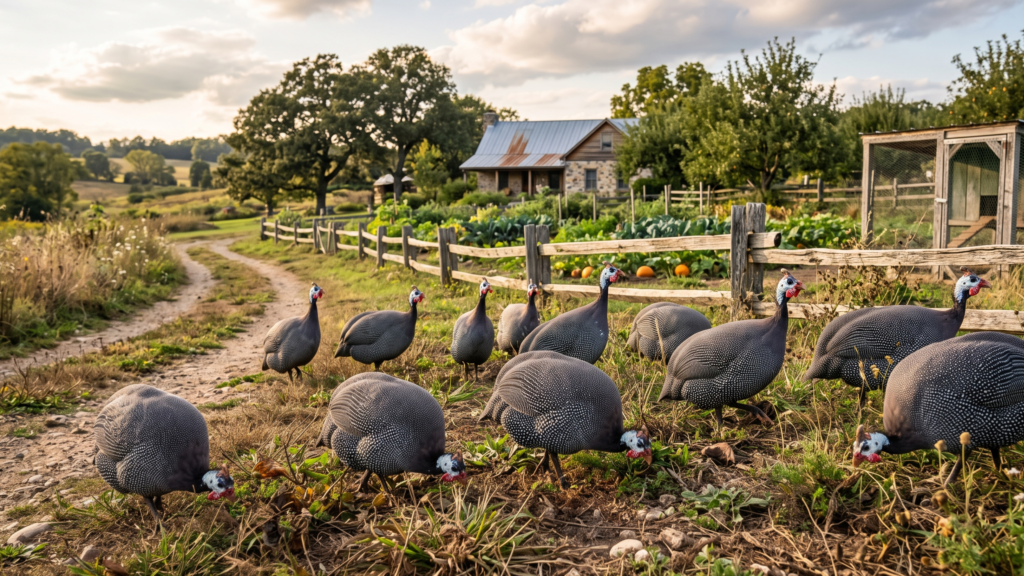
Guinea fowl are excellent at pest control and property alarm duty, but they’re loud, prone to wandering, and don’t take well to confinement — which makes them a great fit for some homesteads and a frustrating mismatch for others.
I get asked about guinea fowl more than almost any other bird I keep. Someone hears they can help with the tick problem in their yard, sees a photo of their spotted feathers, and wants to know if they should get a few. My honest answer is always: it depends on what kind of property you have and how much noise and chaos you’re willing to live with.
I’ve kept guineas for years now, and they’ve earned their place on my land. But I’ve also watched them drive neighbors crazy, vanish into the tree line for good, and ignore every coop I’ve ever built for them. Before you bring any home, you deserve the full picture — not just the highlight reel. This guide walks through what guinea fowl actually do well, where they fall short, and how to tell if they belong on your homestead.
Quick Summary: Guinea Fowl Pros and Cons
| Pros | Cons |
|---|---|
| Strong pest and insect control | Very loud, especially in groups |
| Natural alarm system against predators and intruders | Prone to wandering off your property |
| Lower feed costs once mature (largely self-foraging) | Difficult to confine or coop-train |
| Lean, flavorful meat | Not affectionate or easily tamed |
| Hardy in most climates with minimal health issues | Inconsistent, hard-to-find nesting habits |
| Long productive lifespan | Not ideal for small yards or close neighbors |
Pro: They’re Working Birds for Pest Control
This is the reason most people look into guinea fowl in the first place. Turn a flock loose on your property and they’ll spend their day hunting down grasshoppers, beetles, flies, and other insects instead of scratching up your garden beds the way chickens do.
Extension resources on raising guinea fowl in backyard flocks note that guineas have long been used against grasshoppers, flies, and crickets, and that domestic birds can eat large quantities of insects without doing much damage to garden vegetables or flowers. That matches what I’ve seen on my own land — my guineas patrol the garden edges all day and mostly leave the actual crops alone, which is more than I can say for my chickens.
Where I want to be careful is the claim you’ll hear constantly: that guineas will wipe out your tick problem. It’s more complicated than that. Older research on blacklegged ticks found a real reduction where guinea fowl foraged, but a more recent peer-reviewed study on lone star ticks found no evidence that guineas actually reduce that species or the pathogens it carries — and it turned up something else worth knowing: the birds themselves can end up hosting tick nymphs. In practice, expect fewer ticks in the open areas your flock actively works — not a tick-free yard.
Con: The Noise Is Not an Exaggeration
If there’s one thing that ends a guinea fowl experiment early, it’s the noise. Guineas — especially the females — have a piercing, repetitive call that carries a long way, and they’ll sound it off for almost anything: a passing car, a hawk overhead, a neighbor in their own yard, or sometimes nothing you can identify at all.
I won’t sugarcoat this one. If you live on a few acres with space between you and the next house, it’s usually manageable. If you’re in a suburban backyard with neighbors on both sides, the noise alone can turn this into a bad fit fast — and in some areas, it can also trigger noise complaints. It’s worth checking local rules on keeping guinea fowl before you commit, since some municipalities restrict them specifically because of the racket.
Pro: A Genuinely Useful Alarm System
The same call that annoys your neighbors works in your favor when something unwanted shows up. Guineas notice movement fast, and the whole flock tends to sound off together, which makes it hard for a person or predator to approach unnoticed.
A sizeable flock effectively becomes a farm-wide alarm system, and guineas have been known to gang up on predators together, which can help shield the rest of your animals from foxes or weasels. I’ve had guineas alert me to a hawk circling the yard well before I’d have noticed it myself, which gave me enough time to get the smaller birds under cover. That said, they’re an early-warning system, not a defense system — they’ll raise the alarm, but you shouldn’t count on them to fight off anything determined. Pairing them with solid predator-proofing for the rest of your flock still matters.
Con: They Wander, and They Don’t Always Come Back
Guinea fowl are barely domesticated compared to chickens, and it shows in how they move around a property. They roam in a tight group, cover a lot of ground during the day, and don’t respect fence lines the way you’d hope.
Most of the time mine circle back toward the coop by dusk out of habit, not loyalty. But I’ve had stretches — usually in spring, when they’re pairing off — where a few birds simply didn’t come back. If you live near a busy road or have neighbors who won’t appreciate guineas showing up in their yard, this is a real risk, not a rare exception. Clipping flight feathers helps keep them from launching over fences, but it won’t stop them from walking off, and it does leave them a bit more exposed to ground predators while their wings grow back in.
Pro: They’re Inexpensive to Feed as Adults
Because guineas forage so aggressively, your feed costs drop noticeably once they’re past the keet stage. A flock with room to range will cover a meaningful share of its own diet through insects, seeds, and greens, and you’ll mostly be topping off with layer feed rather than relying on it entirely.
That said, this only holds true if you can actually let them free-range. Confined guineas eat like any other confined poultry, and you lose the cost advantage along with a lot of what makes them interesting to keep.
Con: They Don’t Take to Confinement Well
Guinea fowl want space, and they let you know it. Birds kept in a small run tend to get restless, noisier than usual, and more prone to pacing fences or trying to fly out. This isn’t a minor preference — it’s close to a requirement for keeping them calm and healthy.
If your property is small, heavily fenced, or shared closely with neighbors, guineas may not be the right bird no matter how much you like the idea of them. It’s worth being honest about your actual space before bringing any home, rather than finding out the hard way once they’re already loud and unhappy.
Pro: Lean Meat and a Long Productive Life
Guinea fowl are also raised for meat, and the flavor is often described as closer to game bird than to chicken — leaner, slightly richer, and a draw for people who want something different from their homestead table. It’s genuinely lean meat, too, with a solid amino acid profile compared to standard broiler chicken.
They’re also a durable bird overall. With decent housing and diet, guineas tend to stay healthy for years, and hens can keep laying well into their later seasons rather than tapering off quickly the way some production breeds do.
Con: Eggs Are Small, Seasonal, and Hard to Find
If you’re getting guineas mainly for eggs, temper your expectations. Guinea hens typically lay somewhere around 100 eggs a year, starting between 20 and 32 weeks of age, and they’re seasonal layers rather than steady year-round producers. Because the eggs run smaller than a chicken egg, it takes roughly two of them to match one large chicken egg in the kitchen. Production also drops off sharply outside of spring and summer.
Then there’s the hunt itself. According to Oklahoma State University’s breed records, hens seldom lay in the nests provided in the hen house, and hunting down where they’ve actually laid becomes something of a regular chore during the season, since the eggs tend to turn up in secluded spots out in the grass and weeds. If you want a reliable, easy-to-collect egg supply, chickens will serve you better.
Pro: They Generally Get Along With Other Flock Animals
Once established, guineas tend to coexist reasonably well with chickens, ducks, and other poultry, especially if raised together from a young age. They mostly do their own thing during the day and don’t cause much trouble for other birds sharing the same space.
The one exception worth knowing about is breeding season. If a rooster harasses guinea hens while everyone’s pairing off, the guinea cocks may retaliate, so it’s smart to keep guinea males and roosters separated during that window to avoid conflict. Outside of that period, mixed flocks are usually calm. If you’re planning a combined setup, it’s worth reading through the specifics on keeping guinea fowl alongside chickens, ducks, and turkeys before you combine everyone.
Con: They’re Not an Affectionate Bird
If you’re hoping for a bird that follows you around or tolerates being picked up, guineas will disappoint you. They’re social with each other, but standoffish with people, and handling them regularly tends to stress them out rather than tame them.
I don’t say this to talk anyone out of keeping them — plenty of homesteaders, myself included, don’t need a cuddly bird. But if a friendly, easy-to-handle flock matters to you, it’s a real trade-off you should walk in expecting, not one you discover after the fact.
Guinea Fowl vs. Chickens: A Quick Gut Check
A lot of people land on guineas after comparing them to the chickens they already keep. If you’re still deciding between the two, or whether to keep both, it helps to look at where each bird actually wins. I broke this down more fully in guinea fowl versus chickens, but the short version is: chickens win on eggs, ease of handling, and quiet; guineas win on pest patrol and perimeter alerts.
Frequently Asked Questions
Are guinea fowl worth it for a small backyard? Usually not. They need room to roam and get restless in small runs, and the noise is much harder to manage when neighbors are close by. A larger, more rural property suits them far better.
Do guinea fowl really keep snakes away? They’ll harass and sometimes kill small snakes if they cross paths, and a vigilant flock can make a property feel less snake-friendly overall. But they’re not a guaranteed snake deterrent, and larger snakes are generally left alone.
Can you keep just one or two guinea fowl? It’s not recommended. Guineas are strongly flock-oriented, and a single bird or pair tends to be more stressed, louder, and more likely to wander looking for company. Most keepers start with at least a half dozen.
Do guinea fowl need a special coop? Not necessarily a special one, but they do need enough space and a setup they’ll actually use — many guineas resist going into a coop at night, especially if not trained early. It helps to build good habits from day one rather than trying to retrain an adult flock later.
Final Thoughts
Guinea fowl aren’t a bird you get for one single reason — they’re a trade-off you either want to make or don’t. You’re gaining pest control, an early-warning system, and a genuinely interesting flock to watch. In exchange, you’re accepting real noise, a tendency to wander, and eggs that won’t fill a carton the way chickens’ will.
If your property has the space and the tolerance for a bit of chaos, I’d encourage you to give them a try — they’ve more than earned their keep on my land. If you’re working with a small lot or close neighbors, it may be worth starting with a beginner’s guide to guinea fowl farming to see the full commitment before deciding either way.
What’s tipping the scale for you — the pest control, or the noise? I’d genuinely like to know where you land, so drop a comment below and share your own experience if you’ve already kept a flock.
Hi, I’m Rayyan. I raise guinea fowl and share practical, research-backed guides for backyard keepers and homesteaders. I combine hands-on flock experience with trusted poultry management and university extension resources to help you raise healthier, more productive birds — with confidence, not guesswork.