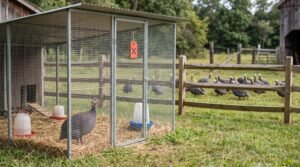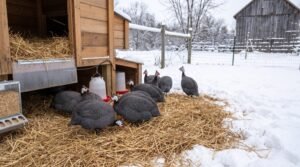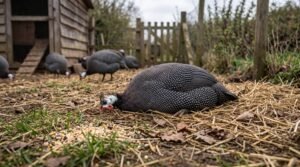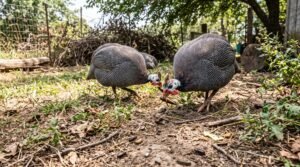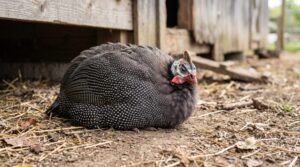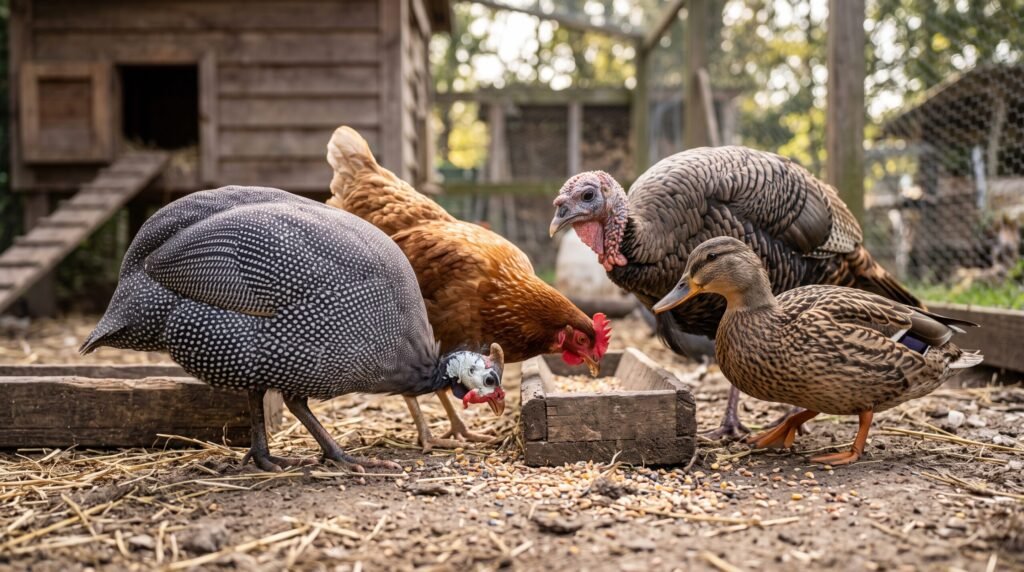
Yes, guinea fowl can live with chickens, ducks, and turkeys, and most keepers find they get along well once they’re introduced properly. Guineas aren’t chickens with a different haircut, though. They’re semi-wild, fiercely independent, and loud enough to wake the whole street, and those traits shape how well a mixed flock actually works day to day.
I’ve kept guinea fowl alongside chickens for years, and I’ve fielded enough questions from readers about ducks and turkeys to know the answer isn’t a flat yes or no. It’s “yes, with a few caveats you’ll want to know before you bring guineas home.” Below, I’ll walk through what actually happens when you mix guinea fowl with each of these birds, where the friction points show up, and how to set your flock up so everyone thrives.
Here’s a quick look at how guinea fowl typically get along with each species before we dig into the details:
| Species | Compatibility | Main things to watch |
|---|---|---|
| Chickens | Generally good | Territorial males, coop-training guineas to roost inside |
| Ducks | Usually easy | Ducks are calmer; guard against guineas crowding feed/water |
| Turkeys | Workable, with care | Histomoniasis (blackhead) risk, breeding-season tension between males |
Can Guinea Fowl Live With Chickens?
Guinea fowl and chickens are the most common mixed-flock pairing, and for good reason — they tolerate each other well in most households. In my experience, hens and guinea hens often settle into the same pecking order without much drama, especially if you introduce them young or keep the ratio of birds sensible.
The friction, when it happens, usually comes from males. Guinea cocks can turn territorial and chase or peck at roosters, particularly during breeding season, and an unbalanced ratio of males to females tends to make it worse. A good rule of thumb is to keep several hens for every guinea cock so tension has somewhere to go besides your rooster. Interbreeding between the species does happen occasionally, but any resulting offspring are generally not viable, so it isn’t something you need to plan around.
Roosting habits are the other sticking point. Chickens come home to the coop like clockwork; guineas would rather sleep in a tree, on a fence rail, or on your barn roof if you let them, since they’re surprisingly strong flyers for a bird their size. If you want your guineas sleeping safely indoors at night, you’ll need to train them early — more on that below.
What tends to work well:
- Raising keets and chicks together from a young age, so they imprint on each other as flockmates — my guide to introducing new guinea fowl to an existing flock covers this in more detail
- Giving guineas high perches of their own inside the coop, since they don’t like roosting low the way chickens do
- Keeping enough space that a guinea’s sudden bursts of energy don’t feel like a threat to your hens; if you’re still working out how much room your flock needs, my guinea fowl space requirements guide has the numbers
Can Guinea Fowl Live With Ducks?
Guinea fowl and ducks are, in my experience, the easiest pairing of the three. Ducks are laid-back by nature and mostly ignore the guineas’ antics, and guineas generally leave ducks alone in return. The two species have different foraging styles too — ducks dabble in mud and water, guineas hunt bugs on the move — so they’re not constantly competing over the same patch of ground.
The main thing to watch is pace. Guineas eat fast and range widely, and in a tight space they can end up crowding ducks out of feeders or watering stations. Spreading out multiple feeding and watering points solves most of this — the same logic applies whether you’re free-ranging or keeping a confined setup. It’s also worth remembering that ducks need standing water for their nostrils and eyes, which guineas don’t require, so your setup should accommodate a wading or dabbling area even if the guineas never use it.
Noise is a smaller issue here than with chickens, since ducks aren’t especially reactive to the guineas’ alarm calls the way flightier birds can be.
Can Guinea Fowl Live With Turkeys?
This is the pairing where I’d tell you to slow down and do your homework first. Guinea fowl and turkeys can live together, and plenty of keepers raise them side by side successfully, especially when the birds are introduced young. But there are two real risks worth understanding before you commit.
The first is disease. According to the University of Guelph’s Animal Health Laboratory, the parasite behind histomoniasis, commonly called blackhead disease, affects avian species in this order of susceptibility: turkeys, peafowl, guinea fowl, chickens, chukar, pheasant, and bobwhite quail. Turkeys are by far the most vulnerable, and outbreaks in turkey flocks can be devastating. Guinea fowl can carry and be affected by the same parasite, so housing them with turkeys does carry some shared disease risk, even if it’s not as severe as the well-documented turkey-chicken problem. If a member of your flock has had prior issues with blackhead, or you’re working with turkeys as a primary flock, it’s worth talking to a vet or your local extension office before mixing species in one run.
The second issue is behavioral. Some keepers successfully raise guineas and turkeys together, particularly when they’re young when introduced, but guinea males can occasionally harass turkey toms during breeding season. This tends to resolve on its own outside of breeding months, but it’s worth watching closely the first spring your flock is together.
If you decide to go ahead, the safest approach is the same one that works for chickens: raise the young birds together, give everyone enough room to retreat from a squabble, and keep an eye on things as breeding season approaches.
Setting Up a Mixed Flock That Actually Works
A few management basics make the difference between a mixed flock that thrives and one that’s a constant headache, regardless of which species you’re combining.
- Coop-train your guineas early. Left alone, guineas will roost in trees or on rooftops rather than coming inside at night, which leaves them exposed to predators. Lock young guineas in the coop for a few weeks with treats as a reward, and most will settle into the habit — this pays off even more if you’re dealing with regular predator pressure.
- Give guineas high perches. They prefer to roost above the rest of the flock, so a coop with varied perch heights keeps everyone comfortable.
- Space out feed and water stations. Guineas eat quickly and can crowd slower birds, especially ducks and chicks, out of shared resources.
- Watch your male-to-female ratios. Too many guinea cocks in one flock leads to more fighting, both within the species and toward other males in the coop.
- Raise young birds together when you can. Species that grow up side by side are far more likely to accept each other as a single flock rather than rivals.
- Match feed to life stage, not just species. Keets need more protein than chicks. University of Kentucky Cooperative Extension guidance recommends a starter feed with 24 to 26 percent protein for young guineas, dropping to 18 to 20 percent from the fifth to eighth week, before moving to a standard 16 percent laying mash after that. If you’re feeding a mixed flock a single ration, err toward the higher-protein option while keets and poults are still growing, and adjust as the flock matures — my guide to what guinea fowl eat breaks this down stage by stage if you want the full picture.
If your birds do squabble more than expected after introduction, a temporary separation followed by a slower reintroduction usually settles things down — there’s no need to give up on the mixed flock over a rough first week.
Final Thoughts
Guinea fowl can live with chickens, ducks, and turkeys, and in a well-managed flock they often add real value — sharper predator alerts, relentless pest control, and a bit of personality your other birds don’t have. Chickens and ducks are typically the easiest fits, while turkeys call for a bit more caution around disease risk and breeding-season tempers. Give the birds space, coop-train your guineas early, and raise young stock together when you can, and most flocks settle into a workable rhythm within a few weeks.
Have you mixed guinea fowl with other poultry on your own homestead? I’d love to hear what worked — and what didn’t — for your flock. If you’re just getting started with guineas, my beginner’s guide to guinea fowl farming is a good next stop, and if you’re weighing whether guineas are worth the noise and quirks in the first place, my rundown of guinea fowl pros and cons can help you decide.
FAQ
Do guinea fowl need a separate coop from chickens? Not necessarily. Many keepers house guinea fowl and chickens together successfully, though giving guineas their own high perches and a bit of extra space helps prevent overcrowding-related squabbles. Some keepers do prefer separate coops simply because guineas are harder to train to come inside at night.
Will guinea fowl hurt baby chicks, ducklings, or poults? Adult guineas generally ignore young birds of other species, but it’s safer to keep very young chicks, ducklings, or poults separated or supervised until they’re large enough to hold their own in a mixed pen.
Can guinea fowl and turkeys share the same feed? They can, since both do well on a higher-protein gamebird or turkey starter as young birds. Just make sure the feed matches their current life stage — young, growing birds need considerably more protein than mature laying or breeding birds do.
Why won’t my guinea fowl sleep in the coop with my other birds? Guineas naturally prefer to roost high up outdoors, in trees or on rooflines, rather than in an enclosed coop. Training them young, using a lighted and secure coop, and locking them in for a few weeks usually corrects this.
Hi, I’m Rayyan. I raise guinea fowl and share practical, research-backed guides for backyard keepers and homesteaders. I combine hands-on flock experience with trusted poultry management and university extension resources to help you raise healthier, more productive birds — with confidence, not guesswork.