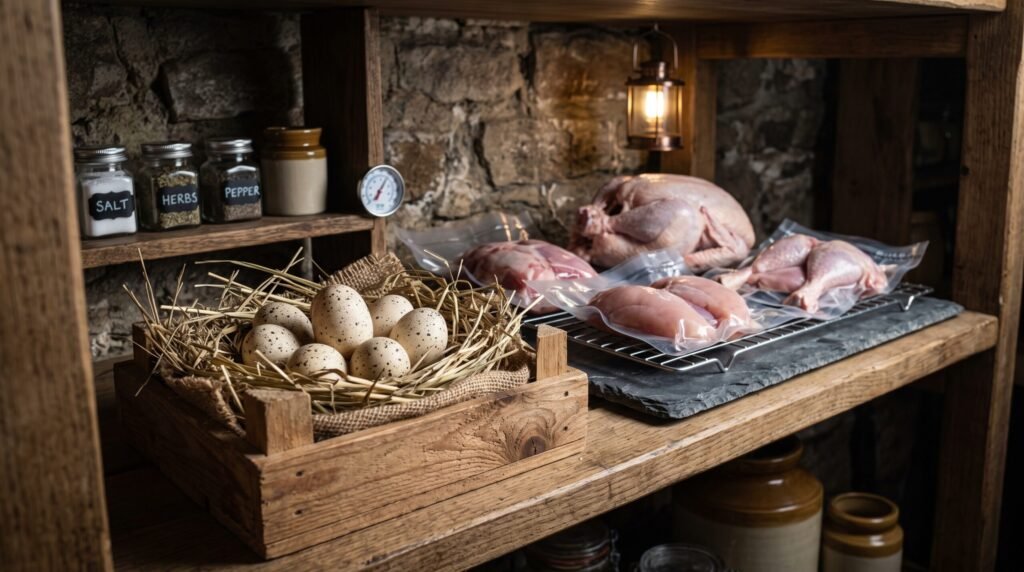
Guinea fowl eggs stay safe unwashed at room temperature for a couple of weeks or refrigerated for months, while raw guinea fowl meat needs to go in the fridge and get used within a day or two, or moved to the freezer. Get the temperature and timing right, and you’ll waste almost nothing you raise.
I learned this the hard way my first season, when a surprise haul of eggs from a hidden nest sat on my counter a little too long and I had to guess whether they were still good. Since then I’ve built a simple system for both eggs and meat, and it’s saved me more than a few dozen eggs and a couple of birds I’d otherwise have tossed out of caution. Here’s exactly how I handle storage on my own farm, backed up by food-safety guidance from USDA and university extension sources.
By the end of this guide, you’ll know how long guinea eggs and guinea meat actually last, the safest way to refrigerate or freeze each one, and the warning signs that tell you it’s time to throw something out.
| Product | Room Temp | Refrigerator | Freezer |
|---|---|---|---|
| Unwashed eggs | 2–3 weeks | 3+ months | Not recommended whole in shell |
| Washed eggs | Not recommended | 4–5 weeks | Beaten, up to 12 months |
| Raw meat | Not safe | 1–2 days | Up to 9–12 months |
| Cooked meat | Not safe | 3–4 days | 2–3 months |
Why Guinea Fowl Eggs and Meat Need Different Rules Than You’d Expect
Guinea fowl eggs and chicken eggs are close enough biologically that the same shell science applies to both, but guinea eggs have noticeably thicker, harder shells. That extra shell thickness is actually good news for storage — it’s a stronger barrier against bacteria getting in, provided you don’t wash away the natural coating that seals it.
Guinea fowl meat, on the other hand, follows the same food-safety rules as any other poultry. It’s lean, it spoils at the same rate as chicken or turkey, and it needs the same cold-chain discipline. There’s no guinea-specific shortcut here — the birds just happen to be smaller, so a whole carcass chills and freezes a little faster than a big roasting chicken would.
How to Store Guinea Fowl Eggs
Leave the Bloom Intact
When a hen lays an egg, she coats it in a thin, invisible protein layer called the cuticle, or bloom. This layer plugs the microscopic pores in the shell and is the entire reason farm-fresh eggs can sit safely on a counter when store eggs can’t. Once you wash an egg, that coating is gone for good, and the shell becomes more permeable to bacteria.
My rule on the farm: unless an egg is visibly caked in mud or droppings, it doesn’t get washed until right before I crack it. A dry paper towel or a soft brush handles light dust just fine and keeps the bloom intact.
Room Temperature Storage
Left unwashed with the bloom intact, guinea fowl eggs will keep at normal room temperature for roughly two to three weeks. I collect mine daily, set them pointed-end down in a carton, and keep the carton somewhere that doesn’t swing wildly in temperature — not next to a stove or a sunny window.
If you’re gathering eggs faster than you can eat them, this counter window is your buffer before you need to make a refrigeration or freezing decision. During peak laying season, when you’re wondering just how many eggs to expect from a healthy flock, that buffer fills up fast.
Refrigerator Storage
For longer holding, the fridge is the safest bet, and it’s not close. Unwashed eggs kept refrigerated can maintain good quality for four to six months, far outlasting anything you’d get leaving them out. I keep mine in a covered carton rather than the fridge door’s built-in egg tray — the door swings open constantly and exposes eggs to temperature changes every time.
A couple of practical notes I’ve picked up:
- Don’t wash before refrigerating unless the eggs will be used or sold soon. Once eggs have been cleaned and sanitized, they need to stay refrigerated, since washing removes the protective cuticle. And once eggs have been chilled, keep them chilled — moving them back to room temperature causes condensation that can let bacteria work their way through the shell.
- Store them pointy-end down. This keeps the air cell at the wide end stable and tends to preserve yolk position, which matters if you’re planning to hatch or just want the freshest-tasting eggs later.
- Skip the plastic reusable egg trays if you can. Condensation tends to build up inside sealed plastic containers, which can accelerate spoilage — a ventilated carton breathes better.
Should You Ever Wash a Guinea Egg?
If an egg is genuinely soiled, wash it — a dirty shell is a bigger risk than a washed one. Wash and rinse eggs individually in warm to hot water rather than soaking a batch together, since soaking lets contaminated water get pulled into the shell’s pores as the egg cools. Once washed, treat that egg like a store egg: refrigerate it right away and use it sooner rather than later, since it’s lost its natural barrier.
Freezing Guinea Fowl Eggs
You can’t freeze a guinea egg in its shell — the contents expand as they freeze and will crack it. If you want to bank a surplus for months down the line, crack the eggs first.
For whole eggs, stir the yolks and whites together gently, pour into ice cube trays or small freezer-safe containers, and freeze until solid before transferring to a sealed bag — three tablespoons of the mixture is roughly equivalent to one whole egg, which makes it easy to portion out later for baking or scrambling. Because guinea eggs run smaller than chicken eggs, I usually combine two into one cube slot to keep the math simple.
If you’re freezing yolks separately, they’ll turn thick and gel-like on their own. Adding about a teaspoon and a half of sugar or corn syrup, or a half teaspoon of salt, per cup of yolks prevents that graininess — just remember to label whether you used sugar or salt, so you don’t end up with a salty pancake batter. Egg whites freeze cleanly on their own with no additives needed.
Frozen this way, eggs are good for cooking and baking for up to about a year, though I try to use mine within six months for the best texture.
How to Store Guinea Fowl Meat
Getting It Cold Fast After Processing
The clock starts the moment a bird is processed. The USDA’s food safety guidelines call for refrigerating perishable food, including fresh poultry, within two hours — or within one hour if the temperature is above 90°F. On a hot butchering day, I keep an ice-packed cooler right at the processing station so birds go straight into the cold rather than sitting on a counter while I work through the rest of the flock.
Refrigerator Storage for Raw Meat
Your refrigerator should hold at 40°F or below, and fresh poultry should be cooked or frozen within two days of going in. That two-day window applies whether it’s a whole guinea fowl or cut pieces — guinea meat doesn’t get any special exemption here.
A few things that help it hold up for those two days:
- Keep the meat in its original wrap, or over-wrap it in foil to catch any drips.
- Store it on the coldest shelf, usually toward the back, rather than in the door.
- Keep raw meat below or well away from anything you’ll eat without cooking, so drips can’t cross-contaminate.
If you know you won’t cook a bird within that window, move it to the freezer before day two rather than pushing your luck.
Freezing Raw Guinea Fowl
Freezing is where guinea fowl really shines for the small-scale keeper — a full-sized processed bird fits in the freezer easily, and quality holds up well over time. Whole poultry keeps its best quality for up to a year in the freezer, while cut parts start to lose quality after around nine months — after that point they’re still safe to eat, just not at peak texture and flavor.
Press as much air out of the packaging as you can before sealing, whether you’re using a vacuum sealer, a heavy freezer bag, or foil. Air pockets are where freezer burn starts, and freezer-burned guinea meat toughens up fast.
Cooking and Storing Leftovers
All poultry, guinea fowl included, needs to reach a safe internal temperature of 165°F to destroy salmonella and other pathogens, a benchmark the USDA settled on after research showed it reliably kills the most heat-resistant bacteria found in raw poultry. A food thermometer is the only reliable way to confirm that, since color and texture alone can be deceiving on a smaller-boned bird like a guinea fowl.
Once it’s cooked, pull the meat off the bone before storing leftovers. Wrapped well and refrigerated, cooked guinea fowl keeps for about three to four days. For longer storage, freeze it the same way — pressed free of air, in a sealed container or bag — and plan to use it within two to three months for the best eating quality.
Thawing Safely
Never thaw guinea fowl meat on the counter at room temperature — that’s exactly the danger zone where bacteria multiply fastest. You’ve got three safe options:
- In the refrigerator — a whole guinea fowl (typically 2–3 lbs) will thaw within about 24 hours.
- In cold water — submerge the sealed bird in a watertight bag, changing the water every 30 minutes; a whole bird thaws in roughly two hours this way.
- In the microwave — use the defrost setting and cook immediately afterward, since parts of the meat may begin to warm unevenly.
Signs Your Eggs or Meat Have Gone Bad
Even with good storage habits, it’s worth knowing what spoilage looks like:
- Eggs: a sulfur smell when cracked, a watery or discolored white, pink or greenish tints, or an egg that floats aggressively in water (a sign of a large air cell and significant age).
- Raw meat: a sour or ammonia-like odor, a sticky or slimy surface, or a dull gray-green tinge instead of the normal pale pink.
- Cooked meat: any off smell, visible mold, or a slimy texture after a few days in the fridge — when in doubt, throw it out rather than risk it.
Frequently Asked Questions
Can you eat guinea fowl eggs that have been left unrefrigerated for a month?
It depends entirely on whether the bloom is intact. An unwashed egg can often still be safe past the three-week mark, but I wouldn’t push it that far without doing a float test first — an egg that sinks and lies flat is likely still fine, while one that floats has aged considerably and is best used only in fully cooked dishes, if at all.
Do guinea fowl eggs need to be refrigerated like chicken eggs?
Not immediately. Because their thicker shell and intact bloom protect them well, unwashed guinea eggs can sit safely at room temperature for a couple of weeks. Refrigeration simply extends that window dramatically, so it’s the better choice if you’re not using them right away.
How long can raw guinea fowl meat sit in the fridge before it goes bad?
Plan on one to two days for raw meat kept at 40°F or below. If you’re not going to cook it within that window, freezing is the safer move rather than stretching the fridge time.
Is it safe to refreeze thawed guinea fowl meat?
It’s safe only if the meat was thawed in the refrigerator and never rose above 40°F — in that case you can refreeze it, though quality will suffer slightly. Meat thawed in cold water or the microwave should be cooked before refreezing, since it may have spent time in the temperature danger zone.
If you’ve got a fridge full of fresh eggs and a freezer stocked with processed birds, you’re already ahead of most backyard keepers when it comes to avoiding waste. Start with one small habit — collecting eggs daily and getting meat cold within that first hour — and the rest of this system falls into place naturally. What’s your biggest storage headache right now, the eggs or the meat? I’d love to hear how you’re handling it.
If you’re weighing whether to raise guinea fowl at all, it’s worth reading about their general care and feeding needs before you get to the storage stage, and if you’re curious about the nutritional payoff of all that egg-collecting, my breakdown of guinea egg nutrition covers what makes them worth the effort. For anyone thinking about selling extra birds instead of freezing them, I’ve also put together a look at current guinea fowl meat pricing and where buyers are finding it, and a deeper dive into what makes guinea meat nutritionally different from chicken if you want the full picture before you start stocking your freezer.
Hi, I’m Rayyan. I raise guinea fowl and share practical, research-backed guides for backyard keepers and homesteaders. I combine hands-on flock experience with trusted poultry management and university extension resources to help you raise healthier, more productive birds — with confidence, not guesswork.