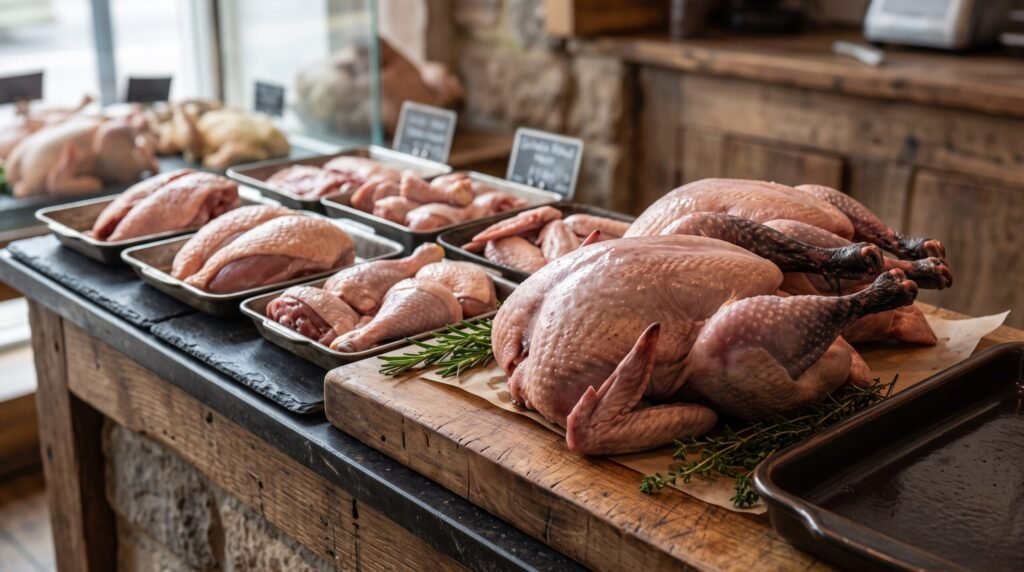
Guinea fowl meat typically costs $13–$20 per pound in the US and £15–£20 per whole bird (roughly £10–£13 per kg) in the UK, making it noticeably pricier than chicken but in line with other specialty poultry like pheasant or duck. I’ve bought guinea fowl from butchers, specialty grocers, and online purveyors on both sides of the Atlantic, and the price swings more than you’d expect depending on where you shop and how the bird is cut.
If you’ve only ever seen guinea fowl on a restaurant menu, the retail price tag can be a surprise. But once you know what drives the cost and where to actually find it, it’s a lot easier to buy smart. Here’s what you’ll pay, why it costs what it does, and exactly where to source it whether you’re in Boston or Bristol.
Guinea fowl meat runs about $13–$20/lb in the US and £15–£20 per bird in the UK. Whole birds are cheaper per pound than cut portions, farmers markets tend to beat online retailers, and French-raised birds dominate UK shelves since domestic UK production is limited.
Why Guinea Fowl Costs More Than Chicken
Guinea fowl aren’t raised at anywhere near the scale of broiler chickens. Most commercial chicken operations process tens of thousands of birds a week; guinea fowl production is a fraction of that, spread across small and mid-sized farms. That alone pushes the price up.
There’s also the growth rate to consider. Guinea fowl mature more slowly than chickens and put on less breast meat relative to their frame, so processors get fewer usable pounds per bird for the same amount of feed and labor. I’ve noticed my own guineas take noticeably longer to reach table weight than the best guinea fowl breeds for meat and eggs suggest a broiler chicken would.
Add in the fact that guinea fowl is still a specialty item in most of the US and UK — not a supermarket staple — and you get smaller supply chains, more hands-on processing, and higher per-unit costs passed straight to the buyer.
US Guinea Fowl Meat Prices
Prices in the US vary a lot depending on the source. Here’s a realistic breakdown based on current retail and direct-to-farmer pricing:
| Source Type | Typical Price | Notes |
|---|---|---|
| Farmers market / local farm | $10–$16/lb | Often the best value; ask about whole vs. cut pricing |
| Specialty butcher shop | $12–$15/lb | Fresh, cut to order, sometimes frozen |
| Online gourmet retailer | $17–$20/lb | Includes overnight shipping costs |
| Whole bird (2.5–3 lb average) | $45–$50 each | Common size sold by mail-order purveyors |
For context, the USDA tracks this in its quarterly pasture-raised poultry report, and the most recent data (April–June 2026) puts direct-to-consumer retail prices for whole guinea hen anywhere from about $7.70 to $20 per pound, averaging out to roughly $14 per pound nationally. That’s a wide range, and it reflects real regional and seasonal variation — I’ve seen prices swing depending on whether it’s a slow month or right before a holiday when demand for something other than turkey or chicken spikes.
Online specialty retailers tend to sit at the higher end. A whole bird in the 2.5–3 pound range commonly runs around $50 delivered, which works out closer to $17–$20 per pound once you account for the smaller size of the bird. Local butchers who carry it fresh are usually more reasonable, often in the $13–$15/lb range, though availability depends heavily on your region — you’ll find it far more easily in cities with a strong French or Italian food culture.
If you’re raising your own and wondering what that translates to on the farm side, the cost of keeping guinea fowl is worth a look before you assume processing your own flock is automatically cheaper than buying.
UK Guinea Fowl Meat Prices
Guinea fowl has a much longer culinary history in the UK than in the US, largely thanks to French influence, and that shows in the retail landscape — it’s easier to find, though still firmly a premium product rather than an everyday one.
| Source Type | Typical Price | Notes |
|---|---|---|
| Independent butcher | £15–£19 per bird | Usually 1.2–1.5kg birds |
| Online farm shop / meat delivery | £18–£20 per bird | Free delivery thresholds often apply |
| Supermarket (seasonal) | £8–£12 per bird | Limited availability, often around Christmas |
| Breast fillets (2-pack, ~350–400g) | £8–£11 | Priced at a premium per kg vs. whole bird |
A whole bird from a quality butcher or online meat retailer typically lands around £18 for a 1.3–1.4kg bird, which works out to roughly £13 per kilogram. That’s fairly consistent across independent sellers — I checked several and most cluster in the same £15–£20 range for a similar-sized bird.
Almost all UK guinea fowl is imported from France, since domestic UK production is minimal. That’s a big part of why prices don’t fluctuate as wildly as in the US — you’re mostly seeing the cost of a consistent French supply chain rather than small, scattered domestic farms.
Supermarkets occasionally stock guinea fowl, particularly larger chains around the winter holidays when shoppers look for an alternative to the usual turkey or goose. Prices there can actually undercut specialty butchers, but selection and availability are inconsistent outside of that seasonal window.
Whole Bird vs. Cuts: Which Is Better Value?
Buying a whole bird is almost always the better deal per pound. Cut portions — breasts, legs, or fillets — carry a premium because someone’s already done the butchery work for you.
- Whole bird: Best value per pound; you get the carcass for stock too
- Breast fillets: Convenient but priced 20–40% higher per pound than whole bird equivalent
- Legs and thighs: Sometimes sold separately, useful for slow braises, moderate premium
- Ground or minced guinea fowl: Rare to find, usually only through specialty processors
If you’re new to cooking it, a whole bird is also the more forgiving option. Guinea fowl breast meat is lean and dries out fast if overcooked, but roasting the whole bird and basting it gives you more margin for error than trying to nail a quick-seared fillet on the first attempt.
Where to Buy Guinea Fowl Meat
In the US:
- Specialty online purveyors like D’Artagnan and similar gourmet meat retailers ship overnight nationwide
- Independent butcher shops in cities with strong European or farm-to-table food cultures
- Farmers markets, especially in regions with active guinea fowl farming communities — the Southeast and parts of the Midwest have a decent concentration of small producers
- Directly from local farms; many keepers sell processed birds seasonally, which is often the cheapest route if you’re near one
In the UK:
- Independent butchers, particularly those specializing in game and specialty poultry
- Online farm-to-door meat delivery services, most sourcing from French farms
- Larger supermarkets seasonally, mainly in the run-up to Christmas
- Farm shops in rural areas, where fresher, sometimes UK-reared birds occasionally turn up
Wherever you’re buying, it’s worth asking whether the bird is fresh or previously frozen, since a lot of UK guinea fowl travels frozen from France and is thawed before sale. That’s not a quality problem, but it does affect how long you can safely keep it in the fridge before cooking.
Is Guinea Fowl Meat Worth the Price?
For most people trying it for the first time, yes — within reason. The meat is leaner than chicken, carries a mild gamey flavor closer to pheasant, and holds up well to roasting, braising, and slow cooking. It’s not an everyday-dinner swap for chicken at these prices, but as an occasional alternative for a Sunday roast or a dinner party centerpiece, it earns its premium.
If you’re keeping guinea fowl yourself rather than buying it, the economics shift. Raising your own for meat means you’re paying in feed and time rather than a per-pound retail markup, and knowing what do guinea fowl eat goes a long way toward keeping your costs predictable. Whether that’s actually cheaper than buying depends on your setup, flock size, and how much you value the time it takes to raise and process birds yourself — something the guinea fowl farming business plan breaks down in more detail if you’re considering it at any scale.
Conclusion
Guinea fowl meat costs more than chicken because it’s raised in smaller numbers, grows more slowly, and hasn’t reached the scale of mainstream poultry — expect to pay $13–$20 per pound in the US or £15–£20 per whole bird in the UK, with farmers markets and independent butchers usually offering the best value. Buying whole rather than pre-cut will save you money in either country, and shopping direct from a local farm or butcher tends to beat both supermarkets and online specialty retailers on price.
Have you found a good source for guinea fowl near you, or do you raise your own? I’d love to hear how your local prices compare to what’s listed here — drop a comment or share your experience with other keepers.
FAQ
Is guinea fowl meat more expensive than chicken?
Yes, significantly. Guinea fowl typically costs three to five times more per pound than conventional chicken, mainly due to smaller-scale production, slower growth rates, and limited commercial supply chains compared to broiler chicken farming.
Can I buy guinea fowl meat at a regular grocery store?
In the US, it’s rare outside specialty grocers or gourmet stores. In the UK, some larger supermarkets carry it seasonally, particularly around Christmas, but year-round availability is inconsistent — an independent butcher or online specialty retailer is usually a more reliable source.
Does frozen guinea fowl cost less than fresh?
Sometimes, but not always. Many online retailers price frozen and fresh birds similarly, or with only a small discount for frozen. The bigger cost factor is usually the source and bird size rather than fresh versus frozen status.
How much meat do you get from one guinea fowl?
A typical guinea fowl weighs 2.5–3.5 pounds (roughly 1.1–1.6kg) oven-ready, smaller than a standard chicken, and comfortably feeds two to four people depending on portion size and what else is on the table.
Hi, I’m Rayyan. I raise guinea fowl and share practical, research-backed guides for backyard keepers and homesteaders. I combine hands-on flock experience with trusted poultry management and university extension resources to help you raise healthier, more productive birds — with confidence, not guesswork.