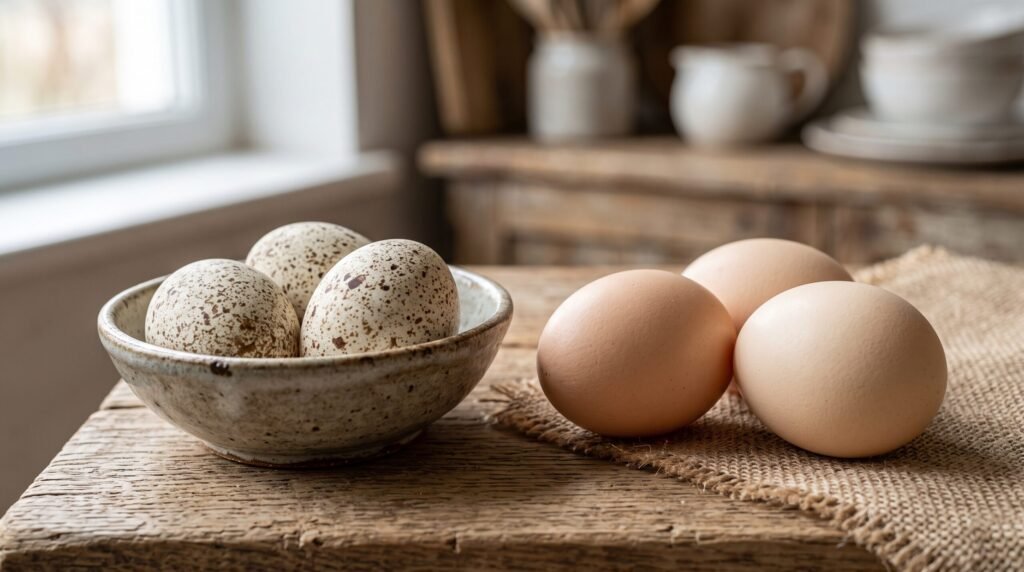
The first time a customer picked up one of my guinea eggs and asked, “Why is it so small and pointy?” I realized most people have no idea how different these eggs really are from what they’re used to. If you’ve been raising chickens for years and are thinking about adding guinea fowl to your flock — or you just found a stash of oddly-shaped eggs in the coop — you’re probably wondering exactly how the two compare.
Guinea fowl eggs are smaller, harder-shelled, and noticeably richer in flavor than chicken eggs, with slightly more protein per gram but a shorter, more seasonal laying window. Chicken eggs win on convenience and volume; guinea eggs win on shelf life, toughness, and taste. Here’s everything I’ve learned from keeping both birds side by side, backed up by what the research actually shows.
Guinea eggs typically weigh 40–45 grams versus 50–70 grams for a chicken egg, and a guinea hen lays 80–150 eggs a year compared to 200–300 for a productive laying hen. Before we get into the details, here’s how the two stack up at a glance.
| Feature | Guinea Fowl Egg | Chicken Egg |
|---|---|---|
| Average weight | 40–45 g | 50–70 g |
| Shell thickness | 0.44–0.7 mm (very hard) | Thinner, more fragile |
| Eggs per hen per year | 80–150 (seasonal) | 200–300 (year-round) |
| Protein content | Slightly higher per gram | High, but slightly less concentrated |
| Yolk-to-white ratio | Higher yolk proportion | Lower yolk proportion |
| Flavor | Richer, slightly gamey | Mild, neutral |
| Shelf life (refrigerated) | Longer, thanks to thick shell | Standard |
| Typical market price | $5–$10+ per dozen | $2–$5 per dozen |
Size and Shape: The First Thing You’ll Notice
Set a guinea egg next to a chicken egg and the size difference jumps out immediately. Guinea eggs run smaller and more tapered, with a pointier end that makes them look almost teardrop-shaped compared to the rounder, more uniform oval of a chicken egg. On my scale, a typical guinea egg comes in around 40 grams, while a large chicken egg from the same coop easily hits 55 to 60 grams.
That size gap matters in the kitchen. As a rough rule, I tell people to use two guinea eggs for every one large chicken egg when substituting in a recipe. It’s not a perfect 1:1 swap, but it gets you close enough for baking, scrambling, or anything else on the stove.
Color-wise, there’s a good bit of overlap. Chicken eggs range from white to deep brown to blue or green depending on breed, and guinea eggs land somewhere in a similar band — cream to light tan, usually dotted with fine speckles. If you’re new to guineas, don’t expect a dramatic color clue to tell the eggs apart; shape and size are the more reliable markers.
Shell Strength: Why Guinea Eggs Are Nearly Impossible to Crack by Accident
This is the difference that surprises new keepers the most. Guinea fowl eggshells run about 0.44 to 0.62 mm thick, and research pegs them as roughly five times stronger than a chicken eggshell. I’ve dropped guinea eggs onto the coop floor that would have shattered a chicken egg on impact, and they came away with barely a hairline crack.
That toughness isn’t just a party trick. A few practical effects come from it:
- Lower breakage during collection and transport. If you’re gathering eggs from free-range nests scattered around the property, guinea eggs hold up far better to the jostling.
- Longer shelf life. The thick shell and membrane slow moisture loss, which is part of why guinea eggs keep well when stored properly. I cover exact storage steps in my guide on how to store guinea fowl eggs and meat safely.
- More effort to actually crack one open. You’ll want a firmer tap than you’re used to with chicken eggs — I’ve watched more than one visitor bruise a knuckle underestimating a guinea shell.
- A longer incubation window if you’re hatching. The tougher shell is part of why guinea eggs take 26 to 28 days to hatch, compared to 21 days for chicken eggs.
Nutrition: How the Two Really Compare
Both eggs are genuinely good sources of protein, and neither one is a “junk” choice. But there are real differences once you look past the surface.
Guinea eggs tend to run slightly higher in protein and fat per gram than chicken eggs, and studies looking at amino acid profiles have found guinea eggs score well on essential amino acid content, meaning your body can put more of that protein to use. Guinea eggs also carry a notably higher yolk-to-white ratio than chicken eggs, which is part of why they taste richer and work so well in baking — more yolk means more fat, more flavor, and a deeper color in your finished bake.
Where chicken eggs pull ahead is B vitamins, particularly choline, which plays a role in brain and liver function. Chicken eggs also tend to have a broader nutrient profile simply because they’ve been studied so much more extensively — guinea fowl research is still catching up.
One area guinea eggs get genuine attention for is potential use with egg allergies. Because guinea egg proteins are structured differently from chicken egg proteins, some people who react to chicken eggs tolerate guinea eggs without the same symptoms. This isn’t a blanket guarantee, and it’s not something to try without medical guidance — but it’s a real enough pattern that it’s worth mentioning if allergies are part of why you’re considering guinea eggs. I go deeper into the nutrient breakdown, including vitamin and mineral content, in my full piece on guinea fowl egg nutrition and health benefits.
Taste and Texture: What to Expect in the Kitchen
Guinea eggs have a noticeably richer, slightly gamier flavor than chicken eggs — not overpowering, but distinct enough that most people notice it right away in a simple scramble. The higher yolk ratio gives dishes a deeper color and a creamier mouthfeel, which is exactly why chefs who work with guinea eggs tend to reach for them in custards, quiches, and pastries where that richness actually shows.
In terms of texture once cooked, guinea eggs firm up a little differently thanks to that yolk-heavy composition — expect a slightly denser result in baked goods, and a creamier one in anything scrambled or poached. If you’ve never cooked with them, I’d start with something simple like a fried egg or omelet so you can taste the difference clearly before working them into a more complex recipe.
Laying Season and Egg Production
This is probably the biggest practical difference between the two birds, not just the eggs. Chicken hens from good laying breeds will produce 200 to 300 eggs a year, spread out fairly evenly across the seasons with the right lighting and care. Guinea hens are a different story — they lay seasonally, typically from spring through late summer, and a healthy hen might give you 80 to 150 eggs total in that window before slowing down or going broody.
A few things affect how many eggs you’ll actually collect:
- Age and breeding stock — well-managed hens from good stock lay more consistently than birds from mixed or unmanaged lines.
- Broodiness — guinea hens often go broody once a clutch builds up to 20–30 eggs, which pauses laying for weeks at a time.
- Disturbance levels — guineas are naturally flighty and prefer quiet, secluded nesting spots; frequent disturbance can reduce how reliably they lay.
- Season length — in cooler climates, the laying window is shorter than in warmer regions where guineas may lay nearly year-round.
If steady, year-round egg supply is your priority, chickens are the more dependable choice. Guineas make more sense if you’re already keeping them for pest control, noise-based alarm duty, or their meat, and you’re happy to treat the eggs as a seasonal bonus rather than a primary income source.
Cost and Availability
Chicken eggs are everywhere — grocery stores, farm stands, neighbors with a backyard coop. That availability keeps prices low, generally $2 to $5 a dozen for standard fresh eggs depending on where you live.
Guinea eggs are a different market entirely. You won’t find them on a regular grocery shelf; sourcing usually means going directly through a guinea keeper, a specialty farm, or an online marketplace. Because of the shorter laying season and smaller supply, prices run noticeably higher — often $5 to $10 a dozen for eating eggs, with hatching eggs from sought-after color varieties going for even more per egg. If you’re weighing whether raising guineas for eggs actually pencils out, it’s worth reading through current guinea fowl meat prices and where to buy them too, since most keepers end up selling both products rather than eggs alone.
Guinea Eggs or Chicken Eggs — Which Should You Raise?
Honestly, it doesn’t have to be either-or. I keep both, and they serve different purposes on my place. Chickens give me dependable, year-round eggs I can count on for the kitchen and for selling. Guineas give me pest control, an early-warning system against predators, and a seasonal specialty egg that customers are genuinely excited to try.
If your main goal is a steady egg supply for the table or for market, chickens are the safer bet. If you’re drawn to guineas for their other benefits — tick and insect control, alertness to predators, low feed competition with other birds — the eggs are a welcome bonus, not a reason on their own to add them to your flock.
What’s pulling you toward guinea fowl — the eggs themselves, or everything else they bring to a homestead? Either way, once you’ve tasted a guinea egg scrambled with a little butter, it’s hard not to see why so many keepers end up hooked on both birds.
FAQ
Can I use guinea eggs and chicken eggs interchangeably in recipes?
Yes, with an adjustment for size. Since guinea eggs are roughly two-thirds the size of a chicken egg, use about two guinea eggs for every one large chicken egg in most recipes, especially baking where proportions matter more.
Are guinea fowl eggs safe for people with chicken egg allergies?
Some people with chicken egg allergies tolerate guinea eggs better because the proteins are structured differently, and this has been studied in a clinical setting with promising early results. That said, it’s not guaranteed for everyone, and anyone with a diagnosed egg allergy should talk to a doctor or allergist before trying guinea eggs.
Why are guinea fowl eggs more expensive than chicken eggs?
It comes down to supply. Guinea hens lay far fewer eggs per year than chickens, only during a limited spring-to-summer season, and they aren’t widely available at grocery stores. That scarcity, combined with steady demand from people curious to try them, keeps prices higher.
Do guinea fowl eggs taste different from chicken eggs?
Yes — guinea eggs have a richer, slightly gamier flavor and a higher yolk-to-white ratio, which gives dishes more color and a creamier texture. The difference is noticeable but not overpowering, especially in simple preparations like a fried or scrambled egg.
Hi, I’m Rayyan. I raise guinea fowl and share practical, research-backed guides for backyard keepers and homesteaders. I combine hands-on flock experience with trusted poultry management and university extension resources to help you raise healthier, more productive birds — with confidence, not guesswork.