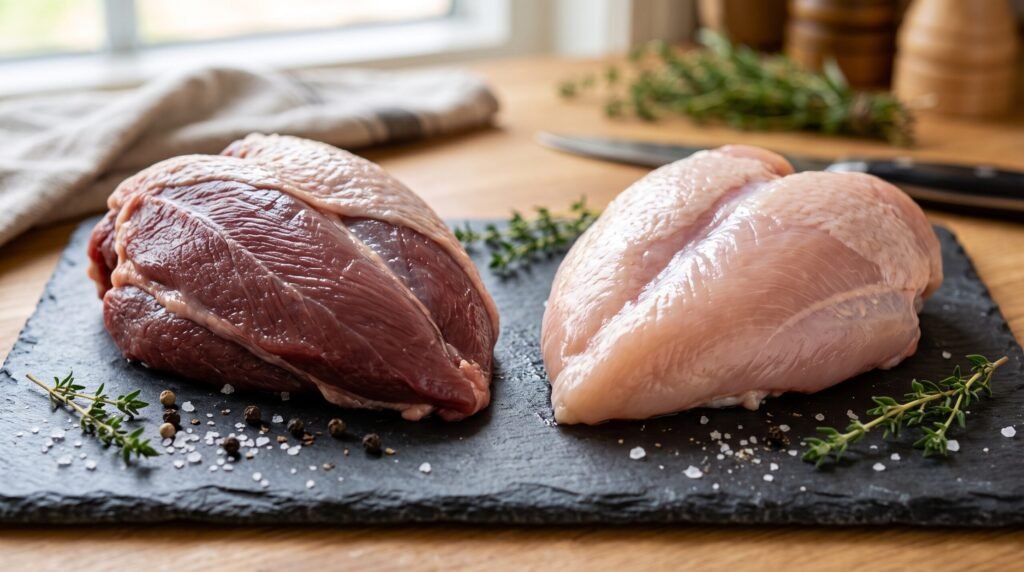
Guinea fowl meat is darker, leaner, and more richly flavored than chicken, with slightly more protein and less fat per serving, while chicken stays milder, more tender, and easier to find at any grocery store. Neither one is objectively “better” — they’re suited to different meals, different budgets, and different palates.
I get asked about this comparison more than almost anything else on this site, usually from someone who’s just tried guinea fowl for the first time at a restaurant, or from a backyard keeper trying to decide whether raising guinea fowl for the table is worth the extra effort compared to chickens. I’ve raised both, cooked both more times than I can count, and the differences go a lot deeper than “one tastes gamier.” Here’s what actually separates them, from nutrition to texture to what each one does best in the kitchen.
| Category | Guinea Fowl | Chicken |
|---|---|---|
| Flavor | Richer, slightly gamey, closer to pheasant | Mild and neutral |
| Texture | Firmer, denser, less water content | Softer, more tender |
| Meat color | Darker throughout, even the breast | Lighter breast, darker thighs |
| Fat content | Lower overall fat | Slightly higher fat |
| Protein (per 100g, raw) | Roughly 21–24g | Roughly 22–23g |
| Calories (per 100g, raw) | Roughly 106–130 kcal | Roughly 110–120 kcal |
| Best cooking methods | Braising, confit, moist-heat roasting | Almost any method |
| Availability | Specialty butchers, farms, some markets | Every grocery store |
| Price | Noticeably higher | Budget-friendly |
Flavor and Texture: Where the Two Birds Really Diverge
If you’ve only ever eaten chicken, the first bite of guinea fowl is a bit of a surprise. It’s not a wild, gamey flavor — nothing like duck or pheasant at their most intense — but it’s noticeably richer than chicken. Chefs and food writers often land on the same shorthand: it eats like an extra-flavorful chicken, with just a whisper of the pheasant family it’s related to.
Texture is where the difference becomes obvious even before you taste anything. Guinea fowl meat is firmer and denser than chicken, with less moisture in the muscle fibers, which is exactly why it dries out so much faster in the oven than a chicken would. I learned this the hard way on my first attempt — I roasted a guinea fowl exactly like I would a chicken, uncovered and dry, and ended up with a bird that was flavorful but tough as shoe leather by the time it hit a safe internal temperature.
Color is another giveaway. Chicken has that familiar split — pale, mild breast meat and darker, richer thigh meat. Guinea fowl doesn’t really do that split. The breast meat stays notably darker than a chicken breast, closer in shade to turkey leg meat, and the flavor is more consistent from breast to thigh as a result.
One thing that surprises new cooks: despite guinea fowl’s reputation as a “game bird,” most people find it far more approachable than they expect. Restaurants sometimes market it as an entry point into game birds for exactly this reason — recognizable enough to feel safe, distinctive enough to feel special.
Nutritional Comparison: Protein, Fat, and Calories
This is usually the part people care about most, so let’s get into actual numbers. Values for both birds vary depending on the specific cut, whether skin is included, and how the bird was raised — a free-ranging, foraging guinea fowl will differ somewhat from an intensively raised one — but the overall pattern holds up consistently across sources.
| Nutrient (per 100g, raw, skinless) | Guinea Fowl | Chicken Breast |
|---|---|---|
| Calories | ~106–130 kcal | ~110–120 kcal |
| Protein | ~21–24g | ~22–23g |
| Fat | ~2–6g | ~2–4g |
| Cholesterol | Moderate | Moderate |
| Carbohydrates | 0g | 0g |
The headline takeaway is that guinea fowl sits comfortably in the lean-protein category, with a calorie count in roughly the same range as chicken breast but a fat percentage that generally comes in a bit lower. Some breakdowns put guinea fowl’s fat content as low as 2-3% of total weight compared to chicken’s closer to 10-11%, though that gap narrows considerably once you’re comparing skinless cuts of both birds side by side, which is the more realistic comparison for most home cooks. USDA figures for cooked, skinless chicken breast land around 165 calories, roughly 31 grams of protein, and about 3.6 grams of fat per 100 grams, which is very much in the same neighborhood as guinea fowl once you factor in cooking losses on both birds.
Where guinea fowl tends to pull ahead is protein density relative to its lean profile. Several nutrition breakdowns put guinea fowl’s protein share of total calories noticeably higher than chicken’s, and while I wouldn’t treat any single figure as gospel given how much variation exists between sources and preparation methods, the consistent theme is that guinea fowl edges out chicken slightly on protein-to-fat ratio, while chicken remains an excellent, well-studied lean protein in its own right.
For a deeper breakdown of vitamins, minerals, and the full nutrition profile, I’ve covered guinea fowl’s nutritional value and health benefits in more detail separately.
Fat Composition: Not Just How Much, But What Kind
Total fat is only half the story. What kind of fat matters too, especially if you’re eating either bird regularly.
Guinea fowl’s fat leans more unsaturated, which is generally considered the more heart-friendly profile. It also carries a modest but real amount of omega-3 fatty acids, likely a reflection of the bird’s foraging diet, which typically includes more insects and varied greens than a commercial chicken’s feed. This lines up with mainstream dietary guidance more broadly, which consistently favors replacing saturated fat with unsaturated fat sources for better long-term cardiovascular outcomes.
Chicken isn’t a poor choice by any stretch — it remains one of the most studied and recommended lean proteins in mainstream nutrition guidance — but if you’re specifically optimizing for a leaner, more unsaturated fat profile, guinea fowl has a slight edge.
Cooking Differences: Why You Can’t Treat Them the Same
This is where I see the most beginner mistakes, myself included in year one. Chicken is forgiving. You can roast it, grill it, fry it, slow-cook it, and even if you overshoot the doneness a little, it’s usually still edible and reasonably moist. Guinea fowl does not offer that same grace period.
Because the meat carries less fat and less water, overcooking dries it out fast, sometimes within just a few minutes past the ideal point. Most experienced cooks treat medium doneness as the ceiling for guinea fowl breast — pushing past that risks turning an expensive, flavorful bird into something chewy and disappointing. That’s a meaningful shift if you’re used to cooking chicken to well-done out of habit.
A few practical adjustments I make every time I cook guinea fowl:
- Brine or marinate first. Even a simple saltwater brine for a few hours adds back moisture the lean meat doesn’t have on its own.
- Cook breast and legs separately when possible. The breast cooks faster and dries out sooner than the legs, so splitting the bird lets you treat each part properly instead of compromising on both.
- Favor moist-heat methods. Braising, confit, or covered roasting with stock or wine protects the meat far better than a dry, high-heat roast.
- Pull it earlier than you think you should. Guinea fowl carries over in temperature after cooking just like any meat, and its lower fat content means it has less margin for error.
- Pair it with bold aromatics. The meat’s richer flavor can handle a heavier hand with garlic, thyme, and other strong herbs than chicken usually can.
Chicken, by comparison, plays well with almost any technique and any level of seasoning, which is part of why it’s the default protein in so many cuisines worldwide.
Whichever bird you’re working with, how you handle it after cooking matters just as much as how you cook it. If you’re processing your own birds at home, it’s worth reading up on how to store guinea fowl eggs and meat safely so nothing goes to waste between the kitchen and the freezer.
Availability and Price: The Practical Difference
Even if guinea fowl wins you over on flavor, there’s a practical wall most people hit fast: you can’t just walk into any grocery store and grab one. Chicken is produced at massive commercial scale, which keeps it cheap, consistent, and available basically everywhere. Guinea fowl is a specialty item in most of the US and UK — more common at farmers markets, specialty butchers, or direct from small farms than on a supermarket shelf.
That limited supply chain shows up directly in price. Guinea fowl typically costs noticeably more per pound than chicken, sometimes several times over, simply because production volume is so much smaller and the birds grow slower than commercial broiler chickens. If you’re curious what to actually expect to pay and where to source it, I’ve put together a full breakdown of guinea fowl meat prices and where to buy them in the US and UK.
If you’re raising your own flock and weighing whether guinea fowl is worth it as a meat bird compared to chickens from a farming and profitability angle rather than just a kitchen one, that’s a slightly different question — I get into the economics of it in my comparison of guinea fowl versus chicken for profitability.
Which One Should You Choose?
Honestly, it depends on what you’re after. If you want a reliable, mild, budget-friendly protein you can cook a dozen different ways without thinking too hard, chicken is still the better everyday choice — there’s no getting around its convenience and affordability. If you want something with more character on the plate, a bit of a special-occasion feel, and you’re willing to pay more and cook a little more carefully, guinea fowl delivers a flavor and texture chicken simply can’t match.
In my own kitchen, chicken handles the weeknight meals. Guinea fowl comes out for Sunday dinners, when I have the time to braise it properly and actually enjoy the process. If you keep your own flock, raising a few guinea fowl alongside your chickens is one of the more satisfying ways to taste the difference yourself — and if you’re just starting to look into keeping the birds at all, my guide to helmeted guinea fowl traits, feeding, and housing is a good place to begin.
Have you cooked guinea fowl before, or is this your first time considering it? If you try it, start with a braise rather than a roast — it’s the most forgiving way to get a feel for how different this bird really is from chicken.
FAQ
Is guinea fowl healthier than chicken?
In most comparisons, yes, though only slightly. Guinea fowl tends to be a bit leaner and higher in protein relative to its calorie count, and its fat leans more unsaturated. Chicken breast is still an excellent lean protein in its own right, so the difference matters more if you’re fine-tuning a specific diet than for general health.
Does guinea fowl taste like chicken?
It’s closer to chicken than to a truly gamey bird like pheasant, but it’s noticeably richer and darker in both flavor and color. Most first-time eaters describe it as “chicken, but more flavorful,” rather than something entirely unfamiliar.
Can I substitute guinea fowl for chicken in any recipe?
Mostly yes, but adjust your cooking method. Because guinea fowl is leaner and dries out faster, recipes that call for long, dry roasting need to shift toward braising, brining, or covered cooking to keep the meat from turning tough.
Why is guinea fowl so much more expensive than chicken?
It comes down to scale. Chicken is produced through massive commercial operations built for efficiency and volume. Guinea fowl is raised in far smaller numbers, grows more slowly, and is usually sold through specialty channels rather than mass retail, all of which pushes the price up.
Is guinea fowl meat safe to eat medium-rare?
Like other poultry, guinea fowl should be cooked to a safe internal temperature to avoid foodborne illness, generally the same guidance given for chicken. Check current USDA poultry safety recommendations for the specific target temperature, and use a meat thermometer rather than judging by color alone, since guinea fowl’s darker meat can be misleading to the eye.
Do guinea fowl also produce eggs worth comparing to chicken eggs?
Yes, and it’s a popular follow-up question for anyone weighing the two birds as a whole. Guinea fowl eggs are smaller and have a notably harder shell than chicken eggs, with their own distinct taste and nutrition profile — I’ve broken down the taste, nutrition, and health benefits of guinea fowl eggs if you want the full comparison there too.
Hi, I’m Rayyan. I raise guinea fowl and share practical, research-backed guides for backyard keepers and homesteaders. I combine hands-on flock experience with trusted poultry management and university extension resources to help you raise healthier, more productive birds — with confidence, not guesswork.