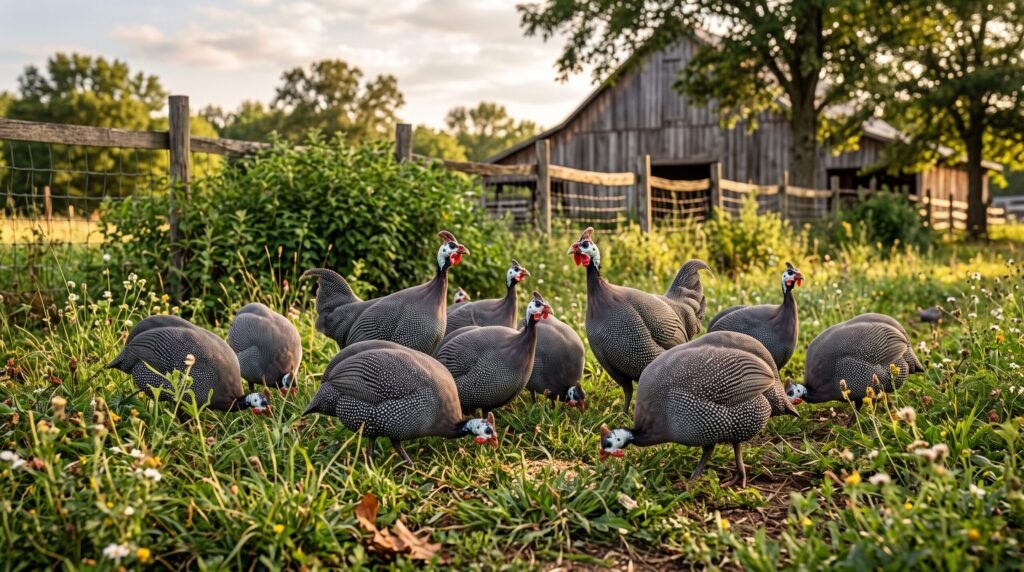
For most backyard flocks, one male guinea fowl for every four to five females gives you the best balance of fertility and peace in the coop. If you’re keeping guineas in close confinement, you can push that closer to one male per six to eight hens, but wider free-range setups tend to do better with a tighter ratio.
I get asked about this ratio more than almost anything else, usually right after someone’s hatch rate disappoints them or their males start scrapping in the yard. It’s one of those numbers that sounds simple until you actually try to apply it to your own flock, because guinea behavior doesn’t always follow the tidy math. I’ve adjusted my own ratio more than once after watching what actually happened once breeding season hit. By the end of this guide, you’ll know what ratio to aim for depending on your goals, how to tell when you have too many males, and what to do about it before it turns into a real problem.
Here’s a quick reference before we get into the details:
| Goal | Recommended Ratio (Male : Female) |
|---|---|
| Maximum fertility, free-range | 1 : 4–5 |
| Maximum fertility, close confinement | 1 : 6–8 |
| Pest/tick control only, no hatching | 1 : 2–3, or no males at all |
| Guard/watchdog behavior with hatching | 1 : 4–5 |
| Long-term flock harmony (small flock) | Closer to 1 : 1 |
Why the Ratio Matters More Than You’d Expect
Unlike chickens, where a single rooster can comfortably manage ten or more hens, guinea fowl have their own rulebook. Guineas are naturally inclined to pair off, and in the wild they often mate monogamously, one male bonding with one female for the season. That instinct doesn’t disappear just because you’ve got them penned up in your backyard.
This is exactly why so many new keepers get surprised. You bring home an assortment of keets, they grow up, and suddenly you’ve got more males than you planned for, all trying to pair off with the same handful of hens. That’s when fertility problems and fighting start.
Recommended Rooster-to-Hen Ratios
For Free-Range Flocks: 1 Male to 4–5 Females
If your guineas have room to roam, this is the ratio most experienced keepers land on. It’s frequently cited as the point where fertility peaks without overloading any single hen. I’ve found this holds up well in practice — enough males to cover the flock, but not so many that they’re constantly squaring off over territory.
For Confined Flocks: Up to 1 Male to 6–8 Females
When guineas are kept in a run rather than free-ranging, the math shifts a bit. According to guidance from the USDA and university poultry extension programs, closely confined males can be mated with six to eight hens, since several hens will use the same nest. Because the birds are physically closer together and the male doesn’t have to actively search for or follow hens across open ground, one male can often fertilize eggs from a larger group in this setup compared to free-ranging.
For Non-Breeding Purposes: Fewer Males, or None at All
If you’re keeping guineas purely for pest control or as noisy alarm systems rather than for hatching eggs, you don’t need to stick to a breeding ratio at all. A ratio of one male to two or three hens works fine if you still want some males around for their guarding instincts, or you can skip males entirely if fertility isn’t a priority. Hens will lay just as well without a male in the flock — the eggs simply won’t be fertile.
Why Too Many Males Causes Problems
A flock with too many males rarely stays peaceful for long. Guinea roosters are territorial by nature, and when there aren’t enough hens to go around, that instinct turns into competition. I’ve seen it happen with my own birds — what starts as one male getting a little pushy can spiral into a full pecking-order battle within days.
Here’s what an unbalanced ratio (too many males) commonly leads to:
- Fighting between males — competing for the same hens, sometimes drawing blood
- Stress on hens — being chased or mounted excessively by multiple males
- Lower fertility overall — dominant males may block subordinate males from breeding at all, while over-focusing on one or two hens
- Aggression toward people or other animals — excess testosterone in a flock tends to spill over into chasing chickens, pets, or even you
- One hen getting singled out — in flocks where males significantly outnumber hens, a particular hen can end up overbred and worn down
Small flocks seem to feel this more acutely than large ones. If you’ve only got six or seven birds total and half of them are males, there’s nowhere for the tension to dissipate. Larger flocks with more space give birds room to sort out a pecking order without it turning into constant conflict.
Why Too Few Males Can Also Be a Problem
It’s not just about avoiding excess. If you keep only one male with a very large group of hens, fertility can actually drop, since the male may simply not get to every hen regularly, especially on a free-range setup with lots of ground to cover. Fertility research on backyard flocks consistently points to failure at the extremes — either the male is spread too thin, or there’s too much male-on-male competition eating into breeding time.
There’s also a social angle. Some keepers who want a stable, long-term flock — not primarily for maximizing hatch rates, but for a calm, cohesive group — find that closer to an even 1:1 ratio actually works better over the years, since guineas that pair off tend to stick with that bond rather than one male juggling several partners. This is more of a long-term flock management philosophy than a fertility-maximizing one, and it isn’t necessary for most backyard setups, but it’s worth knowing the tradeoff exists.
Signs You Have the Wrong Ratio
You don’t need a spreadsheet to figure out whether your ratio is working. Watch for these signs in your flock:
- Cracked, missing, or unusually low fertility rates in eggs you’re trying to hatch — this often points to too many males interfering with each other, or too few covering the group.
- Visible fighting or chasing among males, especially during spring and summer when mating season ramps up.
- One or two hens looking noticeably worn, with feather loss on the back or neck from repeated mounting.
- A male being excluded or bullied by the rest of the flock, unable to eat or move with the group.
- Excess aggression toward you, pets, or other poultry that wasn’t there before breeding season.
If you’re spotting two or more of these, it’s worth reassessing your numbers rather than waiting for it to resolve on its own. In my experience, it rarely does — guinea flock dynamics tend to get more entrenched, not less, the longer an imbalance sits.
How to Fix an Unbalanced Ratio
Rehome or Cull Extra Males
This is the most direct fix. If you can identify which males are causing the most conflict, removing them from the flock usually restores calm within days. Many keepers process extra males for meat, sell or rehome them to someone who wants males for pest control without breeding, or separate them into their own bachelor group away from the hens.
Add More Hens
If your flock skews male-heavy but you’d rather not remove any birds, adding hens can rebalance things — assuming you have the space and it fits your goals. Just introduce new birds carefully; guineas can be wary of unfamiliar additions to an established flock.
Separate Breeding Groups
For keepers managing multiple males with specific hens they want to pair (for particular color varieties, for example), physically separating breeding pairs or trios into their own pens during the season can prevent competition entirely. It’s more hands-on, but it gives you control over which birds are actually producing your hatching eggs.
Give Them More Space
Sometimes the ratio itself isn’t the real issue — it’s a lack of room. A tight coop with a borderline ratio can turn combative, while the same ratio on a few acres of free range might never cause a problem at all. If you’re not ready to remove birds, increasing available space is worth trying first.
How Many Males Do You Actually Need? A Practical Example
Say you’re planning a flock of 15 hens for egg and meat production, and you want fertile eggs to hatch your own replacement keets each spring. Based on the ratios above, you’d want somewhere between three and four males if the flock free-ranges, or as few as two if they’re kept in a more confined run. Starting on the lower end and watching how the flock behaves during the first breeding season is generally safer than starting high — it’s much easier to add a male later than to remove one from an already-established, bonded group.
If you’re just getting your flock started and haven’t settled on your goals yet, it helps to decide upfront whether hatching your own eggs matters to you. That single decision changes how many males you actually need to keep — and if hatching is the goal, it’s worth reading up on egg incubation timing before your first breeding season arrives.
Frequently Asked Questions
Can one male guinea fowl breed with multiple hens?
Yes. While guineas often show a preference for pairing off with one hen, a single male is capable of successfully breeding with four to eight hens, depending on whether the flock is free-ranging or confined. Fertility tends to be highest when the ratio stays within the ranges covered above rather than pushing a male to cover an excessive number of hens.
Do I need a male guinea fowl at all?
Only if you want fertile eggs to hatch. Hens lay eggs on the same schedule with or without a male present; the eggs simply won’t develop into keets without one. Many keepers who raise guineas purely for eggs, meat, or pest control skip males altogether.
What happens if I have too many male guinea fowl?
Expect more fighting, more stress on your hens, and often lower fertility rather than higher. Excess males compete for the same limited number of hens, and that competition can turn aggressive, particularly in smaller or more confined flocks.
Can guinea fowl males live together without hens?
Generally, yes, especially outside of breeding season. A bachelor group of males kept separately from hens tends to be far calmer than the same males competing over hens in a mixed flock. Some keepers use this as a long-term solution for extra males they don’t want to cull.
How do I tell males and females apart to get my ratio right?
Guinea fowl are notoriously difficult to sex, especially as keets. If you’re trying to sort out your existing flock’s ratio, it helps to know the visual and vocal differences between males and females before you start making changes.
Getting your ratio right isn’t a one-time decision — it’s something worth revisiting each breeding season as your flock grows, ages, or changes. Keep an eye on fertility rates and flock behavior, and adjust before small tension turns into real conflict. Have you found a ratio that works particularly well for your setup, or dealt with a male that just wouldn’t share? I’d love to hear how your flock has handled it.
Hi, I’m Rayyan. I raise guinea fowl and share practical, research-backed guides for backyard keepers and homesteaders. I combine hands-on flock experience with trusted poultry management and university extension resources to help you raise healthier, more productive birds — with confidence, not guesswork.