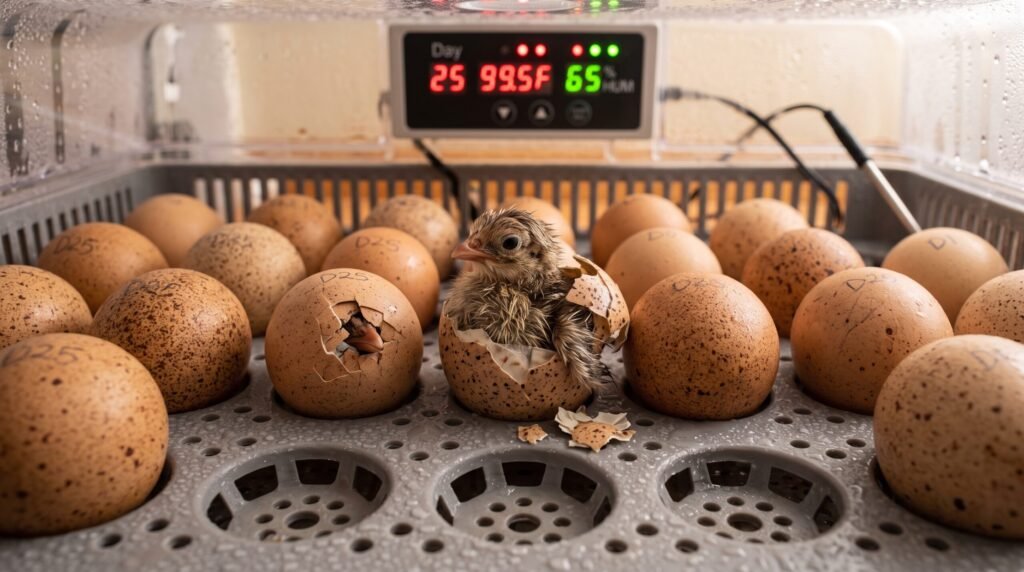
Guinea fowl eggs take 26 to 28 days to hatch, which University of Kentucky poultry extension notes is roughly the same timeline as turkey eggs and about a week longer than chicken eggs — and every one of those days matters. I still remember setting my first tray of guinea eggs and checking the calendar obsessively, half-convinced I’d done something wrong when day 21 came and went with no pips. Nothing was wrong — guineas just run on their own clock.
Once you know what’s supposed to happen at each stage, incubation stops feeling like a mystery and starts feeling like a checklist. Here’s exactly what to expect from the day you set your eggs to the moment those first speckled keets dry off in the brooder.
- Days 1–7: Set eggs, stabilize temperature at 99.5°F (forced air) or 100–101°F (still air), humidity 45–55%, begin turning 3–5 times daily
- Day 7: First candling — look for spidery veins and a dark embryo spot
- Days 8–14: Rapid growth, embryo fills more of the shell
- Day 14: Second candling — remove any clear or non-developing eggs
- Days 15–24: Continued turning and steady humidity, minimal handling
- Days 25–28 (lockdown): Stop turning, raise humidity to 65–70%, wait for pips and hatching
Before You Set the Eggs: Day 0 Prep
Everything that happens over the next four weeks depends on what you do before a single egg goes into the incubator. If you’re still gathering eggs or deciding whether to buy hatching stock, my guide to buying your first guinea fowl walks through the trade-offs between eggs, keets, and adults.
Run your incubator empty for at least 24 hours before setting eggs. This gives the thermostat time to settle and lets you catch temperature swings before they cost you a hatch. I learned this the hard way on my second attempt, when I loaded eggs into an incubator I’d only just plugged in — the temperature crept up two degrees overnight and I lost half the clutch by day 10.
A few other things to sort out first:
- Store eggs properly if you’re not setting them immediately. Keep them pointed-end down at 55–60°F, and don’t hold them longer than seven to ten days before setting — hatch rates drop the longer eggs sit.
- Let shipped or chilled eggs warm to room temperature for several hours before they go in. Cold eggs placed straight into a warm, humid incubator are prone to cracking.
- Wash your hands before handling eggs. Guinea eggshells are porous, and bacteria can work through them faster than you’d expect.
- Calibrate your thermometer and hygrometer. Built-in incubator gauges are notoriously unreliable, and with a 28-day incubation, a few degrees off compounds fast. If you want to run the numbers before you commit a batch, the guinea fowl incubation calculator is a handy way to map out your hatch date and turning schedule in advance.
Days 1–7: Setting the Foundation
This is where consistency matters more than anything else. Guinea embryos are sensitive to temperature swings in the first week, and small mistakes here echo through the rest of incubation.
Temperature and humidity targets:
| Incubator type | Temperature | Humidity (Days 1–24) |
|---|---|---|
| Forced-air | 99.5°F (37.5°C) | 45–55% |
| Still-air | 100–101°F (37.8–38.6°C), measured at top of eggs | 45–55% |
Notice that humidity target — it’s lower than what most people run for chicken eggs. Guinea shells are thick and dense, so moisture escapes more slowly. If humidity runs too high early on, the air cell doesn’t develop properly, and you end up with oversized, “drowned” keets that can’t pip themselves out even after fully developing. Running slightly dry through the first 24 days is a safer bet than running wet.
Turning: Start turning eggs immediately, at least three times a day, ideally five if you’re hand-turning. Odd numbers work well because it means the eggs never rest on the same side for two consecutive overnight stretches. If your incubator has an automatic turner, confirm it’s actually cycling before you walk away — I once assumed mine was working for four days before noticing the motor had stalled.
By the end of week one, nothing will look different from the outside. The real activity is happening inside the shell, where cell division has already progressed into the earliest stages of the guinea embryo.
Day 7: First Candling
Candling is where incubation stops being abstract. Hold a bright light against the fat end of the egg in a dark room, and you’ll see one of two things: veining that looks like a small, spidery network radiating from a dark central spot, or nothing at all.
- Fertile and developing: You’ll spot a dark embryo spot with thin blood vessels branching out — often described as looking like a tiny spider on the yolk.
- Clear or undeveloped: No visible veining, just a uniform glow. This usually means the egg wasn’t fertile or development stopped very early.
- Blood ring: A solid reddish circle instead of branching veins signals the embryo died shortly after starting. Remove these.
Guinea eggshells are noticeably harder to see through than chicken shells, so don’t panic if the picture isn’t crystal clear at exactly day 7. Some keepers don’t get a confident read until closer to day 10. A strong LED candling light makes a real difference here — a dim flashlight just won’t cut it on a shell this thick.
Pull anything that’s clearly not developing. A rotten egg left in the incubator for three more weeks risks cracking or, worse, contaminating the eggs around it.
Days 8–14: Rapid Growth
Between the first and second candling, the embryo goes from a barely visible spot to something that fills a noticeable portion of the shell. Down feathers start forming around day 10, and the shape that will eventually be a keet becomes more distinct.
Keep doing exactly what you were doing in week one — steady temperature, steady humidity, regular turning. This stretch doesn’t demand new decisions from you; it demands you not get complacent. Turning stays important through this period, since the embryo is still developing its orientation inside the shell and uneven positioning can lead to abnormalities.
If you’re incubating a mixed batch alongside chicken or duck eggs, remember guinea eggs are running on a longer clock. It’s easy to assume something’s wrong with the guinea eggs around day 21 just because that’s when chicken eggs are hatching — they’re simply not there yet.
Day 14: Second Candling
This check matters more than the first one. By day 14, a developing egg should look mostly dark and full, with visible movement in a lot of cases. You’ll usually still be able to see through the air cell at the large end, but the rest of the egg should be difficult to see through at all.
Remove anything that still looks clear, shows a blood ring, or seems to have stalled since day 7. This is your last realistic checkpoint to catch non-viable eggs before lockdown — waiting longer increases the odds of a bad egg going unnoticed until it becomes a problem inside a sealed, humid incubator.
While you’re in there, take a look at air cell size relative to the rest of the egg. It should be noticeably larger than it was at day 7. If air cells across your batch look small and humidity has been running high, that’s worth correcting now, before you head into the final stretch.
Days 15–24: The Quiet Stretch
Not much changes procedurally here — same temperature, same humidity range, same turning schedule — but this is also the stretch where people get tempted to open the incubator more than they need to. Resist it. Every time you lift the lid, you lose heat and humidity that takes time to recover, and guinea eggs are already running a longer race than most poultry.
If you’re keeping records (and I’d recommend it, especially for your first few hatches), this is a good window to note anything unusual: a stalled egg you’re still watching, a humidity reading that’s drifted, a turner that’s making a strange noise. Small problems are much easier to fix on day 18 than on day 26.
Some keepers choose to stop turning a day or two early, around day 23, particularly with older or shipped eggs that may need extra settling time before lockdown. It’s not required, but it’s a reasonable adjustment if your batch has had a rougher start.
Days 25–28: Lockdown and Hatch
Lockdown is the biggest procedural shift in the entire incubation process, and getting it right matters as much as anything you did in week one.
What changes at lockdown:
- Stop turning completely. The keet needs to settle into hatching position, and continued turning at this stage can actually work against it.
- Raise humidity to 65–70%. This softens the inner membrane enough for the keet to break through without getting stuck.
- Stop opening the incubator. Resist checking on progress once pipping starts. Every time the lid comes up, humidity crashes, and a keet mid-hatch can dry out and get shrink-wrapped inside the membrane.
- Move eggs to a still, undisturbed spot away from foot traffic, curious kids, or pets.
Most guinea eggs pip between day 25 and day 26, and a full hatch usually wraps up within 24 hours of that first pip. Give it the full window before you worry — guinea keets tend to hatch faster once they start than chicks do, but that first crack can take a while to appear.
Leave hatched keets in the incubator until they’re fully dry and fluffed out, which typically takes several hours. They can go up to 24 hours without food or water while they finish drying, so there’s no rush to move them the moment they’re out of the shell. Once everyone’s dry, they’re ready for the brooder setup you’ll want to have prepped in advance.
Troubleshooting a Stalled Hatch
If you hit day 28 with quiet eggs and no pips, don’t assume the worst immediately. A few things to check:
- Verify your temperature history, not just the current reading. A brief dip or spike days ago can delay hatching without necessarily killing the embryo.
- Candle again. Movement or a visibly large, healthy air cell means the keet may just need more time. Give it another day or two before giving up on a quiet egg.
- Check your air cell shape. A slanted or tilted air cell late in incubation can mean the keet has malpositioned itself, which sometimes leads to a harder hatch.
- Resist assisting too early. A keet that pips but doesn’t progress for many hours may be genuinely stuck, but assisting too soon does more harm than good in most cases. Give it real time before intervening.
If you’re consistently seeing stalled hatches around the same day across multiple batches, that pattern usually points back to temperature or humidity calibration rather than bad luck. It’s worth cross-checking your process against a full walkthrough like how to hatch guinea fowl eggs successfully to see if a step in your routine needs adjusting.
Quick Reference Timeline
| Day | What’s Happening | Your Job |
|---|---|---|
| 0 | Pre-warm and stabilize incubator | Run empty 24 hrs, calibrate gauges |
| 1–7 | Early cell division and embryo formation | Turn 3–5x daily, hold 45–55% humidity |
| 7 | Veining visible | Candle, remove clears/blood rings |
| 8–14 | Rapid embryo growth, feather formation begins | Maintain routine, avoid excess handling |
| 14 | Embryo fills most of shell | Candle again, remove non-developers |
| 15–24 | Steady development | Keep turning, minimize incubator openings |
| 25–28 | Lockdown and hatching | Stop turning, raise humidity to 65–70%, don’t open |
Frequently Asked Questions
Why is my guinea egg still not hatched on day 28? It’s not necessarily a lost cause. Guinea incubation can stretch to 30 days in some cases, especially with older eggs or minor temperature inconsistencies earlier in the process. Check for movement and a healthy air cell before giving up.
Can I mix guinea eggs with chicken eggs in the same incubator? Yes, as long as you run temperature and humidity settings that work for both, which is usually manageable since the ranges overlap closely. The main adjustment is lockdown timing — guinea eggs go into lockdown a week later than chicken eggs, so you’ll need to stagger your turning schedule accordingly.
Do I need to turn guinea eggs differently than chicken eggs? Not really — the frequency and method are the same. The main difference is duration: you’re turning for 24–25 days instead of 18, so a reliable automatic turner is worth the investment if you’re hatching regularly.
Is a lower hatch rate normal for guinea eggs compared to chickens? Somewhat, yes. Guinea eggs have thicker shells and a narrower humidity margin for error, so hatch rates tend to run a bit lower than chicken eggs even under good conditions. Don’t read a single underwhelming hatch as a sign you did something fundamentally wrong.
Twenty-eight days is a long time to wait, but once you’ve got the rhythm down — steady temperature, dry-leaning humidity, patient hands during lockdown — it becomes second nature. Keep a log of your first few hatches so you can spot your own patterns instead of relying purely on general guidelines. What’s tripped you up most in your own incubation attempts — humidity control, timing lockdown, or just the waiting? I’d love to hear how your hatch goes.
Hi, I’m Rayyan. I raise guinea fowl and share practical, research-backed guides for backyard keepers and homesteaders. I combine hands-on flock experience with trusted poultry management and university extension resources to help you raise healthier, more productive birds — with confidence, not guesswork.