The fastest way to tell a male guinea fowl from a female is to listen: hens make a two-syllable call that sounds like “buck-wheat,” while males only ever make a single-syllable “chi-chi-chi.” Add in helmet size, wattle shape, and posture, and you’ve got a reliable read on your flock.
I get asked this question more than almost any other, and I get why. Guinea fowl don’t hand you an easy answer the way chickens do. There’s no bright red comb flopping over one eye, no glossy tail feathers announcing “I’m the rooster here.” Males and females wear practically the same plumage, stand about the same height, and even keet-to-keet, you’d be hard pressed to sort them into two piles. It took me a full season with my first flock before I trusted my own eye on this.
The good news is that guinea fowl aren’t actually a mystery once you know where to look and, more importantly, where to listen. By the end of this guide, you’ll know every reliable method for sexing your birds, which ones actually hold up, and roughly when in your flock’s life each one starts to work. If you’re still getting your flock off the ground, it’s worth pairing this with a complete beginner’s guide to guinea fowl farming so sexing fits into the bigger picture.
Here’s a quick look at the main methods, what they rely on, and how dependable each one is:
| Method | What to look for | Reliability | Works from age |
|---|---|---|---|
| Call/vocalization | Two-syllable “buck-wheat” (female only) vs. one-syllable “chi-chi-chi” (both sexes) | Most reliable | ~6–8 weeks |
| Helmet size | Taller, thicker helmet on males; smaller, more angular on females | Moderate, best combined with other traits | 20–24 weeks (fully mature) |
| Wattle shape | Larger, more cupped/curved wattles on males; flatter on females | Moderate | 20–24 weeks |
| Posture/back hump | Slight hump near the tail on some females | Weak, inconsistent | Adulthood |
| Vent examination | Presence of a rudimentary phallus in males | High, but requires skill and handling | Adult birds |
Why Sexing Guinea Fowl Is So Difficult
Chickens make this easy. Chicks hatch into fairly identifiable little bundles, and by a few weeks old, you’re watching combs and wattles grow in on the boys while the girls stay comparatively plain. Guinea fowl skipped that memo entirely.
Both sexes hatch with the same mottled down, grow the same body size, and develop nearly identical bald, helmeted heads with the same wattles and the same slate-blue or reddish skin coloring. Research on guinea fowl sexing backs up what every keeper eventually learns the hard way: birds between roughly 12 and 52 weeks old are extremely difficult to sex by appearance, because young males and young females genuinely do look the same. Even a university extension publication on raising guinea fowl points out that it’s nearly impossible to tell them apart until the birds mature.
This is also why I always tell newer keepers not to stress over sexing during the early weeks. Your energy is better spent nailing down solid keet care and brooding basics — sex sorts itself out once the calls and features come in.
This is exactly why relying on a single trait, like helmet size alone, sets you up to guess wrong. I’ve watched hens with tall, bright helmets get mistaken for males, and stockier males mistaken for hens. The traits are real, but they’re subtle, and they only get more useful once you stack a few of them together.
The Most Reliable Method: Listening to Their Calls
If you only learn one thing from this article, let it be this: sound is your best tool. It’s the one difference that isn’t subjective, doesn’t depend on lighting or how the bird is standing, and doesn’t require you to catch anything.
- Females make a distinctive two-syllable call that most keepers describe as “buck-wheat” or “come-back.” You’ll usually hear it starting around 6 to 8 weeks of age, though some hens don’t pick it up until later.
- Males are limited to a one-syllable call, often written as “chi-chi-chi” or “come-back” minus the second beat. It’s sharper and more clipped.
- Both sexes can make that one-syllable alarm call. This is the trap. A guinea that never buckwheats isn’t automatically male; some hens are simply slower to find their voice, or call less often than others.
Because of that overlap, the rule isn’t “one-syllable equals male.” It’s closer to “two-syllable calls are a guaranteed female, but silence on the two-syllable call doesn’t guarantee a male.” Give a bird several mornings of observation before you write its sex down anywhere permanent. Guineas are loudest and most vocal early in the day, so that’s the best window to eavesdrop.
In my own flock, I’ve had a couple of hens that stayed quiet on the buckwheat call for what felt like forever, only to suddenly start in on it once the weather warmed up and breeding season kicked off. Patience pays off more than a quick glance ever does. It also happens to be the same call that drives most noise complaints — if you’re dealing with especially vocal birds, my guide on why guinea fowl get so noisy covers what’s normal and what isn’t.
Visual Differences: Helmet, Wattles, and Posture
Once your guineas hit full maturity, usually somewhere around 20 to 24 weeks, physical traits start to become genuinely useful, especially as a second opinion alongside the calls.
Helmet (Casque) Size
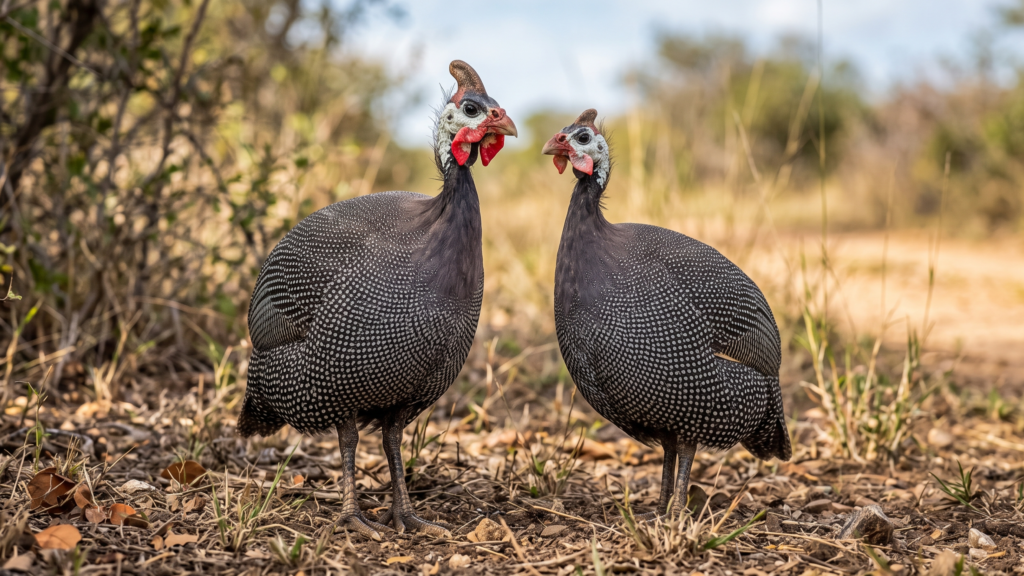
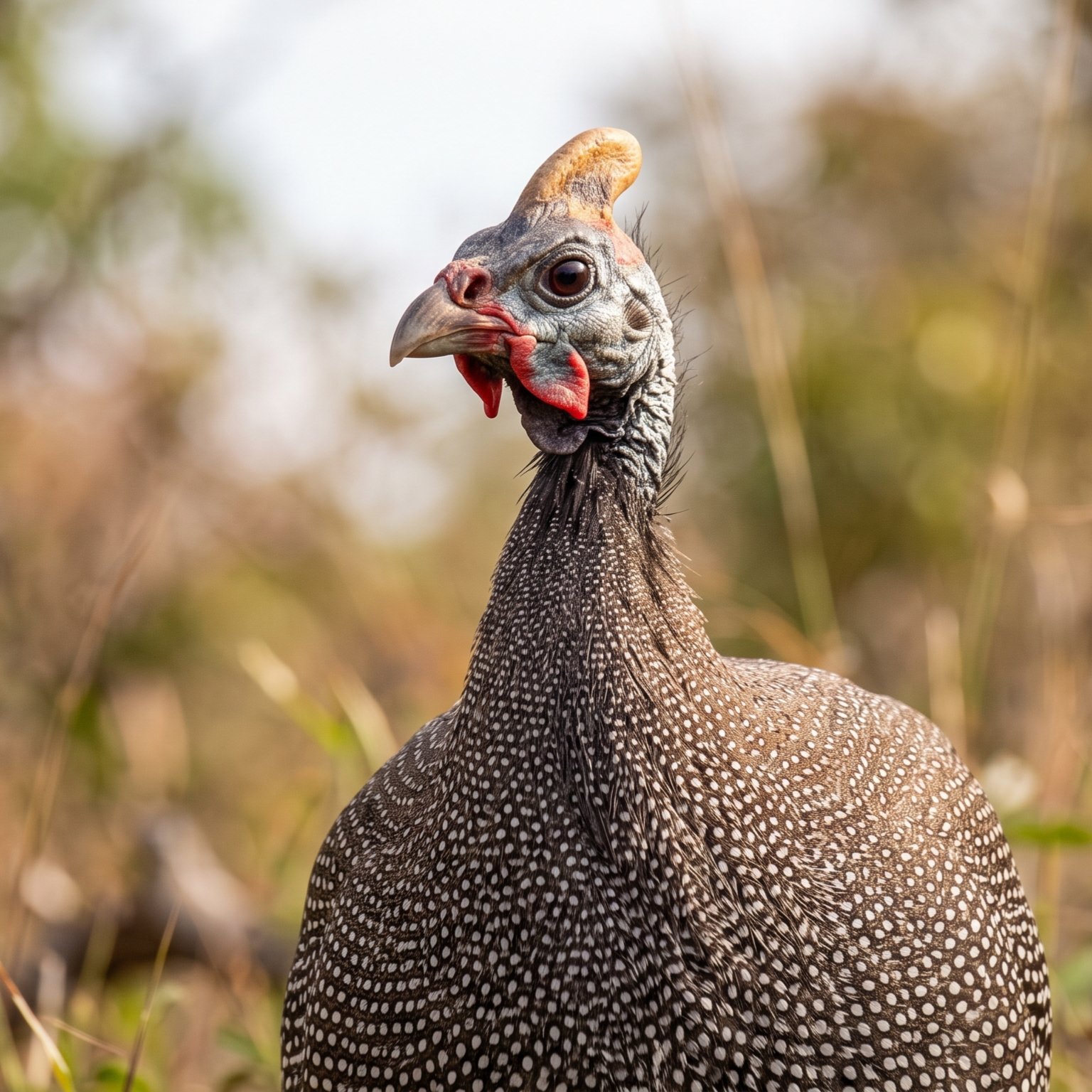
The helmet is that hard, horn-like knob sitting on top of a guinea’s head. In males, it tends to sit taller, look thicker at the base, and stand out more when you view the bird from a distance. On females, the helmet is usually smaller, sits a bit lower, and angles more toward the back of the skull, giving hens a slightly less dramatic head profile.
The catch: this difference can be genuinely subtle, and it varies bird to bird. I wouldn’t sex a flock off helmet size alone, but paired with calls, it’s a useful confirming clue.
Wattles
Wattles are the fleshy flaps hanging near the beak, and they differ in both size and shape between the sexes.
- Male wattles tend to be larger and more curved or cupped, folding upward toward the jaw.
- Female wattles are usually smaller and flatter, without that pronounced curl.
Like helmet size, wattle shape becomes more obvious with maturity and isn’t something you can count on with young birds, whose wattles look nearly identical until several months of age.
Posture and Back Shape
This one is the least reliable of the visual cues, but some keepers do notice it: certain hens develop a slight hump or lift where their tail meets their back, while males tend to have a smoother, more level line from back to tail. Not every hen shows it, and no males seem to, so treat this as a “nice if you spot it” clue rather than something to rely on.
Vent Sexing: The Hands-On Method
Vent sexing involves examining the cloaca directly for the presence of a rudimentary phallus, which indicates a male. Research comparing vent, biometric, and molecular sexing techniques has found vent examination to be one of the more accurate physical methods available, particularly in birds several weeks old and up.
That said, it’s not something I’d recommend for a first-timer. It takes practice to do correctly, guinea fowl generally do not enjoy being restrained and flipped for examination, and getting it wrong is easy if you haven’t been shown the technique by someone experienced. If you’re planning to breed on any real scale and want certainty beyond calls and physical traits, it’s worth learning from an experienced breeder or a poultry extension specialist rather than guessing from a written description alone.
When Can You Actually Tell Males From Females?
Timing matters more with guinea fowl than with almost any other backyard bird. Here’s roughly what to expect as your keets grow:
- 0–6 weeks: Essentially impossible to sex. Keets of both sexes look and sound identical.
- 6–10 weeks: Calls begin to differentiate. Hens may start their two-syllable buckwheat call, though some lag behind.
- 12–20 weeks: Still genuinely tricky by sight. Physical traits haven’t fully developed, and calls are your best bet.
- 20–24 weeks and beyond: Helmet size, wattle shape, and calls all become more distinct. This is the point where most keepers feel confident sexing their flock with reasonable accuracy.
If you’re trying to sex a flock for breeding purposes, I’d hold off on any firm decisions until birds are at least 20 weeks old, and lean on calls the whole way through rather than waiting on looks alone. This timeline also lines up nicely with when to start thinking seriously about breeding and incubation planning if that’s the direction you’re heading.
Why Getting the Sex Ratio Right Matters
Knowing who’s who isn’t just trivia. Guinea fowl flock dynamics depend on it. Too many males in a small flock leads to fighting, stress, and excessive chasing of hens, which can hurt egg production and overall flock harmony. Most keepers aim for roughly one male for every four to five females, which gives good fertility without overwhelming your hens — a ratio that also feeds into how many eggs you can realistically expect per year from a well-balanced flock.
If you’re building a breeding program or just trying to keep the peace in the run, getting a reasonably accurate sex count early lets you rehome extra males before they start creating tension, rather than after. It’s also worth thinking about how your ratio interacts with general flock behavior and management, since an unbalanced flock tends to show it in more than just noise.
Final Thoughts
Sexing guinea fowl really does test your patience, but it’s not the guessing game it can feel like early on. Lean on the calls first, since that two-syllable buckwheat is the closest thing to a guarantee you’ll get. Then use helmet size, wattle shape, and posture as supporting evidence once your birds mature. Give it time, watch your flock over several weeks rather than a single glance, and the picture will get clearer than you’d expect.
Have you found a trick that works especially well for your flock, or a bird that had you completely stumped? I’d love to hear about it in the comments. And if you’re just getting your first keets sorted out, my week-by-week guide to raising guinea fowl keets is a good next stop for what to expect as they grow.
Frequently Asked Questions
Can you tell the sex of a day-old keet? No. Keets of both sexes hatch looking identical, and there’s no reliable visual or auditory way to sex them until they’re at least several weeks old and start developing their calls.
Do female guinea fowl ever make the one-syllable call? Yes. Both sexes can make the one-syllable alarm call, which is why hearing it doesn’t confirm a bird is male. Only the two-syllable “buck-wheat” call is exclusive to females.
Is it true male guineas don’t have a penis like other male birds? Correct. Male guinea fowl have a rudimentary, non-erectile phallus rather than a true penis, similar to roosters, which is part of why vent sexing them takes more practice than it does with waterfowl.
How many males should I keep per female for good fertility? Most keepers aim for about one male per four to five females. That ratio tends to support solid fertility while keeping competition and stress among males to a minimum.
Hi, I’m Rayyan. I raise guinea fowl and share practical, research-backed guides for backyard keepers and homesteaders. I combine hands-on flock experience with trusted poultry management and university extension resources to help you raise healthier, more productive birds — with confidence, not guesswork.