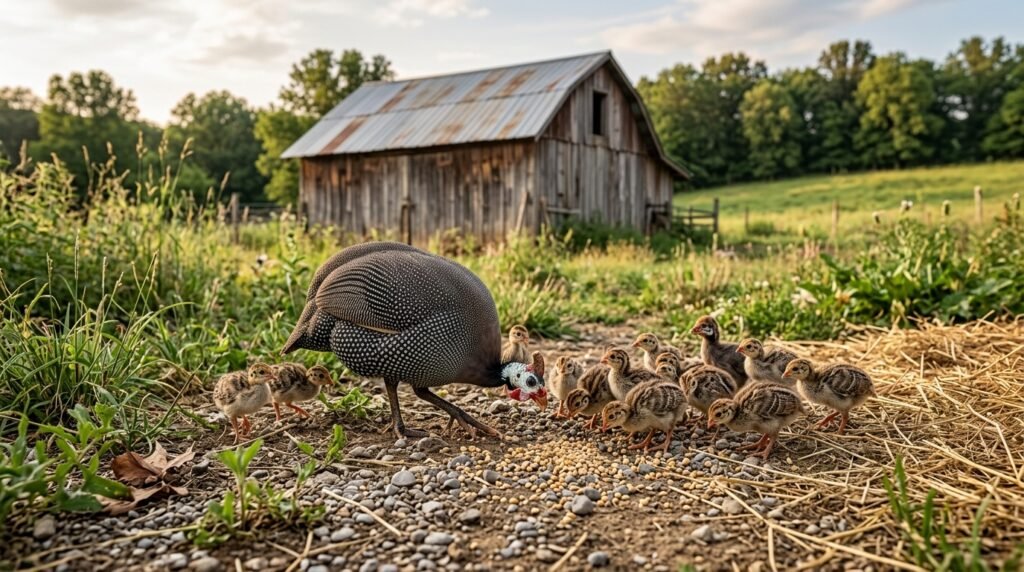
Guinea fowl generally range from about 25 grams at hatch to 2.5–4 pounds (1.1–1.8 kg) as mature adults, with hens often running slightly heavier than cocks through most of the growing period. Below, I’ll break that growth curve down stage by stage and explain why sex, breed, and feed all move the numbers.
I get asked about this constantly, usually by someone standing in the coop with a keet in one hand and a kitchen scale in the other, wondering if their bird is “on track.” So I pulled together everything I track on my own flock alongside published growth data, and built a chart you can actually use — not just a single “adult weight” figure that tells you nothing about the months it takes to get there.
By the end of this guide, you’ll know what a healthy guinea fowl should weigh at every major age milestone, how males and females compare, and what to do if your birds are falling behind the curve.
| Age | Average Weight (Both Sexes) | Notes |
|---|---|---|
| Day 1 (hatch) | 24–26 g | Males and females hatch at nearly identical weights |
| 4 weeks | 150–250 g | Rapid feather development begins |
| 8 weeks | 270–300 g | Keets are typically ready to move outdoors around this age |
| 12 weeks | 1.0–1.3 kg (2.2–2.9 lb) | Market weight for many meat producers |
| 16 weeks | 1.2–1.5 kg (2.6–3.3 lb) | Full adult plumage develops; often the “finished” weight |
| Adult (6–8+ months) | 1.1–1.8 kg (2.5–4 lb) | Sex-based difference is small and inconsistent across studies |
Guinea Fowl Weight From Hatch to 4 Weeks
A newly hatched keet is tiny. Most weigh in the neighborhood of 25 grams at one day old, and a controlled feeding trial in Burkina Faso recorded nearly identical hatch weights for both sexes — right around that same mark for males and females alike. There’s no visible size difference between the sexes at this stage, so don’t waste time trying to sex keets by weight. It won’t tell you anything.
What surprises new keepers most is how fast that changes. A healthy keet typically gains a few grams a day through its first few weeks, and it’s not unusual for a keet to nearly triple in size within the first month alone. I weigh mine every few days through that early stretch, mostly because it’s the easiest way to catch a keet that’s failing to thrive before it turns into a real problem. If you’re setting up a brooder and haven’t nailed down heat requirements yet, my guinea fowl keet temperature chart pairs well with weight tracking — cold, stressed keets almost always show up as light keets on the scale first.
By four weeks, most keets land somewhere between 150 and 250 grams. This is also roughly when true feathers start replacing the fuzzy natal down, so a chunk of that early growth goes toward plumage rather than pure body mass.
8 to 12 Weeks: The Growth Sprint
This is where guinea fowl really pack on weight. It’s also the window where keepers start noticing size differences between individual birds, though not yet reliably between sexes. In one large feeding study, researchers tagged 600 guinea fowl at 8 weeks old and recorded an average live weight right around 285 grams — a figure that lines up closely with what I’ve seen weighing my own birds on a standard grower ration.
Growth accelerates sharply after that. Research on meat-type guinea fowl found that 12-week-old birds of both sexes typically weigh between 1.2 and 1.3 kilograms, gaining roughly 150 grams a week from that point until they’re fully grown. This is also the age many commercial operations target for market weight — some hatcheries report birds reaching close to four pounds by 12 weeks under an intensive game-bird-starter-and-broiler-style feeding program, though that’s on the higher end of what most backyard setups will see without that level of feed management.
If you’re raising guineas for meat and want to dial in feeding for this growth window, my guide on what guinea fowl eat at each life stage covers the protein levels that actually drive this kind of gain.
13 to 16 Weeks: Sex Differences Start Showing
This is the age range where research starts showing a consistent, measurable pattern: hens edge out cocks. A carcass and growth study comparing 13-week-old and 16-week-old guinea fowl found that body weight increased by about 118 grams in males and 120 grams in females over that span — and at both ages, the females came out heavier. Other researchers working with pearl grey, royal purple, and lavender varieties reported the same trend: higher body weights in females than males at both 13 and 16 weeks.
That tracks with what I’ve seen raising a mixed flock. It’s a subtle difference — maybe 5 to 10% — not a dramatic one, but if you line up same-age birds side by side, the hens often edge out the cocks on the scale even before you can reliably tell them apart by their calls. If you’re still learning to sex your flock, weight alone won’t get you there; my guide on telling male and female guinea fowl apart covers the more reliable visual and vocal cues.
By 16 weeks, birds also hit a meaningful physical milestone: this is generally when guinea fowl develop their full adult plumage and markings, even though they haven’t necessarily reached full adult body weight yet. One commonly cited figure puts average live weight at 16 weeks around 1.48 kg — a useful benchmark if your birds are tracking noticeably under that and everything else (diet, health, housing) checks out fine.
Adult Guinea Fowl Weight by Sex
Once guinea fowl reach full maturity — typically somewhere between six and eight months of age — the sex-based weight gap tends to narrow, and depending on the source, it can flatten out almost entirely or even shift. This is genuinely one of the more confusing parts of guinea fowl weight for new keepers, because published sources don’t fully agree:
- Some sources put mature hens slightly ahead. One poultry guide notes mature hens averaging around three pounds with cocks closer to four, while a separate comparison lists average males topping out around three pounds versus females up to about three pounds nine ounces — so even sources that agree hens are heavier don’t agree by how much.
- Some research finds the gap holds into adulthood. A study on pearl grey, royal purple, and lavender guinea fowl found that beyond 20 weeks — specifically at 24 weeks — females were still generally heavier than males.
- Other sources find essentially no meaningful difference. One detailed breed comparison states plainly that there isn’t much size variation based on sex in guinea fowl at all, unlike the more pronounced dimorphism you’d see in chickens or turkeys.
My honest take, after raising these birds for years: the sex-based weight difference in guinea fowl is real but small and inconsistent, and it’s easily overshadowed by breed, feed, and plain individual variation. If you want one working number, plan on adult guinea fowl weighing somewhere between 2.5 and 4 pounds (1.1 to 1.8 kg) regardless of sex, and don’t lean on a scale to sex your birds. Body size just isn’t a reliable indicator the way it is in some other poultry.
What Affects Guinea Fowl Weight Beyond Age and Sex
Age and sex explain a lot of the variation, but they’re far from the whole story. A few other factors move the needle just as much:
- Breed and variety. Broiler-type guinea fowl lines are bred specifically for faster growth and larger frames, while heritage varieties like the common Pearl grow more slowly and top out smaller.
- Feed protein levels. Keets need a high-protein starter — commonly in the 24–26% range for the first several weeks — to hit their growth potential. Birds on lower-protein or inconsistent feed will lag behind chart averages.
- Free-range access versus confinement. Guineas that forage heavily for insects and greens sometimes grow a touch more slowly than birds on a controlled, calorie-dense ration, though in my experience they tend to be leaner and hardier for it.
- Clutch and hatch conditions. Egg size and incubation consistency affect hatch weight, and keets that start smaller often stay slightly smaller through the early growth stages, even if they eventually catch up.
- Health and parasite load. Intestinal parasites and coccidiosis are common, sneaky culprits behind a keet or grower that’s mysteriously falling off the weight curve.
If you’re trying to figure out why your birds seem light for their age, my guide on common guinea fowl parasites is a good place to rule that out before assuming it’s a feed problem.
How to Weigh Your Guinea Fowl Accurately
Getting a clean, useful weight on a bird that hates being handled takes a little technique:
- Use a digital kitchen or luggage scale. A kitchen scale in grams is precise enough for keets. For adults, a hanging luggage scale with a sling or bag is far easier than trying to balance a squirming bird on a flat platform.
- Weigh at the same time of day. Crop fullness can swing a bird’s weight by tens of grams, so first thing in the morning before feeding gives you the most consistent baseline.
- Support the body fully. For adults, a cloth bag with the head left uncovered — or a snug, secure wrap — keeps birds calmer and keeps the reading steady.
- Track individuals if you can. Leg bands let you follow the same bird’s growth curve over time instead of just comparing flock averages, which is far more useful for catching a bird that’s struggling.
- Log it somewhere. Even a simple notebook or spreadsheet with date, age, and weight turns one-off numbers into a growth trend you can actually act on.
Final Thoughts
Guinea fowl growth is fast and fairly predictable through about 16 weeks, and the age-based averages above should give you a solid reference point whether you’re raising birds for meat, eggs, or pest control. The sex-based weight gap is real but modest — don’t lean on it to sex your flock — and breed, feed quality, and free-range access will explain an underweight or overweight bird far more often than sex does.
If you’re weighing your flock and something looks consistently off from these numbers, check feed protein levels and rule out parasites before assuming it’s just how your birds are built. How does your flock’s growth compare to these figures? I’d love to hear what you’re seeing, especially if you’re raising a broiler-type variety or free-ranging heavily, since both tend to push the numbers in different directions.
FAQ
At what age are guinea fowl fully grown?
Guinea fowl typically develop full adult plumage and markings around 16 weeks, but they usually don’t reach full adult body weight and sexual maturity until somewhere between 6 and 8 months of age.
Do male or female guinea fowl weigh more?
Research is mixed. Several studies found hens slightly heavier than cocks through the 13-to-24-week range, but by full maturity the difference is small and inconsistent enough that weight alone isn’t a reliable way to sex your birds.
Why is my guinea keet not gaining weight?
The most common causes are insufficient protein in the starter feed, cold stress in the brooder, and intestinal parasites or coccidiosis. Check brooder temperature first, since chilled keets burn energy staying warm instead of growing.
What is a healthy market weight for meat guinea fowl?
Most meat producers target somewhere between 12 and 16 weeks of age, when birds typically weigh 1.0 to 1.5 kg (roughly 2.2 to 3.3 lb), depending on breed and feeding program.
Hi, I’m Rayyan. I raise guinea fowl and share practical, research-backed guides for backyard keepers and homesteaders. I combine hands-on flock experience with trusted poultry management and university extension resources to help you raise healthier, more productive birds — with confidence, not guesswork.