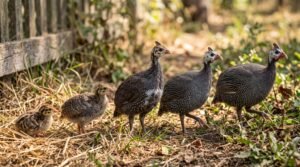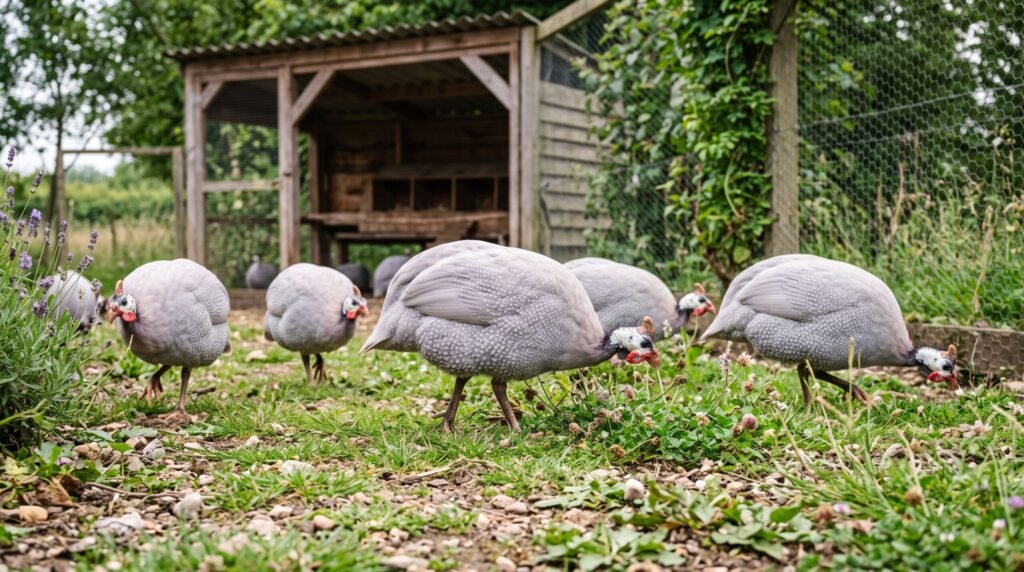
Lavender guinea fowl are a soft blue-gray variety of the helmeted guinea fowl, prized for their pale, pearlescent plumage, sharp watchdog instincts, and knack for clearing ticks and other pests off a property. They’re just as hardy and low-maintenance as any other guinea color, which makes them a good fit for backyard keepers and homesteaders who want a productive, self-sufficient bird without a lot of fuss.
I added lavenders to my own flock a few years back mostly because I liked how they looked next to my pearls, and I’ve kept them ever since for the same reasons everyone else does — they’re tough, they’re loud in all the right ways, and they’ve done more for my tick problem than anything I ever bought at the feed store. This guide covers everything I’ve learned about their traits, feeding needs, general care, and housing setup, plus what to expect if you’re thinking about bringing some home.
| Trait | Details |
|---|---|
| Color | Soft lavender to pale blue-gray, sometimes with faint spotting |
| Weight | Hens ~3–4 lbs, cocks ~4–5 lbs |
| Egg production | 60–100 eggs per season (typically March–August) |
| Lifespan | 10–15 years |
| Temperament | Active, alert, flock-oriented, vocal |
| Care level | Low-maintenance once established |
| Best suited for | Homesteads, farms, rural properties with space to roam |
Where Lavender Guinea Fowl Come From
Every guinea fowl, regardless of color, traces back to the helmeted guinea fowl of West Africa, where the birds have been part of the landscape for thousands of years. Images of guinea fowl have turned up on buildings from Ancient Egypt and Greece dating back as far as 2400 B.C., and the Greeks were known to raise them for both meat and eggs.
The lavender coloring itself isn’t a separate species — it’s a lighter-colored variety of the same traditional helmeted guinea fowl that also produces pearl gray and royal purple birds, and hatcheries have spent decades refining the bloodline to get that consistent, soft gray-lavender shade. It’s not a color recognized by the American Poultry Association, but that hasn’t slowed its popularity among keepers who want something a little different from the standard pearl gray.
What Lavender Guinea Fowl Look Like
The name says it all — these birds carry a pale, muted lavender-gray plumage that reads almost silvery in certain light. Their feathers have a pearlescent quality that creates an eye-catching display, and compared to darker pearl or royal purple guineas, lavenders look noticeably lighter and more uniform across the body.
A few things to expect on appearance:
- Subtle spotting. Some birds show faint spotting, but overall the look stays clean and muted rather than heavily patterned.
- Lean, athletic build. Like all guineas, they’re built for near-constant movement and foraging, not for sitting still.
- Similar coloring between sexes. Males and females share a similar appearance, though males tend to run slightly larger.
- More visible in open ground. That lighter color is gorgeous, but it also makes lavenders easier for predators to spot in open pasture compared to darker varieties — something worth factoring into where you let them free-range.
If you’ve ever tried to sex a guinea fowl by looking at it, you already know feathers won’t help you. The real tell is in the call: males typically stick to a one-syllable “chit-chit-chit,” while hens add a second syllable, giving their call that familiar two-note “buck-wheat, buck-wheat” rhythm.
Size and Weight
Lavender guineas run on the smaller side compared to production-bred meat poultry, but they’re solidly built for their size.
- Hens: roughly 3 to 4 pounds
- Cocks: roughly 4 to 5 pounds
- Pullets and cockerels: slightly smaller than mature birds, as expected
That’s a fairly typical weight range for guinea fowl in general, and it’s one reason they’re often raised as a leaner, more flavorful alternative to chicken rather than a high-yield meat bird.
Temperament: What to Actually Expect
If you’ve never kept guineas before, the temperament is the part that surprises people most. Lavender guinea fowl are active almost to a fault — they move constantly, forage relentlessly, and rarely sit still for long. They’re also intensely social with each other and tend to travel, roost, and forage as a tight-knit group rather than scattering off individually.
That same alertness is what makes them such effective watch birds. They notice movement, predators, strangers, or changes in the yard well before most other poultry would, and they’ll let the whole property know about it with a loud, repeated alarm call. In my experience, that’s been genuinely useful — I’ve had more than one visit from a fox chased off by nothing but the racket my guineas kicked up before it got anywhere near the coop.
The trade-off is noise. Guineas, lavenders included, are not quiet birds, and if you have close neighbors, that’s worth thinking through before you order keets. Because Lavender Guineas are alert, vocal, and excellent foragers, they tend to work best for farms, homesteads, orchards, and rural properties rather than tight suburban backyards. If noise complaints are a real concern where you live, it’s worth checking legal rules for keeping guinea fowl on your property before you commit.
They’re also somewhat independent-minded compared to chickens. Guineas don’t bond with keepers the way some chicken breeds do, and they’ll happily wander property lines if given the chance, which is part of why fencing and flock training matter so much early on.
Feeding Lavender Guinea Fowl
Feeding needs shift a lot depending on age, and getting this right — especially in the first few weeks — makes a real difference in how your keets grow.
Keets (0–6 weeks)
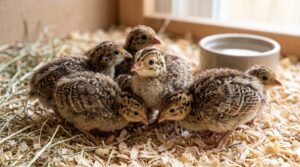
Young guinea keets need considerably more protein than chicken chicks of the same age. A starter ration in the range of roughly 24–28% crude protein is standard advice for this stage, since keets are putting on rapid growth and are more fragile than chicken chicks during this window. Game bird or turkey starter crumbles are commonly used because standard chick starter usually falls short on protein for guineas. If chick starter is genuinely the only option available, supplementing with a protein source like mealworms can help close that gap.
Fresh water and access to grit are just as important as the feed itself — grit helps keets digest properly once they start pecking at anything beyond crumbles.
Growers (6–16 weeks)
As keets mature, protein needs step down gradually. A grower ration in the 18–20% protein range is typical during this stage, giving birds what they need to finish developing their frame and feathering without overdoing it on protein once the fastest growth phase has passed.
Adults (16+ weeks)
Once guineas reach maturity, a standard layer or all-flock ration works well, generally in the 15–18% protein range depending on whether hens are actively laying. Research on indigenous guinea fowl nutrition has found that dietary crude protein requirements differ meaningfully between the growing phase and the laying phase, which is part of why stepping protein down as birds mature — rather than feeding one ration for life — tends to produce better results.
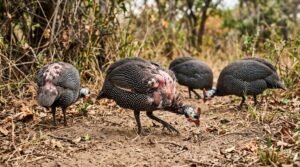
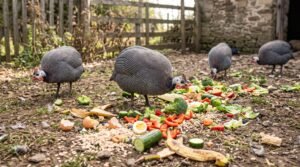
Adult guineas are also enthusiastic foragers, and a big part of their appeal is how much of their own diet they’ll find themselves. Free-ranging birds will happily hunt down ticks, grasshoppers, beetles, and other insects, which cuts down on feed costs and is exactly why so many people add guineas to a property in the first place. Just don’t rely on foraging alone in the off-season or in smaller runs — birds without enough space to range still need a complete ration to stay healthy. For more detail on rations and feeding schedules by age, my full guide on what guinea fowl eat walks through it stage by stage, and the feed calculator can help you estimate how much you’ll actually need to keep on hand.
Egg Production
Lavender guineas are seasonal layers, not the year-round producers that many chicken breeds are.
- Production: roughly 60–100 eggs per season, typically concentrated between March and August
- Egg size: small, with a dark, speckled shell
- Fertility: generally 60–75%
- Broodiness: hens are known setters, though how consistently they’ll actually sit on a nest varies bird to bird
One quirk worth knowing before you start: free-ranging hens tend to hide their nests rather than use anything you provide. It’s not unusual to lose track of a hen for a few weeks and then have her reappear trailing a dozen keets she hatched somewhere in the brush. If you’re trying to collect eggs reliably rather than let hens hatch their own, daily nest checks in likely hiding spots (tall grass, brush piles, along fence lines) become part of the routine. I’ve had good luck training a few hens to use enclosed nesting areas early on, though it’s never a sure thing with this breed — my guide to guinea fowl nesting boxes covers what’s actually worked for me. If you’re weighing lavenders against other production goals, how many eggs guinea fowl lay per year breaks down how output compares across breeds and conditions.
Housing Requirements
Housing is where a lot of new keepers underestimate what guineas actually need. They’re bigger, more restless, and fly better than chickens, so a standard small chicken coop usually isn’t enough.
A few space guidelines to plan around:
- Coop space: figure on at least 2–4 square feet per bird indoors, with more being better if birds will spend extended time inside during bad weather.
- Run or outdoor space: guineas need considerably more room to range than chickens — 10 square feet or more per bird in a covered run is a reasonable starting point if you can’t offer true free-range access.
- Roosting height: guineas strongly prefer roosting up high. A roost height of around 4 feet or more suits their natural instinct, and if you don’t give them adequate height inside, they’ll often try to roost in trees instead.
- No nest boxes needed: unlike chickens, guineas rarely use standard nest boxes, so you can skip that fixture in the coop design.
- Predator-proofing: guineas are decent at raising the alarm, but the coop itself still needs to be fully secure at night — hardware cloth over any openings, a solid latch, and no gaps large enough for a raccoon or weasel to squeeze through.
Ventilation matters more than insulation in guinea housing. According to guinea fowl management guidance from the University of Connecticut’s Department of Animal Science, these birds are generally hardy and adaptable, but damp, poorly ventilated coops still lead to respiratory problems fast, so airflow should take priority over sealing up the space for warmth. Because lavenders are also strong flyers — capable of clearing a six-foot fence without much effort — a covered run or clipped wings is worth considering if you need them to stay inside a set boundary rather than range the whole property.
If you’re setting up housing from scratch, my guinea fowl housing guide goes deeper into coop setup, and the coop size calculator can help you size things out based on your flock count.
General Care Tips
A few things I’ve picked up keeping lavenders that apply broadly to the breed:
- Flock training takes patience. New keets need to be trained to return to the coop at night — expect several weeks of consistent routine before it clicks.
- Keep them in groups. Guineas are herd-minded birds and don’t do well kept as a single individual; aim for at least three to four birds minimum.
- Watch for heat and cold stress. Provide shade and fresh water in summer, and a dry, draft-free shelter in winter — guineas handle cold better than heat in most climates.
- Introduce new birds carefully. Guinea flocks can be territorial toward newcomers, so a gradual, supervised introduction goes a lot smoother than just tossing new birds in.
- Mind the noise around neighbors. If you’re in a mixed-use area, position housing away from property lines where possible.
If you’re just getting your setup going, my beginner’s guide to starting guinea fowl farming is a good place to see how all these pieces — housing, feeding, flock training — fit together from day one.
Frequently Asked Questions
Are lavender guinea fowl good for beginners?
They’re a reasonable choice for beginners who have enough outdoor space and aren’t overly concerned about noise. Lavenders are just as hardy and low-maintenance as other guinea colors, but their vocal nature and tendency to roam mean they’re a better fit for rural or farm settings than a small suburban yard.
Do lavender guinea fowl need a special diet compared to other colors?
No. Feeding needs come down to age and life stage, not color. A lavender guinea eats the same starter, grower, and layer rations as a pearl or royal purple bird of the same age.
Can lavender guinea fowl free-range safely?
Yes, and free-ranging is actually where they do their best pest control work. The main risk is their light coloring, which makes them more visible to aerial predators like hawks in open pasture compared to darker varieties — cover from trees or shrubs helps offset that.
How do lavender guinea fowl get along with chickens?
They can share a property with chickens reasonably well, especially if there’s enough space for both to establish their own routines. Guineas are more independent and less likely to compete directly for chicken feeders and roosts, though mixing flocks always goes smoother with a gradual introduction.
Lavender guinea fowl bring a rare combination to a homestead: a genuinely useful pest-control bird, a natural alarm system, and a striking bit of color in the yard, all wrapped into one low-maintenance package. If you’ve got the space and don’t mind the noise, they’re one of the more rewarding birds you can add to a flock.
Have you kept lavenders alongside other guinea colors, or are you considering them for your first flock? I’d love to hear how it’s going — drop a comment below, or browse the full blog for more breed-specific guides as you plan your flock.
Hi, I’m Rayyan. I raise guinea fowl and share practical, research-backed guides for backyard keepers and homesteaders. I combine hands-on flock experience with trusted poultry management and university extension resources to help you raise healthier, more productive birds — with confidence, not guesswork.