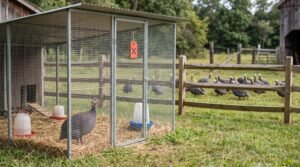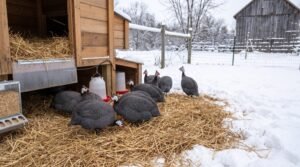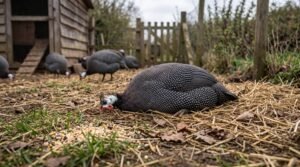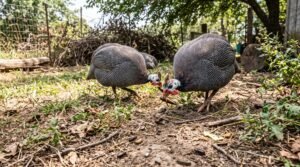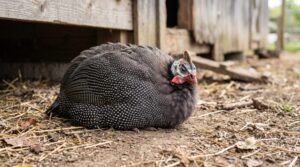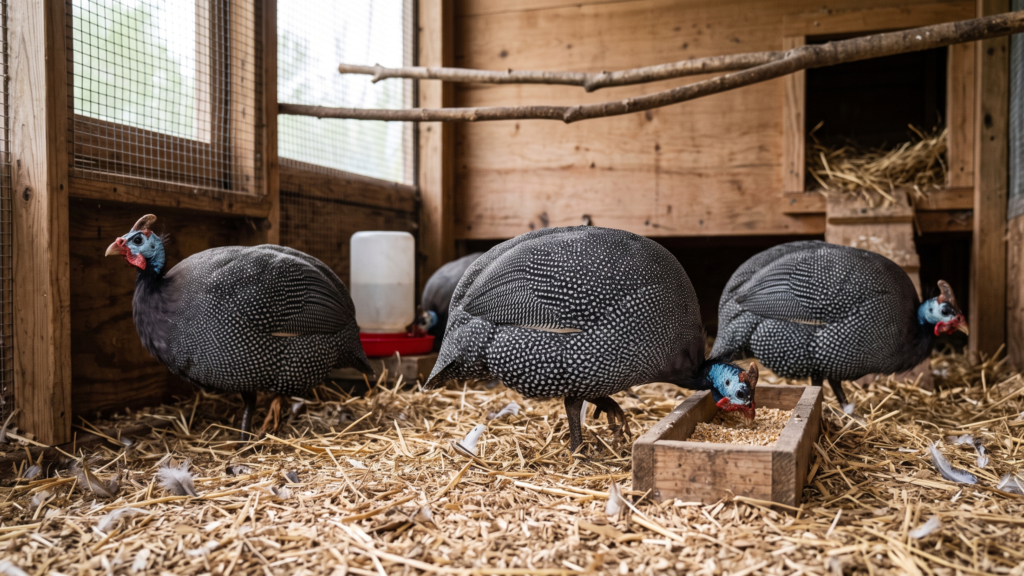
A good guinea fowl coop gives each adult bird roughly 4 square feet of floor space, stands at least 6 feet tall for high roosting, and is fully enclosed with predator-proof hardware cloth — because unlike chickens, guineas won’t reliably put themselves to bed at night.
I learned that last part the hard way. My first flock spent two weeks roosting in the walnut tree behind my barn before I finally got them trained into a coop, and I lost a hen to an owl in the process. Guinea fowl housing isn’t complicated, but it does have to account for how differently these birds behave compared to chickens — their instinct to fly, their poor night vision, and their stubborn refusal to do anything on your schedule instead of theirs.
In this guide, I’ll walk you through exactly how much space your guineas need, what a coop actually requires to keep them safe, and how to set up a run that won’t have them airborne over the fence by lunchtime.
Here’s what a solid guinea fowl setup looks like at a glance:
| Feature | Recommendation |
|---|---|
| Indoor space | 4 sq ft per adult bird (minimum) |
| Outdoor run space | 10 sq ft per adult bird (minimum) |
| Coop height | 6 feet minimum; 8 feet is better |
| Roosting bar height | 4–6 feet off the ground |
| Fencing/mesh | ½-inch hardware cloth, not chicken wire |
| Run height | 6 feet, fully covered on top |
| Buried fence depth | 12 inches, to stop digging predators |
Why Guinea Fowl Housing Is Different From a Chicken Coop
My first guinea fowl used a hand-me-down chicken coop from my old flock as their starter housing, and it worked — but only after I made a few changes. Chickens are ground birds by instinct. Left to their own devices, they’ll still wander into a coop at dusk because that behavior is baked into them.
Guineas are not built that way. They’re closer to their wild West African ancestors than most domesticated poultry, and that shows up in two big ways:
- They fly, and they fly well. Guineas are strong fliers from a young age, and research from the University of Kentucky’s poultry extension program notes they’re capable of covering 400 to 500 feet in a single flight. Any enclosure without a secure top is really just a suggestion to them.
- They don’t self-house at night. Chickens head for the coop as the sun goes down. Guineas would rather roost high in a tree, which leaves them exposed to owls, raccoons, and hawks after dark. You have to actively train them to use the coop, usually by keeping keets confined to it for their first several weeks so it becomes “home.”
Because of this, guinea fowl housing has to do two jobs a chicken coop doesn’t: physically prevent escape from above, and give the birds enough appeal — height, security, roosting room — that they choose to go inside on their own once trained.
If you’re still deciding whether housing needs to be fully enclosed at all, it helps to understand the tradeoffs between letting guineas range freely and keeping them confined before you commit to a design.
Coop Space Requirements
Guinea fowl don’t need much floor space compared to some poultry, but they do need height and roosting room. The consistent figure across poultry keepers and breed associations is 4 square feet of indoor floor space per adult bird as a baseline.
A few notes on that number:
- If your guineas free-range during the day and only use the coop at night, 4 square feet per bird is generally enough.
- If you expect to confine them for stretches — bad weather, predator pressure, or you’re away and can’t let them out — plan for closer to 5–6 square feet per bird to prevent boredom-driven pecking and stress.
- Keets need less absolute space but more relative space per pound of body weight while they’re growing; I cover that separately in my guide on raising guinea keets week by week.
For a flock of 10 adult guineas, that puts you at a minimum of 40 square feet of coop floor — something like an 8×5 or 6×7 structure. It doesn’t need to be fancy. I’ve seen guineas do perfectly well in a converted shed, a repurposed dog kennel, or a corner sectioned off from a barn.
If you’re working out numbers for your own flock size, running them through a guinea fowl coop size calculator is faster than doing the math by hand every time your flock grows.
Height Matters More Than Floor Space
This is the part beginners underestimate. Guineas want to be up high, and a coop that feels cramped vertically will frustrate them even if the floor space checks out.
- Minimum ceiling height: 6 feet
- Preferred ceiling height: 8 feet for adult birds
- Roosting bars: installed at multiple heights, starting around 4 feet off the ground and ideally going higher
Guineas will fight for the highest available perch, so if you only install one roosting bar, expect squabbling. Two or three bars at staggered heights solves most of that on their own.
Ventilation and Flooring
Guinea droppings are drier than chicken droppings, which helps, but moisture control still matters — especially in a fully enclosed structure. Damp bedding is one of the fastest routes to respiratory problems in a flock.
A few things I’ve found non-negotiable, and they line up with what the Virginia Cooperative Extension’s small-scale poultry housing guidance recommends for backyard flocks generally:
- Vent placement above roost level. Warm, moist air rises, and you want it escaping through vents near the roofline rather than drifting out at bird height, where it can chill the flock in cold weather.
- Skip the insulation. It sounds counterintuitive, but insulating a guinea house tends to trap moisture inside, which creates more respiratory risk than it solves. Good ventilation does more work than insulation ever will.
- Absorbent bedding. Wood shavings or chopped straw both work. Straw holds moisture longer, so if you’re in a humid climate, shavings are usually the lower-maintenance choice.
- Solid or dirt flooring, not wire. Wire floors are sometimes used for young keets in brooders, but for adult housing, a solid or dirt floor covered in bedding is safer and easier on their feet.
Plan on replacing bedding when it starts to feel damp or smell of ammonia — don’t wait for a set schedule, since how fast litter breaks down depends heavily on flock size and weather.
Predator-Proofing: The Part You Cannot Skip
If there’s one section of this guide I’d tell a beginner to read twice, it’s this one. Guinea fowl are nearly blind at night, which makes an unsecured coop a buffet for anything that finds its way in after dark.
Here’s what actually holds up:
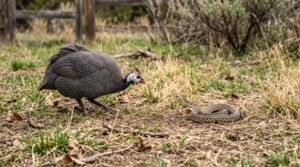
- Use ½-inch hardware cloth, never chicken wire. Chicken wire keeps birds in, but it does almost nothing to keep raccoons, weasels, or snakes out. They can reach through it or tear it open.
- Bury fencing at least 12 inches underground around the perimeter of any attached run, angled outward, to stop digging predators from tunneling under.
- Cover every vent and window opening with hardware cloth, no exceptions — vents are one of the most common entry points people forget to secure.
- Install secure, latched doors, including on nesting access points. Raccoons are dexterous enough to open simple hook latches.
- Fully enclose the run’s top, not just the sides. Guineas can fly out, and hawks and owls can fly in.
For a closer look at specific predator threats and how to defend against each one, I’ve put together a full breakdown on protecting guinea fowl from foxes, hawks, and other predators.
Outdoor Run Requirements
Not everyone has acreage for guineas to free-range safely, and a secure run is a reasonable middle ground. The space math here is more generous than indoor housing:
- Minimum run space: 10 square feet per bird
- Better run space: 20–30 square feet per bird if you can manage it
- Run height: 6 feet, fully covered — an open-topped run is not a guinea fowl run
Guineas kept in a run long-term get bored faster than chickens do, and boredom in a flock this flighty tends to show up as pecking, fence-testing, or general agitation. If space allows, scattering some cover — brush piles, low shrubs, a few perches inside the run — gives them something to do besides pace the fence line.
If your birds do get any daytime range access, it’s worth knowing which plants and forage areas actually benefit them; I go into that in my guide on the best plants and grasses for free-ranging guinea fowl.
Nesting Boxes: Do You Actually Need Them?
Short answer: guineas will use nest boxes, but far less predictably than chickens do. Hens frequently choose to lay in a hidden ground nest instead, especially if they have any outdoor access at all.
If you do want to offer boxes:
- Plan on one box per 4–6 hens
- Size each box around 12 inches deep, 18 inches wide, and 6 inches tall
- Place boxes in a low, quiet, dimly lit corner of the coop — guineas prefer nesting somewhere that feels hidden, not exposed
Don’t be surprised if you still find eggs in a brush pile across the yard. I go into this in more detail, including how to encourage box use, in my article on whether guinea fowl actually use nesting boxes.
Training Guineas to Use Their Coop
Building the right structure only solves half the problem — you still have to get the birds to use it. This is where most of the frustration in guinea fowl keeping actually comes from, not the construction itself.
What’s worked consistently for me and for most keepers I’ve talked to:
- Start keets in the coop from day one. Birds raised inside a structure treat it as home far more reliably than adults introduced later.
- Keep adult birds confined to the coop and run for the first 1–2 weeks after you bring them onto the property, even if you plan to free-range eventually. This builds the habit before you give them the option to roost elsewhere.
- Feed and water inside the coop, not out in the yard. Guineas will go where the food is, especially in the evening.
- Close them in at dusk consistently. Once the habit is set, most flocks will start returning on their own as light fades.
- Use a wide, gently sloped ramp if the coop is elevated. A steep or narrow ramp triggers their flight instinct and makes them harder to herd inside.
Expect some resistance early on. Guineas are intelligent but stubborn, and a bird that’s used to roosting in a tree may test the coop door for a few nights before it becomes routine.
Frequently Asked Questions
Can guinea fowl share a coop with chickens? Yes, many keepers house them together successfully, though guineas need higher roosting options and can be pushy with chicken feed if space is tight. I cover the details of mixed-flock housing in my guide to keeping guinea fowl with chickens, ducks, and turkeys.
How cold can a guinea fowl coop get before it’s a problem? Guineas handle cold reasonably well as long as the coop is dry and draft-free, but frostbite risk goes up once temperatures drop well below freezing. For specifics on winterizing housing, see my guide to guinea fowl winter care.
Do guinea fowl need a heat lamp in their coop? Adult guineas generally don’t need supplemental heat in a properly draft-free coop, even in cold climates — their bigger vulnerability is dampness and drafts, not cold air itself. Keets are a different story and need brooder heat.
What’s the minimum flock size for guinea fowl housing to make sense? There’s no hard minimum, but guineas are flock-oriented birds that do better in groups of at least 3–4. Housing math scales the same way regardless of flock size — just multiply the per-bird space requirements by your headcount.
Getting Your Setup Right From the Start
The core of guinea fowl housing comes down to a short list: enough floor space, real height for roosting, ventilation that doesn’t trap moisture, and predator-proofing that doesn’t cut corners on mesh size or buried fencing. Get those four right, and the coop itself doesn’t need to be complicated or expensive.
If you’re still in the planning stages and want to see how other keepers have laid out their setups, my roundup of guinea fowl coop design ideas has plans and sizing examples worth comparing against your own space.
What does your current setup look like, and what’s been the biggest challenge in getting your flock to actually use it? I’d like to hear how it’s going for you.
Hi, I’m Rayyan. I raise guinea fowl and share practical, research-backed guides for backyard keepers and homesteaders. I combine hands-on flock experience with trusted poultry management and university extension resources to help you raise healthier, more productive birds — with confidence, not guesswork.