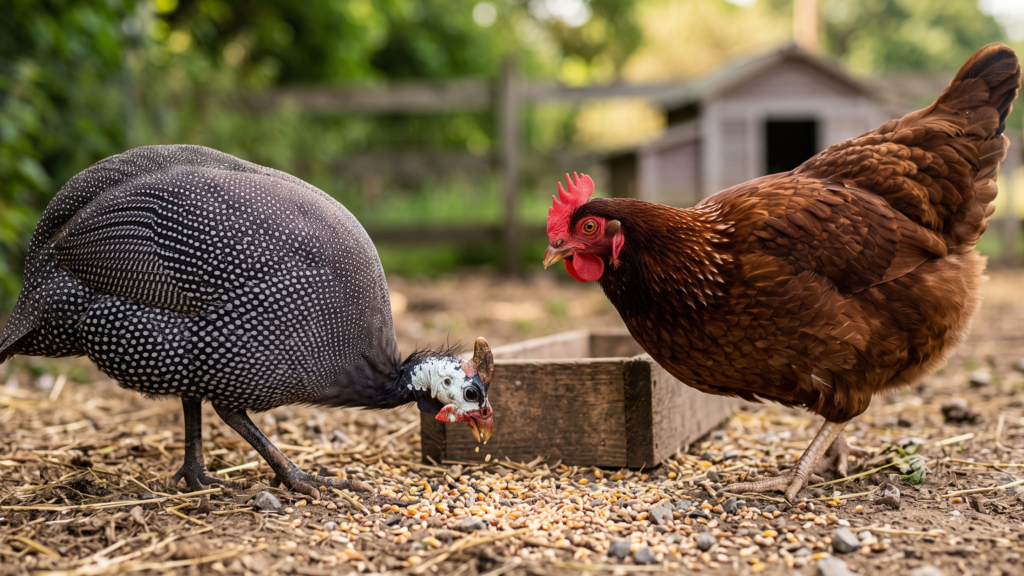
Chickens are the more profitable bird for most keepers, hands down, if your goal is steady egg or meat volume at the lowest cost per pound. But guinea fowl can out-earn chickens per bird in specific niches — premium meat sales, pest-control services, and low-input free-range setups — where fewer inputs and higher per-unit prices tilt the math in their favor.
I’ve raised both, and I used to assume the answer would be simple. It isn’t. A guinea hen lays a fraction of what a good layer chicken produces, but she also eats less, rarely sees a vet, and her meat sells for two to three times the price per pound. Whether that trade-off pays off depends entirely on what you’re selling and who you’re selling it to.
This guide breaks down the real costs and returns for both birds — startup investment, feed, health care, egg output, meat yield, and market price — so you can figure out which one actually makes sense for your setup.
Here’s how the two birds stack up across the categories that determine profitability:
| Factor | Guinea Fowl | Chicken |
|---|---|---|
| Average eggs/year | ~100 | 200–280 |
| Egg size | Small (2 guinea eggs ≈ 1 chicken egg) | Standard |
| Feed cost | Lower (strong foragers) | Moderate to higher (confined layers) |
| Disease resistance | High, minimal vet care | Moderate, more routine care |
| Meat price per lb | $3.46–$6.49 retail | Typically lower, commodity-priced |
| Market demand | Niche/gourmet | Broad, consistent |
| Startup cost | Similar to chickens | Similar to guinea fowl |
| Best profit angle | Pest control + premium meat | Volume eggs + meat |
Egg Production: Chickens Win on Volume
If eggs are your main income stream, this comparison isn’t close. A productive laying breed will typically give you between 200 and 280 eggs annually, with some high-production breeds pushing close to 300. A guinea hen, by contrast, usually manages around 100 eggs per year at best — and that’s assuming she’s well managed and you’re diligent about collecting eggs from a confined area.
The size gap compounds the problem. Guinea eggs run noticeably smaller than chicken eggs — it takes roughly two guinea eggs to match the volume of one chicken egg. So you’re not just getting fewer eggs; you’re getting fewer eggs that individually hold less. If you’re running the numbers on egg sales alone, a flock of laying hens will out-produce an equivalent flock of guineas by something like five or six times in usable egg volume per year.
There’s also a seasonal wrinkle worth knowing before you commit to guineas for eggs. Guinea hens don’t lay year-round — they mostly lay between March and October — which means several months of the year with no guinea eggs at all, while a well-managed layer flock (with supplemental light in winter) can keep producing close to year-round.
Where guinea eggs claw back some value is on the specialty market. They’re rarely found in grocery stores, and their thick shells and longer shelf life let them command a premium price compared with standard chicken eggs. If you have a farmers market or a niche buyer base willing to pay a premium for something unusual, a small guinea flock can carve out a profitable side line — just don’t expect it to compete with chickens on raw output. If you want a clearer sense of what realistic annual output looks like before you build a business case around it, this breakdown of how many eggs guinea fowl actually lay per year goes deeper into the numbers.
I’ve found the real advantage of guinea eggs isn’t income at all — it’s the thick shell holding up better in transport, which matters if you’re hauling eggs any distance to sell.
Meat Production: Guinea Fowl’s Price Premium vs Chicken’s Volume Edge
This is where the profitability question gets genuinely interesting, because guinea fowl meat sells for considerably more per pound than commodity chicken.
On price alone, guinea comes out ahead. According to Selina Wamucii’s US market pricing data, retail guinea fowl meat runs roughly $3.46 to $6.49 per pound, with wholesale prices coming in somewhat lower. That’s a meaningful premium over standard broiler chicken, which typically sells for a fraction of that at retail. Part of the reason is positioning: guinea is often nicknamed the “poor man’s pheasant” — a luxury food that shows up on the menus of upscale French and Asian-influenced restaurants, particularly on the East Coast.
But price per pound isn’t the whole story — yield matters just as much. Guinea fowl are smaller birds. A mature hen weighs around three pounds and a cock around four, dressing out to about 75% of live weight — roughly five percentage points better than the 70% average for a broiler chicken. Even so, you’re looking at a maximum table-ready weight of around 2¼ to 3 pounds per bird, well under what a dedicated meat chicken breed delivers at slaughter weight.
So the real comparison looks like this:
- Guinea fowl: Fewer pounds of meat per bird, but each pound sells for two to three times more, and demand tends to come from a smaller, specialty-focused buyer base.
- Chicken: More pounds of meat per bird, priced for a broad, consistent market, with faster turnaround if you’re using a dedicated broiler breed.
If you already have buyers lined up — a restaurant, a specialty butcher, or a farmers-market crowd that wants something different — guinea can be genuinely more profitable per bird raised. If you’re selling into the general market where buyers expect chicken prices, volume wins.
Guinea meat also has real selling points beyond price. It’s leaner and lower in fat than chicken, with more protein, lower cholesterol, and a solid source of vitamins and minerals like calcium, iron, and magnesium. Flavor-wise, it’s often described as a cross between chicken and pheasant — without a sharp gamey edge, and leaner than chicken overall. That story sells well to health-conscious or adventurous buyers, but it also means you’re marketing a specialty product, not a commodity — expect more time spent educating customers than you’d spend selling eggs or chicken at a roadside stand.
Feed and Input Costs: Where Guinea Fowl Pull Ahead
Feed is usually the single biggest recurring cost in any poultry operation. University of Maryland Extension puts feed at roughly 70% of the total cost of raising a chicken. This is the category where guinea fowl start to close the gap on chickens, because they’re simply cheaper to keep fed.
Guineas are aggressive, wide-ranging foragers. Left with reasonable pasture or yard access, they’ll cover far more ground than chickens hunting down insects, seeds, and greens, which cuts down noticeably on the amount of purchased feed you need to supplement. That forager instinct is also the source of their reputation as pest control specialists — a flock that’s earning its keep by clearing ticks and beetles is, functionally, reducing your feed bill and providing a service at the same time.
Chickens can free-range too, but they don’t cover nearly the same territory and tend to stay closer to the coop, which means more reliance on formulated feed to hit target weights or egg output — especially for high-production layer breeds that need consistent nutrition to perform.
The catch is that a diet built mostly on foraging isn’t a fully controlled input. Weather, season, and the quality of your land all affect how much your guineas actually find on their own, which makes their feed costs more variable year to year than a chicken flock on a set ration.
If you want to run the numbers for your own flock size before deciding, a feed calculator built for guinea fowl can help you estimate purchased feed costs against your expected forage access.
Health Care and Losses: Guinea Fowl Need Less Intervention
Vet bills and flock losses eat into profit just as much as feed costs do, and this is another category where guineas have a genuine edge.
Guinea fowl carry a reputation as some of the hardiest birds you can keep. Unlike chickens or turkeys, which typically need extensive vaccination schedules and regular health monitoring, guinea fowl bring a refreshing simplicity to poultry management, with fewer vet bills and less worry about disease outbreaks. Their African origins are part of the reason — they evolved in wild grasslands and savannas where survival depended on natural disease resistance, which has left them with robust immune systems that would overwhelm many other poultry species.
That said, hardy doesn’t mean maintenance-free. Guinea fowl in mixed flocks alongside chickens or turkeys may still benefit from basic vaccinations to prevent cross-species disease transmission, and properties in high-density poultry areas carry a higher exposure risk that can justify some preventive care. If you’re keeping guineas and chickens together — which plenty of homesteaders do, since guineas make solid lookouts for the flock — don’t assume the guineas’ hardiness protects your chickens too.
On the cost side, the numbers back up the reputation. A small healthy flock typically needs only $15 to $40 a year in basic health supplies like probiotics, electrolytes, and a first-aid kit, and most flocks lose just one or two birds annually to predation, illness, or age — a modest, predictable cost compared to the more frequent monitoring a commercial-style layer or broiler flock tends to need. I cover the fuller cost breakdown, including housing and fencing, in this guide to the annual cost of keeping guinea fowl.
Startup Costs and Housing
Initial setup costs land in roughly the same range for both birds, though a few details shift the math depending on which bird you’re building around.
Guinea fowl have particular housing quirks that can add small costs if you’re starting from scratch. They strongly prefer to roost off the ground rather than nest in a typical coop box, so you’ll want taller roosting bars than standard chicken setups provide. If you’re retrofitting an existing coop rather than building new, that’s a cheap fix; if you’re starting from zero, it’s one more line item to plan for. My own guineas ignored the coop entirely for the first few weeks and roosted in a nearby tree until I raised the perches — a detail that would have saved me some frustration if I’d planned for it from day one.
Fencing and predator-proofing costs are comparable between the two birds, though guinea fowl’s stronger flight ability and more aggressive alarm-calling can mean somewhat better self-defense against aerial predators, which may reduce losses (and replacement costs) over time. If predator pressure is a real concern on your property, it’s worth reading up on how to keep guinea fowl safe from foxes, hawks, and other predators before you finalize your fencing plan.
If you’re weighing the full cost picture before committing to either bird, our guinea fowl farming business plan walks through startup budgeting in more detail, and the profit calculator can help you model your own numbers against local feed and market prices.
So Which Bird Is More Profitable?
It depends on what you’re optimizing for.
- Choose chickens if your profit model depends on egg volume, consistent meat production, or selling into a broad, price-sensitive market. If a consistent egg supply is your main goal, chickens are hands-down the more reliable producers, and that reliability extends to meat production too.
- Choose guinea fowl if you can access a premium or specialty market for meat, want a pest-control bird that partially pays for its own feed through foraging, or you’re keeping a smaller flock where lower vet bills and fewer losses matter more than raw output.
- Choose both if you want the full picture — many homesteaders run a mixed flock, letting chickens carry the volume production while guineas handle pest control, predator alerts, and a side income from specialty meat or egg sales.
The most profitable setup I’ve seen isn’t usually “guinea fowl vs. chicken” at all — it’s guineas working the perimeter while the chickens handle the daily egg basket. Each bird is doing the job it’s naturally suited for, instead of being pushed into a role where the other species would do better.
Before you commit to either bird — or both — it’s worth running your own numbers. Feed prices, market access, and how much land you have for foraging will shift this calculation more than any general comparison can. If you’re just getting your flock off the ground, our beginner’s guide to guinea fowl farming is a good next stop for the setup basics.
What’s driving your decision — are you chasing egg volume, a specialty meat market, or pest control? That answer probably matters more than anything in this comparison.
FAQ
Can guinea fowl and chickens be raised together to maximize profit? Yes, and it’s a common setup. Guineas tend to free-range more aggressively and serve as a natural alarm system for predators, while chickens handle the bulk of egg or meat production. Just keep in mind that mixed flocks may need some preventive vaccination since diseases can move between species more easily than within a single-species flock.
Do guinea fowl really need less feed than chickens? They typically do, mainly because they forage more aggressively and range farther than most chicken breeds. But that savings depends heavily on how much land and insect life is actually available — a guinea flock confined to a small yard won’t see the same feed savings as one with real pasture access.
Is guinea fowl meat actually worth more than chicken? At retail, yes — guinea fowl meat commonly sells for two to three times what commodity chicken brings per pound, partly because it’s positioned as a specialty or gourmet product rather than an everyday staple. Whether that premium translates to real profit depends on whether you have buyers willing to pay it.
Why do guinea fowl lay so many fewer eggs than chickens? It comes down to breeding history. Chickens have been selectively bred for generations specifically to maximize egg output, while guinea fowl have remained closer to their wild ancestors and were never bred the same way for production traits. They also only lay seasonally, typically spring through fall, rather than year-round.
Hi, I’m Rayyan. I raise guinea fowl and share practical, research-backed guides for backyard keepers and homesteaders. I combine hands-on flock experience with trusted poultry management and university extension resources to help you raise healthier, more productive birds — with confidence, not guesswork.