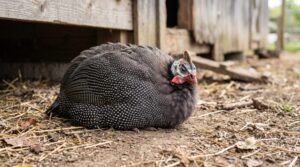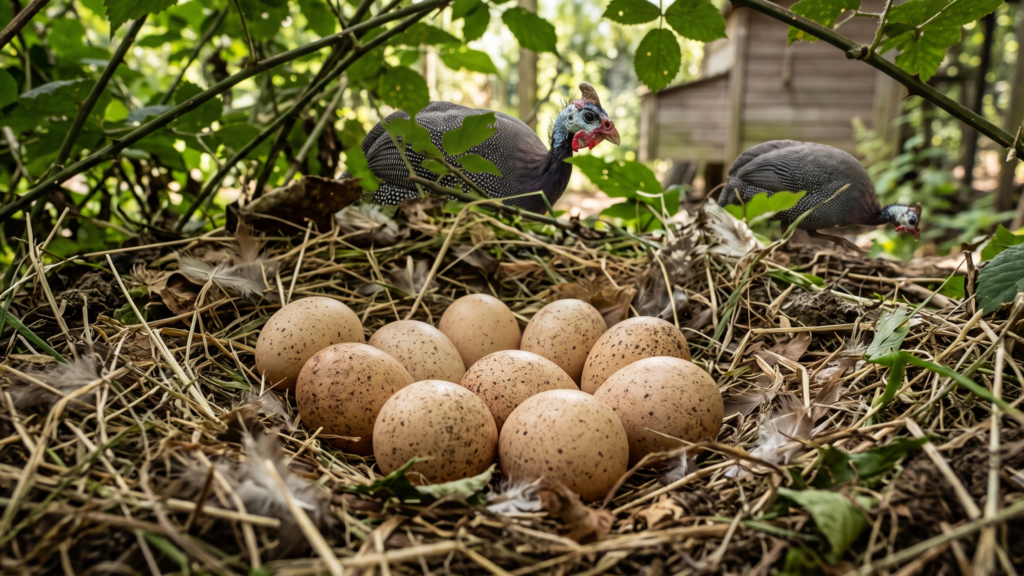
A healthy guinea hen typically lays somewhere between 80 and 180 eggs a year, with most backyard flocks landing around 100. Where a hen falls in that range comes down to her management, her age, and how closely you work with her natural laying season.
When I got my first guinea keets, I expected them to lay like my chickens did — steady, year-round, predictable. That’s not how it works. Guinea hens are seasonal layers, and once you understand their rhythm, the “how many eggs” question actually becomes pretty easy to answer for your own flock.
Here’s what actually shapes that number, and what you can realistically expect from your own guineas.
Free-range hens on pasture generally land at the lower end of production, while confined or well-managed flocks push toward the higher end.
| Management System | Typical Annual Eggs per Hen |
|---|---|
| Free-range, minimal management | 70–100 |
| Well-managed backyard flock | 100–130 |
| Confined/caged with controlled feeding | 150–180 |
| Research settings with lighting programs | up to 200 |
The Short Answer: What’s a Realistic Number?
If you’re keeping a small backyard flock and doing nothing special beyond feeding and basic housing, plan on around 100 eggs per hen per year. That figure comes up again and again in both poultry extension guidance and real keeper experience, and it’s the number I’d tell a new keeper to expect in their first season.
Birds on pure free range, foraging for most of their diet and facing more predator pressure and weather exposure, tend to land toward the lower end of that range, often closer to 70 to 100 eggs a year. Hens kept in cages or closely managed confinement with a controlled layer diet can do noticeably better, sometimes reaching 170 to 180 eggs annually. Some research trials using extended lighting and higher-protein diets have pushed annual output even further, close to 200 eggs, though that’s well beyond what most backyard setups attempt or need.
I’ve found my own flock settles right in the middle of that range most years. If yours does too, you’re right on track.
Why Guinea Fowl Don’t Lay Like Chickens
The biggest adjustment for anyone coming from chickens is accepting that guineas simply aren’t built for year-round laying. A few things drive that difference.
- They’re seasonal layers, not year-round producers. Guinea hens key off day length, so their laying window opens in spring and closes in fall. Most guineas start laying in April or May and continue through the warmer months, often into September or October.
- They lay in clutches, not a steady daily trickle. Rather than one egg a day indefinitely, hens tend to lay in clutches or groups at once, generally somewhere between 20 and 30 eggs per clutch.
- Broodiness interrupts the count. Once a hen finishes a clutch, she often goes broody and her egg production slows while she incubates. If she breaks out of broodiness, she’ll typically start another clutch.
- Daylight, not temperature, is the real trigger. This is why lengthening or shortening days matter more than a mild warm spell in late winter — the birds are responding to light, similar to chickens but with a narrower window of receptiveness.
If you’re weighing guineas against chickens for your setup, it’s worth reading our full comparison of guinea fowl vs chickens for profitability before you commit either way.
The Guinea Fowl Laying Season, Month by Month
Understanding the season helps explain why the annual total lands where it does.
- March–April: Laying typically begins as days lengthen, though first-year hens may start a bit later than established layers.
- May–August: This is peak production. Clutches build during this stretch, and during active laying it’s common for an adult hen to produce an egg nearly every day.
- August–October: Interestingly, some flocks see a secondary production peak here. Research on guinea fowl in a savanna zone found the peak of egg production actually occurred between August and October, coinciding with the peak of the rainy season — a reminder that local climate can shift the exact timing.
- October and beyond: Laying winds down as daylight shortens, and most hens stop entirely through winter.
That gives you roughly a six-to-nine month laying window rather than twelve, which is the core reason guinea totals land well below what a productive laying-hen chicken breed would produce in the same year. If you want to dig into how the calendar affects your birds more broadly, our seasonal care guide covers what to adjust as the year turns.
Factors That Change How Many Eggs You’ll Actually Get
Two flocks in similar climates can still post very different totals. Here’s what tends to move the number.
Age of the Hen
Production isn’t flat across a guinea hen’s life. Laying typically starts somewhere between 24 and 36 weeks of age depending on the variety — research comparing color varieties found pearl guinea fowl begin laying earliest, around 28 weeks, followed by lavender, then black, with white varieties starting latest, closer to 42 weeks. Once mature, hens usually hit their strongest production during their first two years, then gradually decline over the following seasons. I’ve noticed this firsthand — my oldest hens still lay, just less predictably and in smaller clutches than they did their first season.
If you’re deciding which variety to start with based on how quickly they’ll mature into layers, our guide to best guinea fowl breeds for meat and egg production breaks down those differences in more detail.
Housing and Management System
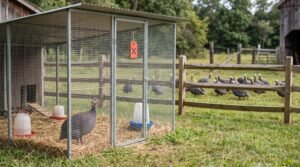
This is the single biggest lever you control. Confinement with a controlled diet consistently outperforms free range because hens aren’t spending energy foraging, avoiding predators, or roaming to find nest sites. That’s why confined-flock figures often run well above free-range figures in the same studies.
If you’re building or upgrading housing with production in mind, take a look at our guinea fowl housing guide for setup basics.
Diet and Protein Levels
Nutrition during the laying period matters more than most new keepers expect. Trials optimizing diet found that sexual maturity and egg production were strongest when hens consumed an 18% crude protein diet with roughly 2,750 kcal of metabolizable energy from 20 to 52 weeks of age. A basic scratch-and-forage diet simply won’t support the same output as a proper layer ration. For the full breakdown of what to feed at each life stage, see our guide on what guinea fowl eat.
Disturbance and Stress
Guinea hens are notably sensitive to disturbance, more so than chickens in my experience. Frequent handling, predator scares, or moving nest sites around can suppress laying or push a hen toward early broodiness. Experienced keepers consistently note that production is highly variable and depends heavily on how much a hen has been disturbed during the season. Keeping nesting areas quiet and predictable pays off in egg count.
Artificial Lighting
Because the trigger for laying is day length, extending light artificially can lengthen the season. Guinea fowl operations have used supplemental lighting to extend the laying period and improve early fertility. This is a common tactic in more intensive operations but works on a smaller scale too, if you’re set up to manage it safely.
How to Get the Most Eggs From Your Flock
If you want to push your hens toward the upper end of realistic production rather than the lower end, a few practical habits make a real difference.
- Collect eggs daily. This won’t increase how many a hen lays, but it prevents hidden clutches from triggering early broodiness and keeps eggs fresh for eating or hatching.
- Feed a proper layer ration during the season. Match protein levels to what the research supports rather than relying on forage alone.
- Minimize disturbance near nesting areas. Quiet, consistent surroundings encourage hens to keep returning to the same laying spot.
- Keep the flock in good body condition going into spring. Hens that enter the season underweight or stressed from winter tend to start later and lay less.
- Consider partial confinement during peak laying months. Even a few extra weeks of controlled conditions can meaningfully raise your seasonal total.
For a closer look at estimating output for your own setup, our guinea fowl egg production calculator can help you project what your flock size should realistically produce.
What This Means If You’re Planning a Flock
If eggs are your main goal, run the math on your own numbers before committing to a flock size. A hen averaging 100 eggs a year gives you roughly two eggs a week across the full year, but remember that’s compressed into a six-to-nine month window rather than spread evenly — so you’ll get a lot of eggs in early summer and very few from November through February.
That seasonality is worth planning around, whether you’re keeping guineas purely for home use or exploring whether guinea fowl farming is profitable at a larger scale. If hatching is part of your plan too, it’s worth reading up on guinea fowl egg incubation timelines so you know what to expect once the eggs start coming.
Frequently Asked Questions
Do guinea hens lay eggs every day? During peak season, yes — it’s common for a hen to lay nearly daily for weeks at a time before she finishes a clutch and goes broody. Outside the laying season, she won’t lay at all.
At what age do guinea hens stop laying well? Production is strongest in the first two years and then gradually tapers. Many hens continue laying in smaller numbers through four or five years of age, though clutch size and consistency both decline.
Can I get guinea fowl to lay in winter? Not under normal conditions — they’re seasonal layers triggered by day length. Extending light artificially in a controlled setting is the main way keepers have managed to shift or extend the season.
Why did my guinea hen suddenly stop laying? The most common causes are the end of her natural season, broodiness after finishing a clutch, or stress from a disturbance near her nest. If it’s mid-season and none of those fit, it’s worth reviewing her diet and body condition.
Have you tracked your own flock’s numbers through a full season? I’d love to hear how your hens’ totals compare — drop your experience in the comments, and if you’re still working out your setup, our getting started guide is a good next stop.
Hi, I’m Rayyan. I raise guinea fowl and share practical, research-backed guides for backyard keepers and homesteaders. I combine hands-on flock experience with trusted poultry management and university extension resources to help you raise healthier, more productive birds — with confidence, not guesswork.