Guinea fowl don’t need the heavy vaccination schedule chickens do, but that doesn’t mean you can ignore the question entirely. In most backyard and free-range setups, a healthy flock with good biosecurity gets by with little or no vaccination. In mixed flocks, high-density areas, or regions with known disease pressure, a few targeted vaccines — mainly Newcastle disease and sometimes fowl pox — are worth discussing with a poultry vet.
I raise guinea fowl alongside a small flock of chickens, and the first time I looked into vaccinating my keets, I expected a chart as detailed as the one I use for chicks. What I found instead was a lot of advice written for chickens and turkeys and stretched to fit guineas. So I dug through university extension publications, talked to my vet, and pieced together what actually applies to this species — what they’re naturally resistant to, which vaccines matter, when they’re given, and how to decide whether your flock needs them at all.
Guinea fowl are naturally hardier than most domestic poultry, so the goal here isn’t to scare you into a full vaccination program. It’s to help you make an informed call based on your specific setup — flock size, what else shares your property, and what diseases are active in your area.
Here’s a quick look at the vaccines most relevant to guinea fowl, when they’re typically given, and why:
| Vaccine | Typical timing | Why it matters for guineas |
|---|---|---|
| Newcastle disease (ND) | Day-old to 2–3 weeks, with boosters if in a high-risk area | Guineas are susceptible and can spread it to mixed flocks |
| Fowl pox | 6–16 weeks (wing-web method) | Recommended only where pox is already present locally |
| Coccidiosis prevention | Not a vaccine for most backyard keepers — managed through medicated starter feed or a coccidiosis vaccine at hatch if sourced from a hatchery offering one | Keets are vulnerable during the brooder stage |
| Fowl cholera | Only in flocks with a history of outbreaks | Bacterial, not commonly needed in small backyard setups |
Do Guinea Fowl Really Need Vaccines?
This is the question I get asked most, and the honest answer is: usually not, but it depends on your situation.
Guinea fowl descend from wild African birds that evolved without the kind of concentrated, high-density housing that makes vaccination essential for commercial chicken operations. That evolutionary background gives them a naturally hardy immune system, and they’re generally considered low-maintenance birds that don’t require the extensive vaccination program chickens or turkeys typically need.
That said, “don’t generally need” isn’t the same as “never need.” A few situations change the calculus:
- You keep guineas alongside chickens, turkeys, or other poultry. Mixed flocks share water, feeders, and roosting space, which means a disease introduced by one species can move through the others. If your guineas share space with other birds, some basic vaccination may reduce the risk of cross-species transmission.
- You’re in a high-density poultry area. If your property borders other flocks or you’re in a region with frequent outbreaks, exposure risk climbs regardless of how careful you are individually.
- A specific disease is already active locally. Extension guidance on fowl pox is consistent on this point: vaccinate if the disease is already present in your area, and skip it if it isn’t a local problem.
If none of these apply and your birds free-range in a low-density setting, you may not need to vaccinate at all beyond good sanitation and a solid guinea fowl feeding program to keep their immune systems strong.
Diseases That Actually Warrant Vaccination in Guinea Fowl
Guineas aren’t immune to poultry disease — they’re just less prone to some of the ones that hit chickens hardest. Here’s where vaccination genuinely makes sense.
Newcastle Disease
Newcastle disease is the one vaccine most extension sources agree is worth considering for guinea fowl, especially in mixed or high-exposure flocks. It’s a highly contagious viral disease, and guinea fowl are among the species known to be naturally susceptible to it, alongside chickens, turkeys, peafowl, pheasants, and quail.
Because it spreads easily between species, a guinea fowl that picks up Newcastle disease can become a vector even if its own symptoms are mild. That’s the main argument for vaccinating guineas in a mixed-flock setting — you’re protecting the whole property, not just the guineas. The University of Florida’s guide to common poultry diseases is a good reference if you want to see how Newcastle disease compares to other threats poultry keepers watch for.
Newcastle vaccines typically come as low-virulence live-virus products, and they can be given several ways — through drinking water, eye drops, nasal drops, or spray, with killed oil-emulsion versions reserved for later boosters before laying begins. For small flocks specifically, individual eye-drop administration tends to give more reliable results than mass methods like spray or medicated water, which are built for large commercial operations.
Fowl Pox
Fowl pox is a slow-moving viral disease spread mainly by mosquitoes, and it affects a wide range of bird species. It rarely kills outright, but it can knock down feed intake, growth, and egg production for weeks. Guinea fowl aren’t singled out as unusually vulnerable to it, but they aren’t exempt either — the pox virus family affects a wide range of birds, and vaccination is generally advised only when the disease is already circulating in your area.
If you decide to vaccinate, it’s done using the wing-web method, where a two-pronged applicator delivers vaccine through the wing membrane, usually administered at 6–8 weeks of age or earlier in mosquito-heavy regions. A successful vaccination shows up as a small swelling or scab at the site within about a week, which is how you confirm the vaccine actually took. Mississippi State University Extension has a detailed breakdown of fowl pox management that’s worth a look if you want more on how the “take” is checked.
Coccidiosis
Coccidiosis isn’t a viral disease you vaccinate against in the traditional sense for most backyard flocks — it’s a parasitic gut infection, and it’s one of the more common health issues in young keets during the brooder stage. Some hatcheries offer a coccidiosis vaccine administered at hatch, but far more common is prevention through medicated starter feed and clean, dry bedding that limits oocyst buildup. If you’re sourcing keets from a hatchery, it’s worth asking directly whether they vaccinate against coccidiosis before the birds ship, since that affects whether you need medicated feed afterward.
Fowl cholera, avian encephalomyelitis, and infectious bronchitis vaccines exist and are used in commercial poultry, but they’re not standard recommendations for backyard guinea fowl unless your flock or region has an active history of the disease. The general rule across extension guidance: don’t vaccinate for a disease you haven’t had a problem with locally — it adds cost and handling stress without a clear benefit.
Guinea Fowl Vaccination Schedule by Age
If you and your vet decide vaccination makes sense for your flock, here’s roughly how the timing breaks down. Treat this as a starting framework, not a substitute for guidance tailored to your region and hatchery source.
- Day-old to 1 week: Some hatcheries administer a Newcastle/bronchitis combination vaccine before keets ship, particularly for larger batches. Ask your hatchery directly what, if anything, they’ve already given the birds.
- 1–3 weeks: If Newcastle disease is a concern in your area, this is the window where an eye-drop or drinking-water vaccine is typically introduced for keets not already covered at the hatchery.
- 3–4 week intervals through early growth: Booster timing for live-virus Newcastle vaccines generally follows a repeat schedule every few weeks through the early growth period, tapering off as the birds mature — though the exact interval depends on the specific product label.
- 6–8 weeks: Fowl pox vaccination, if needed, is typically given in this window via the wing-web method.
- 12–16 weeks and beyond: By this point most guinea fowl that needed baseline vaccination have completed the primary series. Ongoing boosters, if any, are usually reserved for breeding or laying birds in higher-risk situations.
This schedule is built around what’s documented for poultry generally, since guinea-fowl-specific vaccine trials are limited. Your best move is a conversation with a vet who has poultry experience — they can tell you what’s actually circulating locally. I keep a simple written log of what’s been given and when for my own flock, which has saved me more than once when a vet asked about prior history.
How Vaccines Are Actually Administered
Understanding the delivery method matters almost as much as the timing, because getting it wrong can mean the vaccine doesn’t take.
- Eye drop (intraocular): The most reliable method for small flocks. Each bird gets an individual dose, so you know exactly who’s covered.
- Drinking water: Convenient for larger groups, but harder to dose evenly — some birds drink more than others, so coverage can be inconsistent.
- Spray or nasal drops: Common in commercial settings, less practical for a small backyard flock without the right equipment.
- Wing-web (for fowl pox): A two-pronged needle delivers vaccine through the wing membrane. You’ll check for a “take” — a small scab or swelling — about a week later to confirm it worked.
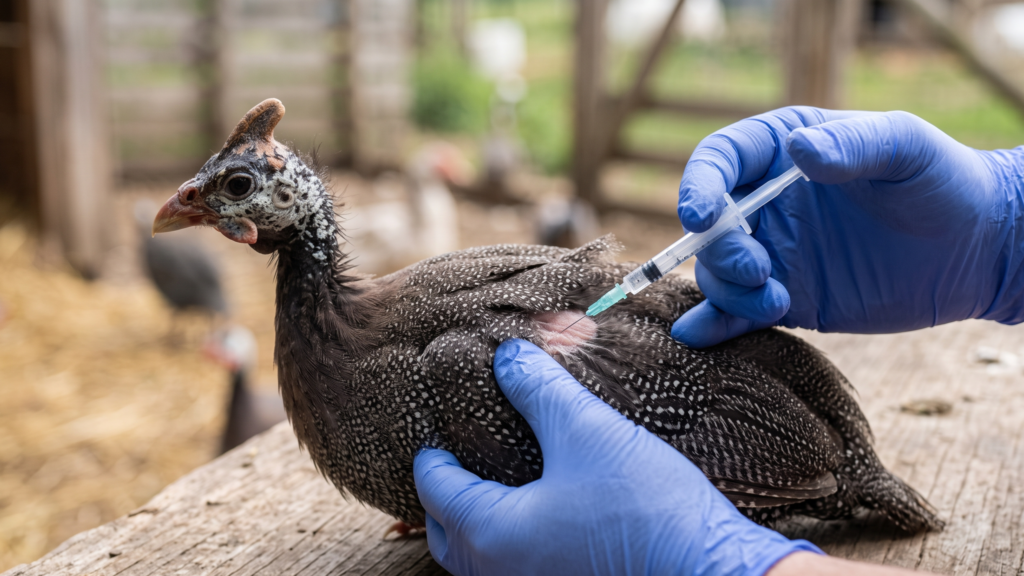
- Injection (subcutaneous or intramuscular): Used for killed, oil-emulsion vaccines, typically as a later booster rather than an initial dose.
Whatever method you use, healthy birds only. Live vaccines cause a mild, controlled version of the disease to build immunity, and a bird that’s already stressed, underweight, or fighting something else may not handle that well.
Vaccinating vs. Relying on Natural Resistance
I get why a lot of keepers land on “skip it” for guinea fowl — and for many flocks, that’s a reasonable call. But it helps to be clear-eyed about the trade-off rather than assuming hardiness means immunity.
Reasons to lean on natural resistance:
- Guinea fowl generally handle common poultry diseases better than chickens do.
- Free-range birds with low flock density and no contact with outside poultry face lower exposure.
- Vaccination adds cost, handling stress, and — for live vaccines — a small window where birds show mild symptoms.
Reasons to vaccinate anyway:
- You keep guineas with chickens or other poultry that do carry disease risk.
- Newcastle disease specifically can move through mixed flocks quickly, and guineas can be carriers even with mild symptoms.
- You’re bringing in new birds regularly, which increases the odds of introducing something from outside.
If you’re still weighing whether guinea fowl fit your setup at all, it’s worth reading through the trade-offs in our guide to guinea fowl pros and cons before you get to the vaccination question.
Signs a Vaccine Didn’t Take (Or Something Else Is Wrong)
Even with a well-timed vaccination, things don’t always go as planned. Watch for:
- No scab or swelling at a wing-web pox vaccination site after 7–10 days — this usually means the vaccine didn’t take and revaccination may be needed.
- Lethargy, loss of appetite, or labored breathing more than a day or two after vaccination, which can point to a separate illness rather than a normal reaction.
- Sudden deaths in a flock that was recently vaccinated — this needs a vet’s attention immediately rather than being written off as a vaccine reaction.
If you’re noticing symptoms that don’t line up with a simple vaccination reaction, it’s worth cross-checking against our broader rundown of guinea fowl diseases, symptoms, and treatment before assuming the worst.
Building a Vaccination Plan That Fits Your Flock
There’s no single schedule that applies to every keeper, because the right answer depends on flock size, what else lives on your property, and what’s circulating in your region. For a lot of small, free-range setups, good housing and biosecurity do more heavy lifting than any vaccine would. For mixed flocks or higher-risk areas, Newcastle disease protection is the one most worth a serious conversation with your vet.
Start by figuring out what’s actually a risk where you live — a quick call to a local poultry vet or your extension office will tell you more than any generic schedule can. From there, keep records of what you give your birds, and don’t vaccinate against something that isn’t a real risk on your property.
Has your flock ever dealt with an outbreak that changed how you think about vaccination? I’d like to hear what worked and what didn’t — it’s the kind of practical detail that doesn’t show up in most guides.
FAQ
Can I vaccinate guinea keets alongside chicks in a mixed brooder? Yes, but dose them individually rather than assuming a chicken schedule transfers exactly. Ask your vet or hatchery about combined brooding, since crowding stress can affect how well a vaccine takes.
Is it too late to vaccinate an adult guinea fowl that was never vaccinated as a keet? Not necessarily. Adults can still receive Newcastle or fowl pox vaccines, though timing and dosing are worth confirming with a vet since most schedules are built around young birds.
Do vaccinated guinea fowl still need biosecurity measures? Yes. Vaccination reduces risk for specific diseases, but it doesn’t replace clean housing, quarantine for new birds, or pest control — it’s one layer, not the whole strategy.
Will vaccinating affect my guinea fowl’s eggs or meat? Standard backyard poultry vaccines aren’t a food-safety concern once birds are past the withdrawal window on the product label. If you’re raising for eggs or meat production, check that label, though it’s rarely an issue with the vaccines discussed here.
Hi, I’m Rayyan. I raise guinea fowl and share practical, research-backed guides for backyard keepers and homesteaders. I combine hands-on flock experience with trusted poultry management and university extension resources to help you raise healthier, more productive birds — with confidence, not guesswork.