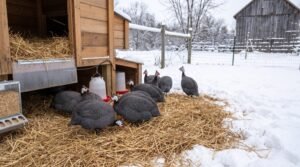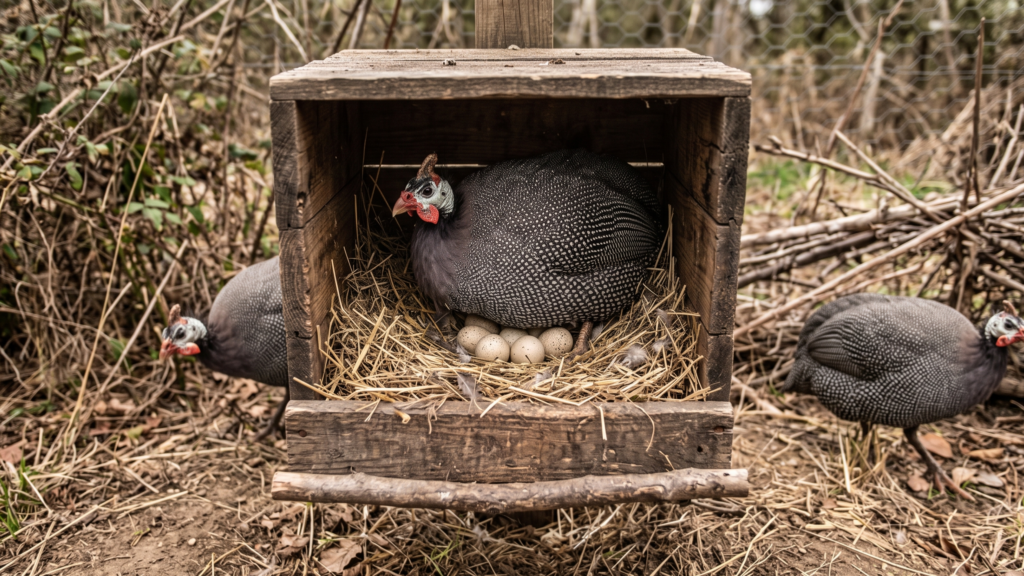
Most guinea fowl won’t use a nesting box even if you build them a perfect one. They’re ground nesters at heart, and given the choice, they’ll almost always pick a hidden spot outdoors over a box in the coop.
That surprises a lot of new keepers, especially if they’ve kept chickens before and expect the same tidy row of eggs every morning. Guineas just don’t think that way. I learned this the hard way in my first season, when I built a beautiful bank of nest boxes along one wall of the coop and my hens ignored every single one of them in favor of a spot behind the compost bin.
Here’s what’s actually going on, why it happens, and what you can do if you still want your eggs somewhere you can find them.
- Guinea fowl are ground-nesting birds by instinct, and most won’t use a box no matter how well it’s built.
- They prefer hidden, communal nests with good sightlines and an escape route, often shared by several hens.
- Confining hens to the coop until midday is the most reliable way to get eggs laid somewhere accessible.
- Guineas raised alongside chickens, or hatched by a broody hen, are more likely to accept a box.
- Disturbing a nest too often will cause a hen to abandon it and start a new one elsewhere.
Why Guinea Fowl Ignore Nesting Boxes
Chickens evolved in dense jungle cover and naturally look for an enclosed, elevated spot to lay in — which is exactly what a nest box mimics. Guinea fowl come from a completely different background. Their wild ancestors are native to the grasslands and scrub of sub-Saharan Africa, where nesting in the open, low to the ground, was the safer strategy.
That instinct hasn’t gone anywhere just because the birds are now living in your backyard. Guineas want a nest site with a clear line of sight around them and a quick way out if a predator shows up. A box tucked into a corner of the coop checks neither of those boxes, literally. It feels closed-in and exposed to a bird that’s wired to want the opposite.
If you’ve spent time on my guide to guinea fowl behavior and flock management, you’ll recognize this as part of a bigger pattern. Guineas are simply more instinct-driven and less domesticated in their habits than chickens, even after generations of backyard breeding.
What a Guinea Fowl Nest Actually Looks Like
In the wild — and in most backyard setups — a guinea hen’s nest is nothing more than a shallow scrape in the ground, lined with whatever grass or straw happens to be nearby. Sometimes there’s no lining at all. You won’t find raised edges, walls, or a roof unless the hen happens to nest under something like a shed, a fallen branch, or a dense shrub.
A few things that make guinea nests distinct from what you’d expect with chickens:
- They’re communal. Several hens will often lay in the same hidden nest, which is why you might suddenly find a stash of 40 or 50 eggs in one spot instead of a handful.
- They’re extremely well hidden. Guineas are genuinely good at finding secret spots — under log piles, in tall grass along a fence line, behind outbuildings, or tucked into a hedgerow.
- They’re abandoned if disturbed. A guinea hen that sees you collecting her eggs will often refuse to return to that nest and will start a new one somewhere else instead.
- They don’t bury eggs. Unlike some other ground-nesting birds, guineas leave their eggs sitting on the surface of the nest rather than covering them.
This is worth keeping in mind if egg hunting turns into a regular part of your routine during laying season, which typically runs from spring through early fall.
When Guinea Fowl Will Actually Use a Nesting Box
It’s not a hard rule that guineas never touch a nest box — it’s more that most won’t, unless the circumstances nudge them in that direction. A few situations tend to change the odds:
- Mixed flocks with chickens. Guinea hens housed with laying chickens sometimes pick up the habit simply by watching the chickens use the boxes day after day.
- Guineas raised by a broody hen. Keets hatched and raised under a chicken tend to adopt more chicken-like habits as adults, including a higher chance of laying in a box or on the coop floor rather than hunting for a hidden outdoor spot.
- Confined flocks with no outdoor access. A hen with nowhere else to go will eventually lay somewhere inside the coop, even if the box itself isn’t her first choice.
Even in these cases, don’t be surprised if the hen lays on the floor next to the box rather than inside it. I’ve had guineas that were raised alongside my chickens still choose a corner of the coop over the box sitting right there. Close enough counts as a win in guinea keeping.
How to Encourage Guinea Fowl to Lay Where You Can Find Their Eggs
If chasing down secret nests across the property isn’t realistic for you, there are a few reliable ways to improve your odds of collecting eggs without needing the hens to cooperate with a nest box specifically.
- Confine hens until midday. Guinea hens typically lay their egg for the day by late morning to early afternoon. Keeping the flock shut in the coop or run until around noon is the single most effective way to get eggs laid somewhere accessible, since the hen simply doesn’t have anywhere else to go.
- Create a hidden spot inside the coop. Since guineas want cover and a sense of security, try setting up something low and enclosed rather than a raised box — a dog crate with the door facing a wall, straw piled behind a leaned sheet of plywood, or hay bales stacked into a corner all work better than a standard box.
- Leave a decoy egg in place. Never empty a nest completely. Guinea hens will abandon a nest that suddenly looks empty, so leaving at least one egg (a fake or wooden egg works fine) helps convince her the spot is still safe to return to.
- Collect eggs consistently and quietly. Try to gather eggs at the same time each day, and avoid doing it while the hens are nearby watching. The less disturbance a nest experiences, the longer a hen will keep using it.
- Start young if egg collection matters to you. Keets raised from a young age in the coop, especially alongside chickens, are more likely to grow into hens with laying habits you can actually work with.
None of these guarantee a hen will start using an actual box, but they’ll get you a lot closer to predictable, collectible eggs than hoping instinct changes on its own.
Do You Even Need to Install Nest Boxes for Guinea Fowl?
Honestly, for guineas alone, probably not. Most keepers find it’s not worth the material or the coop space, since the birds tend to ignore them regardless of how nice they’re built. Poultry extension guidance generally notes that standard chicken-style boxes will work fine if you decide to add them, and that shutting hens into the coop until midday is what actually cuts down on eggs being laid in hidden outdoor spots — the confinement is doing the real work here, not the box itself.
If you’re planning a guinea fowl coop, your money and effort are better spent on solid roosting bars, since guineas roost far more readily than they nest indoors, plus a low, hidden corner where a hen might feel safe enough to settle. Save the dedicated nest boxes for a mixed flock where your chickens will actually use them.
If you do want to give a box a shot anyway — maybe you’re running a mixed flock, or you just want to cover your bases — keep it low to the ground rather than raised, and tuck it into the darkest, most enclosed corner of the coop you can manage. That’s about as close to a guinea’s natural preference as a manufactured box is going to get.
Final Thoughts
Guinea fowl are ground nesters by nature, and no amount of clever box design is likely to override that instinct on its own. If eggs matter to you, focus less on the box and more on confinement, cover, and consistency — that combination will get you further than any coop upgrade. If you free-range your flock, expect a bit of a treasure hunt each season, and don’t take it personally when your hens choose the compost pile over the accommodations you built them.
Have you had any luck getting your guineas to use a nest box, or do you spend your spring hunting through the hedgerows like the rest of us? I’d love to hear what’s worked in your own setup. For more on getting your flock’s housing right from the start, take a look at my guide to guinea fowl housing and coop requirements.
FAQ
Do guinea keets need a nest box? No. Keets don’t lay eggs, so nest boxes are irrelevant until hens reach laying age, typically around 28 to 30 weeks old.
Will guinea fowl lay eggs on the coop floor instead of a box? Yes, this is actually one of the more common outcomes. Even guineas raised in close contact with chickens often choose a corner of the floor, especially if there’s straw or bedding piled up, over the box itself.
Can I use the same nest box for both chickens and guinea fowl? Yes, and it sometimes helps. Guinea hens housed with chickens occasionally start using the boxes simply by following the chickens’ example, though there’s no guarantee.
Why did my guinea hen suddenly stop using a nest I found? She likely noticed you collecting her eggs. Guinea hens are quick to abandon a disturbed nest, so always leave at least one egg behind and try to collect quietly when the hen isn’t watching.
Hi, I’m Rayyan. I raise guinea fowl and share practical, research-backed guides for backyard keepers and homesteaders. I combine hands-on flock experience with trusted poultry management and university extension resources to help you raise healthier, more productive birds — with confidence, not guesswork.