
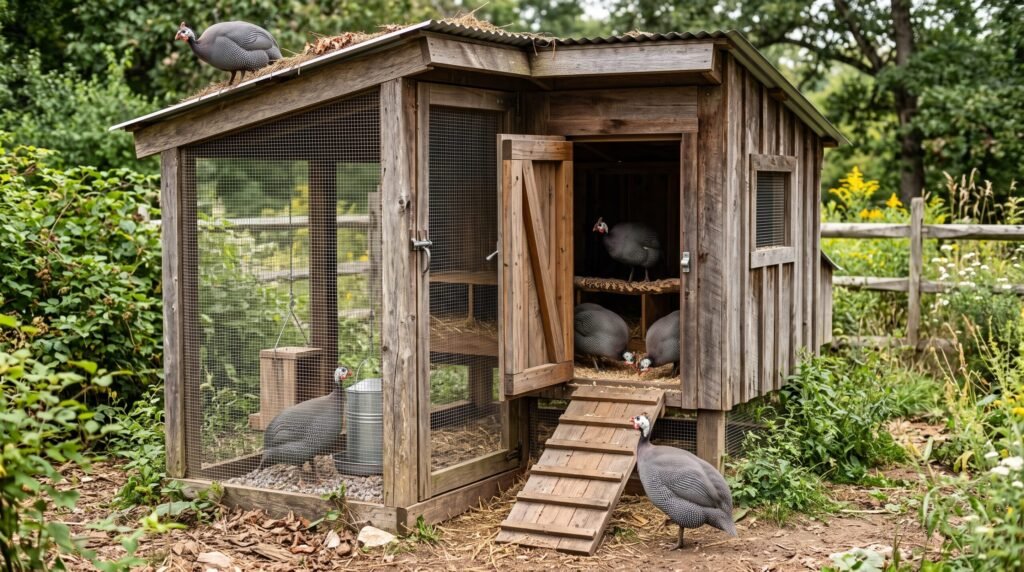
If you’re building housing for guinea fowl, the short answer is this: they need more height, more flight-proofing, and tougher predator defenses than a standard chicken coop, with roughly 4 square feet of indoor space per bird and roosts set at least 4 to 6 feet up. Beyond that baseline, there’s a lot of room to get creative with the actual structure.
I’ve built and modified more guinea housing than I care to admit, starting with a converted doghouse that my first six keets outgrew in about eight weeks. Guineas aren’t chickens with spots — they think differently, fly better, and will find every weak point in a coop you didn’t know was there. The style you pick matters less than getting a handful of details right: height, ventilation, and predator-proofing from every angle, including underground.
Here are ten coop styles that actually work for guinea fowl, what each costs to build, who it fits best, and the setup details that separate a coop your flock uses every night from one they ignore in favor of a tree branch.
Here’s a quick look at how the ten styles stack up before we get into details:
| Coop Style | Best For | Approx. Build Cost | Skill Level |
|---|---|---|---|
| A-frame coop | Small flocks (4–8 birds), mild climates | $150–$400 | Beginner |
| Converted shed | Established flocks, harsh winters | $300–$1,000+ | Beginner–Intermediate |
| Walk-in barn coop | Large or mixed flocks | $800–$2,500+ | Intermediate |
| Chicken tractor (mobile) | Pasture rotation, pest control | $200–$600 | Intermediate |
| Pallet coop | Tight budgets | $0–$150 | Beginner |
| Elevated coop on legs | Wet or flood-prone ground | $250–$700 | Intermediate |
| High-roost aviary coop | Large flocks, breeding pairs | $600–$1,800 | Intermediate–Advanced |
| Repurposed dog kennel | Fast setup, small starter flocks | $100–$350 | Beginner |
| Hoop coop (livestock panel) | Flexible, expandable flocks | $300–$800 | Intermediate |
| Combination coop-and-run with attached garden fence | Free-range with a secure base | $400–$1,200 | Intermediate |
What Guinea Fowl Actually Need From a Coop
Guinea fowl retain a lot of wild instinct. They’re strong fliers, they don’t naturally seek shelter the way chickens do, and they genuinely prefer height. Any coop design has to work with those instincts instead of against them. A few non-negotiables apply no matter which style you choose:
- Indoor floor space: Most experienced keepers and guinea-specific resources land on roughly <cite index=”1-1″>4 square feet per bird inside the coop</cite>, though a wider range of 3 to 5 square feet shows up depending on climate and how much time birds spend confined.
- Height: Guineas like to roost high, so interior height matters more than it does for chickens. A coop should be <cite index=”1-1″>at least 6 feet tall to allow for roosting poles at different heights</cite>, and taller is better if you have adult birds that free-range during the day and just need a night shelter.
- Roosting bars: Place perches starting around 4 feet off the ground and up, since <cite index=”1-1″>guineas prefer high perches</cite> and will pick a tree branch over a low bar every time.
- Ventilation: Ammonia buildup is a real respiratory risk — University of Kentucky’s poultry extension program notes that damp litter and poor airflow in a guinea house can lead directly to respiratory problems. A reasonable target is <cite index=”6-1″>one square foot of ventilation per 10 square feet of coop floor space</cite> in moderate climates, with more airflow in hot, humid regions.
- Predator-proofing: Never use chicken wire as your primary barrier. <cite index=”1-1″>Hardware cloth is essential — chicken wire is too weak to keep predators out</cite>, and any outdoor run needs a covered top, since guineas can fly and a determined hawk or owl won’t hesitate to test an open one.
If you’re mapping this to your own flock size before committing to a design, our coop size calculator will do the square-footage math for you based on your bird count.
1. The Classic A-Frame Coop
The A-frame is probably the most common DIY guinea coop, and for good reason. The triangular shape sheds rain and snow well, uses less material than a box structure, and the peaked roof naturally gives you extra headroom for high roosting bars right where guineas want them.
Most builds start with a simple lumber frame, hardware cloth walls, and a solid or shingled roof. You can build one from <cite index=”16-1″>recycled wood from a scrapyard</cite> to cut costs, though reclaimed lumber usually needs a coat of paint or sealant if it isn’t already treated. In colder regions, close off a section at the back under the roof so birds have a wind-blocked spot to huddle in overnight — an open A-frame works fine in mild climates but leaves birds exposed in a hard freeze.
Setup tips:
- Size the base at roughly 4 square feet per bird, then add a few extra feet for a comfortable margin.
- Dig a shallow foundation trench if you’re in an area with digging predators; otherwise the frame can sit directly on the ground in low-risk areas.
- Install roosting bars near the peak, where the extra height naturally invites birds to climb higher.
This style pairs well with our 10 Guinea Fowl Mistakes Every Beginner Should Avoid guide if you’re building your first coop — a lot of the mistakes on that list are easy to sidestep at the design stage.
2. Converted Shed or Outbuilding
If you already have a garden shed, an old playhouse, or any small outbuilding sitting unused, converting it is often the fastest, sturdiest option. One keeper I came across online housed six to eight guineas comfortably in an <cite index=”13-1″>8x8x8 shed-type building</cite> with room to spare — proof you don’t need a purpose-built structure to get this right.
Conversion usually means cutting in ventilation openings, reinforcing weak points in the walls or floor with hardware cloth, adding roosting bars, and installing a secure, guinea-sized door. Sheds tend to have solid roofs and walls already, which solves a lot of the aerial-predator problem other coop styles have to build in from scratch.
Setup tips:
- Check the floor for gaps or rot before moving birds in — a solid floor is one of your best defenses against digging predators.
- Add vents high on the walls, covered with hardware cloth, to keep airflow moving without creating a predator entry point.
- If the shed door is a standard human-sized door, consider adding a smaller guinea-access door for daily use so you’re not letting in drafts every time you check on the flock.
This is also a solid option if you’re transitioning from an existing chicken coop — our Guinea Fowl Housing Guide covers how guinea needs differ from what a standard chicken coop already provides.
3. Walk-In Barn-Style Coop
For larger or mixed flocks, a walk-in barn-style coop makes daily care dramatically easier. Standing upright inside means faster cleaning, easier egg collection, and simpler repairs — things you’ll appreciate once you’re doing them regularly through a whole season.
These coops are usually framed like a small barn, with a peaked or gambrel roof for extra vertical space, solid exterior walls, and generous hardware-cloth vents near the roofline. The added interior volume makes ventilation planning even more important — stale air pools in the upper corners of a tall structure if you don’t give it somewhere to escape.
Setup tips:
- Budget close to 4 square feet per bird as a floor-space minimum, then round up if you plan to keep the flock confined during bad weather.
- Add ridge vents or high gable vents, since heat and ammonia both rise and need an exit point above the roost line.
- If you’re housing guineas alongside chickens or ducks, give guineas their own elevated roosting section — they don’t love sharing low perches with other species.
If mixed-species housing is on your mind, it’s worth reading:
Can Guinea Fowl Live with Chickens, Ducks, and Turkeys?
4. Mobile Chicken Tractor
A chicken tractor — a bottomless, movable coop-and-run combo — works surprisingly well for young guineas or smaller flocks you want to rotate across pasture. I raised my first batch of keets in a converted doghouse and wire tractor, and moving it every week or two kept the ground underneath green and pest-free in a way a stationary run never quite matched.
The mobility is the whole point: guineas are voracious tick and insect eaters, and a tractor puts that instinct to work across your whole property instead of concentrating it in one spot. This style suits younger or smaller flocks better than full-grown, free-ranging adults, since a tractor’s footprint is naturally limited.
Setup tips:
- Keep the structure light enough for one or two people to move without disassembling it.
- Add wheels or skids on one end to make relocation faster.
- Cover the entire top and sides with hardware cloth — a tractor’s low profile makes it more vulnerable to digging predators than a permanent coop with a buried apron.
For more on how this pest-control benefit plays out at scale, see:
Guinea Fowl for Tick Control: Do They Really Work?
5. Budget Pallet Coop
If cost is the main obstacle, wooden pallets are one of the cheapest ways to build guinea housing, and sometimes free if you can source them locally. The tradeoff is labor: pallets take time to disassemble, and you’ll need to sand or treat the wood if it’s rough or splintering.
A pallet coop typically starts with four to six pallets stood on end and framed into a box or A-frame shape, then covered with hardware cloth and a scrap-wood or tin roof. It’s not going to look polished, but a well-built pallet coop can be just as secure as a store-bought one if you’re diligent about closing gaps.
Setup tips:
- Inspect pallets before using them — avoid any stamped with chemical treatment codes not rated for animal contact.
- Fill gaps between pallet slats with hardware cloth rather than leaving them open; predators and rodents will find any opening wider than about half an inch.
- Add a solid roof panel rather than relying on pallet wood alone, since pallets aren’t naturally waterproof.
6. Elevated Coop on Legs
If your property floods, sits on low ground, or just stays damp much of the year, raising the coop off the ground solves a handful of problems at once. It keeps bedding drier, makes it harder for burrowing predators to get underneath, and improves airflow beneath the structure.
The main design consideration is the ramp. Guineas are flighty by nature, and a steep, narrow ramp will make them reluctant to use it. <cite index=”6-1″>Make it a nice wide ramp of gentle slope</cite> — during training especially, a small door and steep incline will trigger their flight instinct instead of encouraging them in. It also helps to <cite index=”6-1″>close off the underneath space</cite> of the ramp, since otherwise you’ll spend a lot of frustrating evenings chasing birds in circles under the coop instead of into it. This general guidance lines up with what Virginia Tech’s small-scale poultry housing guide recommends for keeping coop floors elevated and well-drained on damp or low-lying ground.
Setup tips:
- Elevate the floor 12 to 18 inches at minimum — enough to deter digging without making the ramp awkwardly long.
- Use a ramp with cross-cleats for grip rather than a smooth board.
- Skirt the area underneath with hardware cloth to prevent animals from denning beneath the coop.
7. High-Roost Aviary-Style Coop
For keepers with breeding pairs or larger flocks who want to lean into guinea behavior, an aviary-style coop with multiple roost heights gives birds the vertical space they naturally seek. Interior height for adult birds is ideally around <cite index=”2-1″>8 feet</cite>, well above the 6-foot minimum that works for smaller setups.
This style uses tiered roosting bars — some lower, some near the ceiling — so birds sort out their own pecking-order preferences without crowding. It’s more material and labor than a basic A-frame, but if guineas keep refusing to settle in a shorter coop, added height is often the fix.
Setup tips:
- Stagger roosting bars at multiple levels rather than one uniform row, since guineas will naturally spread themselves across different heights.
- Use a sturdy roofing material — <cite index=”2-1″>light garden netting is not sufficient</cite> against aerial predators or a determined guinea trying to fly straight up.
- If you’re planning to hatch and raise keets in the same structure, review How to Raise Guinea Fowl Keets: Week-by-Week Care Guide for how brooding space needs differ from adult housing.
8. Repurposed Dog Kennel or Rabbit Hutch
A secondhand dog kennel or oversized rabbit hutch can become a functional guinea coop with minimal modification — one of the fastest ways to get a small starter flock housed securely. Kennel wire is usually too flimsy or widely spaced on its own, so the main job is reinforcing it.
Setup tips:
- Line the entire structure with hardware cloth, even if the kennel wire looks sturdy — most kennel-grade wire isn’t rated to stop small predators.
- Add a solid roof panel if the kennel doesn’t already have full weather cover, since most are designed for daytime use, not overnight shelter.
- Check total floor space against your flock size before assuming a kennel will work — many are sized for one or two dogs, not four to six birds at 4 square feet each.
9. Hoop Coop Using Livestock Panels
Cattle or hog panels bent into a hoop shape and covered with hardware cloth make a surprisingly sturdy, flexible coop frame. The curved shape sheds weather well, and you can extend the hoop’s length easily as your flock grows — harder to do with a fixed-wall structure.
Setup tips:
- Anchor panel ends firmly into the ground or attach them to a wooden baseboard frame for stability in wind.
- Cover the full hoop with hardware cloth rather than tarp alone — tarp keeps rain out but won’t stop a determined predator.
- Leave one end open for a walk-in door, framed and hinged separately from the hoop itself.
10. Combination Coop-and-Secure-Run Setup
This isn’t a single structure so much as a design philosophy: a smaller, weatherproof coop for nighttime roosting attached to a larger, fully enclosed run for daytime activity. It’s the setup most established keepers land on eventually, since it balances security with the space guineas need to actually be guineas.
The coop itself can be any of the styles above, scaled to roughly 4 square feet per bird. The attached run should be considerably larger — <cite index=”1-1″>10 square feet per bird</cite> is a reasonable minimum, and more is better if the birds will spend significant daytime hours confined rather than free-ranging. <cite index=”1-1″>Fencing height of at least 6 feet with a covered top</cite> is essential, since an open-top run is really just an invitation for guineas to fly out.
Setup tips:
- Build the run first if you’re on a tight budget, and add the coop structure once the perimeter is secure.
- Use a hardware cloth apron extending outward from the run’s base to stop digging predators — burying it <cite index=”21-1″>6 to 12 inches deep and 12 to 14 inches out</cite> is a standard, effective approach.
- Keep feed in metal, lidded containers overnight rather than leaving it in the run, since spilled feed draws rodents, and rodents draw the predators that eat rodents — and your birds.
If you’re weighing a fully enclosed run against letting your flock roam more freely, Free-Range vs Confined Guinea Fowl breaks down the tradeoffs in more depth.
Getting the Sizing Right for Your Flock
Whichever style you land on, sizing is where most first-time builders guess wrong — usually by underestimating how much guineas dislike feeling crowded. A rough starting point:
- Small flock (4–6 birds): 16–24 sq ft coop, 40–60 sq ft run
- Medium flock (8–12 birds): 32–48 sq ft coop, 80–120 sq ft run
- Large flock (15+ birds): 60+ sq ft coop, 150+ sq ft run
These numbers shift depending on climate, how much time birds spend confined, and whether you’re housing a mixed-species flock. If you want an exact figure for your specific bird count rather than working from these general bands, the calculator linked above will run the math for you in seconds.
Frequently Asked Questions
Do guinea fowl need nesting boxes in their coop? Not the way chickens do. Guinea hens often prefer to hide nests in tall grass or brush rather than use a box, though some will use one if it’s tucked into a quiet, low-traffic corner. Don’t build your coop around nesting boxes the way you might for a chicken coop.
Can I keep guinea fowl in a coop built for chickens? Sometimes, but it usually needs modification. Chicken coops are often too short for guinea roosting preferences and use wire that’s too weak to stop the predators guineas attract with their noise. Raising the roof height and swapping in hardware cloth are the two most common fixes.
How do I train guinea fowl to actually use the coop at night? Consistency and treats work better than force. Many keepers train their flock with a regular evening feeding time near or inside the coop, since guineas are food-motivated and will start associating the structure with a reliable meal rather than fighting their instinct to roost in a tree.
What’s the minimum coop height for guinea fowl? Six feet is the general minimum to allow for elevated roosting bars, with 8 feet being more comfortable for adult birds in larger flocks.
A good guinea coop doesn’t have to be fancy — it just has to respect how these birds actually behave: high roosts, real ventilation, and no weak points a raccoon or hawk can exploit. Whichever style fits your budget and property, get the basics right first and the rest tends to fall into place.
What coop style have you had the best luck with — or the worst? I’d love to hear what’s worked on your setup, and if you’re still deciding, the Guinea Fowl Coop Size Calculator is a good next stop before you start buying lumber.
Hi, I’m Rayyan. I raise guinea fowl and share practical, research-backed guides for backyard keepers and homesteaders. I combine hands-on flock experience with trusted poultry management and university extension resources to help you raise healthier, more productive birds — with confidence, not guesswork.
Thank you for all your information!