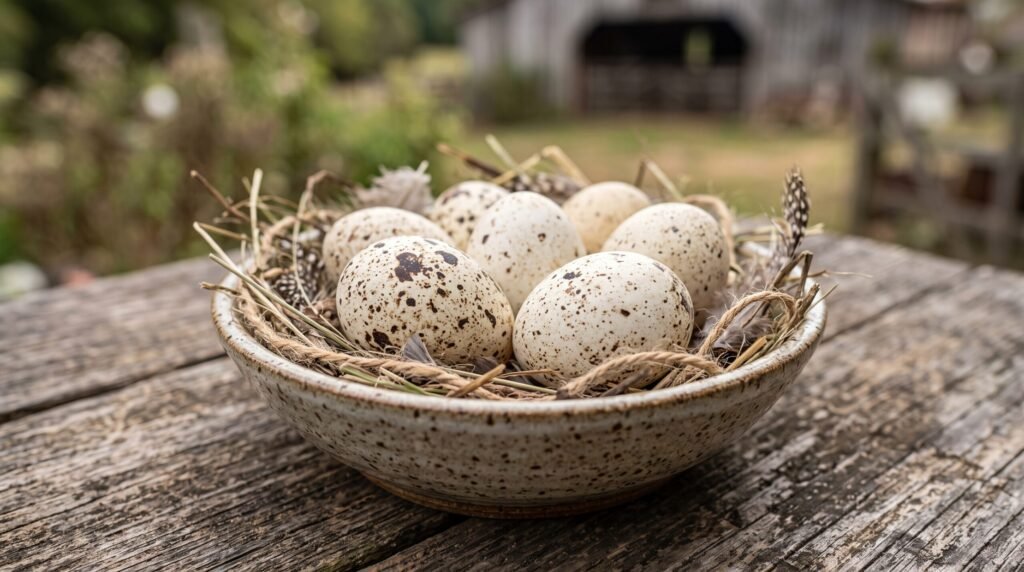
Guinea fowl eggs are richer and more concentrated than chicken eggs — smaller in size, but higher in protein and yolk content, with a dense, creamy texture that sets them apart at the table.
I didn’t start keeping guinea fowl for the eggs. I got them for the ticks and the noise-alarm effect on predators. The eggs were a bonus I didn’t expect to care about. Then I cracked one into a hot pan on a whim, and I understood pretty quickly why so many small-scale keepers end up rationing them instead of selling them.
This guide covers what guinea fowl eggs actually taste like, what’s in them nutritionally, who might benefit from adding them to their diet, and what to know before you start collecting your own.
Here’s a quick look at how guinea fowl eggs stack up before we get into the details:
| Trait | Guinea Fowl Egg | Chicken Egg (Large) |
|---|---|---|
| Average weight | 35–45 g | 50–60 g |
| Shell | Thick, hard, often speckled | Thinner, smoother |
| Yolk-to-white ratio | Higher yolk proportion | Lower yolk proportion |
| Flavor | Rich, dense, slightly gamey | Mild, neutral |
| Laying season | Spring through early fall | Year-round (with light) |
| Eggs per hen, per year | Roughly 80–130 | 250–300+ |
What Do Guinea Fowl Eggs Taste Like?
Guinea fowl eggs taste like a more concentrated version of a chicken egg. The white cooks up firmer, the yolk is deeper in color, and the overall flavor carries more depth without tipping into anything unpleasant or truly “gamey” in the way the meat sometimes does.
That richness comes down to proportion. A guinea egg has noticeably more yolk relative to white than a chicken egg does, and the yolk is where nearly all the flavor lives. Free-range birds intensify this further — a guinea fowl that spends its day hunting insects, seeds, and greens produces a yolk that’s deeper orange and more distinctly flavored than one from a bird on pellets alone.
Texture-wise, expect:
- A firmer white that holds its shape well in poaching or frying
- A denser, creamier yolk that some keepers compare to a duck egg
- A harder, thicker shell, which takes a bit more effort to crack cleanly
- A pointed end more pronounced than the typical chicken egg oval
I’ve served guinea eggs scrambled to guests who couldn’t immediately place what was different — they just knew it tasted “eggier.” That’s about the most accurate one-word description I’ve heard for it.
The flavor tends to track with how the birds are raised and fed, which is the same pattern you’ll see if you dig into what guinea fowl actually eat — foragers with varied diets consistently produce richer eggs than birds on feed alone.
Guinea Fowl Egg Nutrition Facts
Guinea fowl eggs are notably protein-dense, and research comparing them to chicken and quail eggs backs that up. One nutritional analysis found the whole guinea fowl egg contains roughly 13.6% crude protein and 12.1% fat by weight, with the remainder made up mostly of water. That protein concentration is part of why a small guinea egg can feel just as satisfying as a larger chicken egg.
The mineral profile stands out too. In a comparison across chicken, guinea fowl, and quail eggs, guinea fowl egg white had significantly higher potassium levels than either of the other two. Potassium plays a role in muscle function, nerve signaling, and fluid balance, so this isn’t a trivial difference.
A few other patterns show up consistently in comparisons with chicken eggs:
- Higher yolk-to-white ratio — more of the egg’s volume, and nutrition, sits in the yolk
- Comparable core nutrients to chicken eggs, including high-quality protein along with essential nutrients like vitamin B12, selenium, and riboflavin
- Denser fat content, contributing to the creamier mouthfeel
- Higher moisture in the white, which is part of why guinea whites can feel slightly looser when raw, even though they firm up well when cooked
It’s worth being honest about the state of the research here: guinea fowl eggs haven’t been studied nearly as extensively as chicken eggs, so exact values vary between the handful of available studies. What’s consistent across them is the direction — more protein, more fat, and a different mineral balance than a standard chicken egg, not a wildly different nutritional category.
For context on what a well-studied egg looks like nutritionally, standard chicken eggs are themselves a strong source of choline, selenium, and B12 — Healthline’s breakdown of egg nutrients puts a large boiled egg at roughly a quarter of the daily value for both selenium and vitamin B12. Guinea eggs generally track close to or above that baseline, just packaged in a smaller shell.
If you’re curious how egg output fits into the bigger picture of keeping guineas, it’s worth reading up on how many eggs guinea fowl actually lay per year before you start planning meals around your own flock.
Health Benefits of Guinea Fowl Eggs
None of this makes guinea fowl eggs a miracle food — they’re still an egg. But a few specific benefits are worth knowing if you’re deciding whether to work them into your diet.
Protein density in a smaller serving. Because guinea eggs run higher in protein by weight, two guinea eggs can deliver protein closer to what you’d get from one and a half chicken eggs, without the extra volume. That’s useful if you’re managing calories while still wanting a protein-forward breakfast.
A possible option for some chicken-egg-sensitive households. This is the one I’d flag most carefully. A clinical study involving 40 children with confirmed chicken egg allergy, all diagnosed with atopic dermatitis linked to chicken egg exposure, tested guinea fowl egg and meat as alternative foods over a 14-day period. The children who received guinea fowl egg showed tolerance, without a majority developing skin or gastrointestinal allergic reactions, and by the end of the study 73.3% showed decreased IgE antibody levels against chicken egg.
That’s a genuinely interesting finding, but it’s a single small study, not a green light. Guinea eggs are still bird eggs, and Allergy UK’s egg allergy factsheet advises avoiding all bird eggs, guinea fowl included, unless a specific type is known to be tolerated. If egg allergy is a concern in your household, this is a conversation for an allergist, not a substitution to try on your own first.
Nutrient density relative to size. The higher yolk proportion means a larger share of fat-soluble vitamins, choline, and minerals per egg, since the yolk is where most of those nutrients concentrate in any bird egg.
Naturally free-range nutrition, if your flock forages. Guinea fowl are relentless foragers by nature — one of the reasons so many keepers add them for tick and pest control in the first place. A flock that spends its days working through pasture, brush, and garden edges for insects and greens tends to produce richer, more nutritionally complete eggs than birds kept purely on commercial feed — the same principle that applies to pastured chicken eggs.
Guinea Fowl Eggs vs. Chicken Eggs: The Real Differences
The most common question I get from people considering guinea fowl is whether the eggs are actually “better,” and the honest answer is that they’re different, not strictly superior.
Guinea eggs win on flavor concentration and shell durability — that thick shell means fewer breakages in transport and a longer shelf life before quality drops. Chicken eggs win on sheer output; a guinea hen laying 80 to 130 eggs a year is nowhere close to a productive laying hen’s 250-plus, and guinea fowl are seasonal layers, so you’ll see almost nothing from late fall through winter.
If you’re deciding between the two birds for your own setup rather than just the eggs, it helps to look at the full picture of guinea fowl versus chickens — productivity, temperament, and cost — before committing to either. And if eggs alone aren’t the deciding factor, it’s worth knowing that guinea fowl meat is its own draw for a lot of keepers, priced and sold quite differently from the eggs.
Buying, Storing, and Cooking Guinea Fowl Eggs
Guinea fowl eggs aren’t something you’ll find at a regular grocery store. Your realistic sources are:
- Farmers markets during guinea fowl’s spring-through-fall laying season
- Local guinea fowl keepers — often the easiest route if you’re already in a homesteading or backyard poultry community
- Your own flock, if you’re raising or considering helmeted guinea fowl, the most common breed kept for eggs and meat in backyard setups
Because of the thick shell, guinea eggs hold up well in storage — often outlasting chicken eggs by a week or more under the same refrigerated conditions. In the kitchen, treat them as a slightly richer substitute for chicken eggs: two guinea eggs generally sub in for one large chicken egg in baking. For eating on their own, they hold their structure well in poaching, frying, and hard-boiling, and the dense yolk makes for a genuinely excellent custard or quiche base.
FAQ
Can you eat guinea fowl eggs raw?
You can, the same way you can eat any fresh, properly handled egg raw, but it’s not something I’d recommend as a habit. The thicker shell does offer somewhat better protection against bacterial contamination than a chicken egg, but raw eggs of any species carry some salmonella risk. Cooking removes that risk almost entirely.
Why are guinea fowl eggs hard to find in stores?
Guinea hens lay far fewer eggs per year than commercial laying hens, and only during the warmer months, so there’s never been enough volume to support large-scale retail distribution. Nearly all guinea fowl eggs move through farmers markets, direct farm sales, or small local networks instead. If you want a steady supply, raising a small flock yourself is often more realistic than trying to buy them regularly.
Do guinea fowl eggs taste different depending on the season?
Slightly, yes. Eggs laid early in the season, right as hens come back into lay, tend to have a milder flavor than eggs from birds that have spent a full summer foraging heavily. If your guineas are eating a lot of insects and greens by midsummer, expect the richest-tasting eggs around that point in the season.
Final Thoughts
Guinea fowl eggs are smaller than chicken eggs but pack more protein, more yolk, and a noticeably richer flavor into every one. They’re not going to replace chicken eggs as a daily staple for most households — the seasonal laying pattern and lower output see to that — but as an occasional addition, they’re worth trying if you can get your hands on them.
If you keep guinea fowl already, you likely know this firsthand. If you don’t yet, it’s one more reason people end up adding a few to their flock beyond pest control. Have you tried guinea fowl eggs, or are you still deciding whether to add guineas to your setup? I’d love to hear how they compare to what you’re used to.
Hi, I’m Rayyan. I raise guinea fowl and share practical, research-backed guides for backyard keepers and homesteaders. I combine hands-on flock experience with trusted poultry management and university extension resources to help you raise healthier, more productive birds — with confidence, not guesswork.