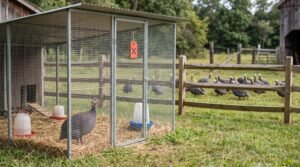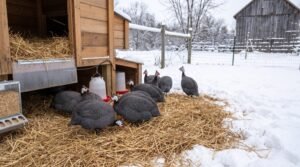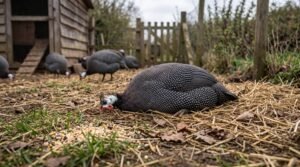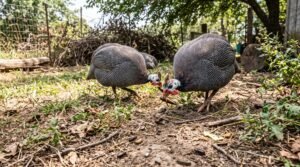
Guinea fowl can protect themselves better than most poultry, but foxes, hawks, and a handful of other regular visitors will still pick off birds if you leave the wrong gaps open. The short answer: secure nighttime housing with a buried or apron-style barrier stops ground predators, overhead netting or wire stops aerial ones, and closing the coop before dusk covers the hours when most losses actually happen.
I learned most of this the hard way, losing a hen to a red-tailed hawk that I was sure would just get chased off. It didn’t. Guineas are loud, alert, and genuinely useful as an early-warning system, but “alert” isn’t the same as “safe,” and treating them as predator-proof is how you end up short a bird.
Here’s what actually keeps a flock alive, broken down by the predators most likely to be watching your yard.
- Know your predators — foxes and raccoons dig and climb, hawks and owls strike from above, and each needs a different fix.
- Bury or apron your fencing — a buried skirt or 12–24 inch outward apron of hardware cloth stops diggers cold.
- Cover the run — netting or wire overhead keeps hawks from swooping in and owls from dropping down at dusk.
- Lock birds up at night — most predation happens between dusk and dawn, so a secure, latched coop matters more than anything else on this list.
- Add a guardian, if you can — a livestock guardian dog, donkey, or even geese adds a layer that fencing alone can’t.
Know What You’re Up Against
Guinea fowl face a wider range of predators than most backyard poultry keepers expect, and each one attacks differently. Knowing which predator you’re dealing with changes what kind of protection actually works.
Foxes and coyotes are patient, opportunistic diggers and jumpers. They’ll test a fence line for days before finding the one loose spot, and they’re perfectly capable of clearing a fence under four feet tall. Raccoons are worse in some ways — they’ll reach through wire mesh and grab birds, pulling them against the fencing to eat them even without ever getting inside the enclosure. Raccoons are also smart enough to work a simple latch, so a hook-and-eye closure won’t hold one out for long.
Hawks and owls split the daylight hours between them. Hawks and eagles hunt during the day and will often carry a smaller bird off to a nearby tree to eat it, while owls hunt at dawn, dusk, and through the night and have been known to enter coops after dark. If you find scattered feathers under a tree at the edge of your property, that’s usually the giveaway. One thing worth knowing before you get creative with deterrents: hawks, owls, and eagles are federally protected under the Migratory Bird Treaty Act, so trapping or killing them isn’t legal — exclusion is the only real long-term option.
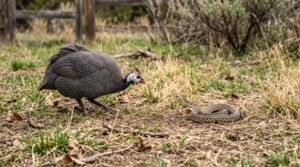
Then there’s the shorter list of opportunists — weasels, mink, snakes, and neighborhood dogs. Weasels can fit through gaps that would stop a raccoon, snakes go after eggs and keets more than adults, and loose dogs are more common in suburban and semi-rural areas than people expect. If you’re just getting your flock started, it’s worth building predator-proofing into your setup from day one rather than retrofitting it after a loss — our predator and pest control hub rounds up more species-specific guides if you want to dig deeper on any one threat.
Build a Coop and Run That Digging Predators Can’t Beat
Guinea fowl naturally want to roost off the ground, and giving them a secure structure to do it in solves most of your nighttime risk in one move. The materials you choose for the run matter as much as the coop itself.
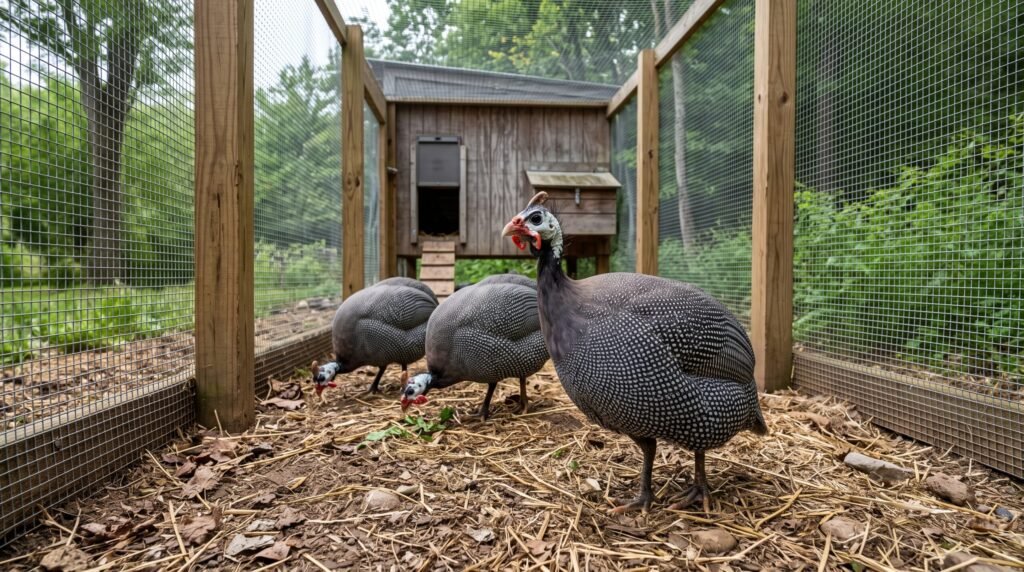
Skip chicken wire for anything but the top of the run — it keeps birds in, but it won’t keep a determined raccoon or fox out. Hardware cloth with a half-inch mesh or smaller is the standard recommendation, since it resists chewing and clawing far better than lighter wire. If you’re weighing coop materials for a build, our housing and coop setup guide walks through the options in more depth.
The part people skip — and the part that actually matters most — is what happens at ground level. Digging predators don’t try to climb your fence; they go straight for the base of it. Two approaches work:
| Method | How it works | Best for |
|---|---|---|
| Buried skirt | Hardware cloth sunk 6–12 inches straight down along the fence line | Permanent runs, smaller footprints |
| Apron | Hardware cloth laid flat on the ground, extending 12–24 inches outward from the base | Avoiding trench digging, sandy or rocky soil |
Both work on the same principle, and it’s a technique poultry extension programs consistently recommend: when a fox or raccoon starts digging right at the fence, it hits wire instead of open ground and gives up. An apron is often easier for backyard setups since it skips the trenching, and weighting it down with pavers, gravel, or soil keeps it in place. Whichever you choose, check it after heavy rain — erosion has a way of exposing the exact gap a predator needs.
A few more habits worth building in:
- Inspect fencing regularly for gaps larger than a quarter inch, especially where panels overlap.
- Reinforce corners and seams, since predators test weak joints before they test flat wire.
- Store feed in metal, lidded containers — spilled grain draws rodents, and rodents draw the predators that eat rodents.
- Use sliding bolts or carabiner-style latches rather than simple hooks, since raccoons can work basic hardware open.
Stop Hawks and Owls From Above
Ground-level protection won’t do anything for a hawk stooping from a tree line, so the run needs a ceiling too. For persistent daytime hawks, covering the run with wire, welded mesh, or netting is the most reliable fix. If you’re stringing netting rather than solid wire, orange netting is worth the extra cost since hawks and owls see that color especially well and are more likely to avoid it, and it needs to stay taut — loose or sagging sections give a hawk an opening to push through.
Owls complicate things because they hunt at dawn, dusk, and after dark, which means daytime cover alone won’t stop them. The fix isn’t more netting — it’s timing. Getting your birds shut into a secure coop before the light fades removes the owl threat almost entirely, since owls have been documented entering open coops at night to take birds.
If raptors are a recurring problem in your area, a couple of additional habits can help:
- Remove tall, isolated perches within 100 yards of the run — hawks use them to scout before striking.
- Keep the run away from open sightlines where a hawk can spot movement from a distance.
- Plant shrubs or low cover guineas can duck under when they’re free-ranging, without blocking their own visibility too much.
Lock the Coop Before Dusk, Every Time
If there’s one habit that matters more than any fencing upgrade, it’s this: get your guineas into a secure, latched structure before dark, every single evening. Guinea fowl naturally want to roost high, and if you’ve trained them to come in at dusk — usually by feeding or watering them inside the coop — most of them will do it on their own.
The reason this matters so much comes down to timing. A large share of predation happens overnight, when foxes, raccoons, and owls are all most active and a flock left in an open run is essentially unguarded. A coop that’s genuinely secure — solid walls, a tight-fitting door, a latch a raccoon can’t defeat — turns those hours from your highest-risk window into a non-issue.
Consider a Guardian Animal
Fencing and timing handle most of the risk, but a guardian animal adds a layer that’s hard to replace. Livestock guardian dogs — breeds like the Great Pyrenees or Anatolian Shepherd — are genuinely effective against foxes, coyotes, and stray dogs, though they need training, commitment, and secure fencing of their own since they tend to roam. For keepers with more acreage, llamas, alpacas, and donkeys can also work well as guardians against canine predators, since they naturally react aggressively toward dog-like intruders.
If a large dog isn’t practical, geese are a smaller-scale option — they can be surprisingly effective deterrents against some daytime predators and tend to get along fine sharing space with guineas. Just don’t expect any guardian animal to replace secure housing entirely; they’re a supplement to good fencing, not a substitute for it.
Read the Signs After an Attack
Even with good precautions, it helps to know what you’re looking at if you do lose a bird, since the evidence usually points to a specific predator. A missing head with the rest of the bird left behind usually points to a bird of prey or a raccoon reaching through mesh, while scattered feathers with no carcass suggest a bird that panicked and was carried off. Multiple dead birds left largely intact, sometimes with signs of a bloodied but uneaten carcass, points toward a weasel or mink, which tend to kill more than they can eat in one sitting. That pattern recognition matters because it tells you exactly which part of your setup to reinforce — chasing the wrong predator wastes time you could spend fixing the actual gap.
Final Thoughts
Guinea fowl are more alert and more capable of defending themselves than almost any other backyard poultry, but that reputation causes almost as many losses as it prevents, because it tempts people to skip the basics. A buried or apron-style barrier stops the diggers, netting or wire overhead stops the fliers, and a coop that’s actually locked before dark stops nearly everything else. Layer those three together and you’ve closed off the paths predators actually use.
Take a walk around your run this week and check it from a predator’s perspective — kneel down at the fence line, look for gaps at the corners, and see whether your coop door would really stop a determined raccoon. If you’re still working out the basics of housing or considering how guineas fit alongside other poultry, our guide on keeping guineas with chickens, ducks, and turkeys is a good next stop.
What predator has given you the most trouble — diggers, fliers, or something sneakier? I’d love to hear what’s worked in your setup.
FAQ
Can guinea fowl actually fight off a fox? Not reliably. Guineas will often mob and chase off smaller or younger predators as a group, and their alarm calls are a genuine early-warning system, but a determined adult fox will still take a bird if the coop and run aren’t secure. Treat their alertness as a bonus, not your primary defense.
Is chicken wire enough to keep predators out? No — chicken wire keeps guineas contained, but raccoons and foxes can tear or reach through it. Use hardware cloth with a half-inch mesh or smaller for anything at ground level or within reach of the run’s perimeter.
Do guinea fowl need to be locked up every single night? Yes, if you want to minimize losses. Owls, foxes, and raccoons are all most active overnight, and a secure, latched coop removes nearly all of that risk. Most guineas will train themselves to come in at dusk if you feed or water them inside the coop.
Will a guard dog stop hawks too? Not directly — guard dogs are most effective against ground predators like foxes and coyotes. For hawks and owls, overhead netting or wire and a securely timed coop closure are the more reliable defenses.
Hi, I’m Rayyan. I raise guinea fowl and share practical, research-backed guides for backyard keepers and homesteaders. I combine hands-on flock experience with trusted poultry management and university extension resources to help you raise healthier, more productive birds — with confidence, not guesswork.