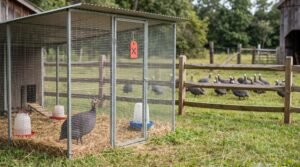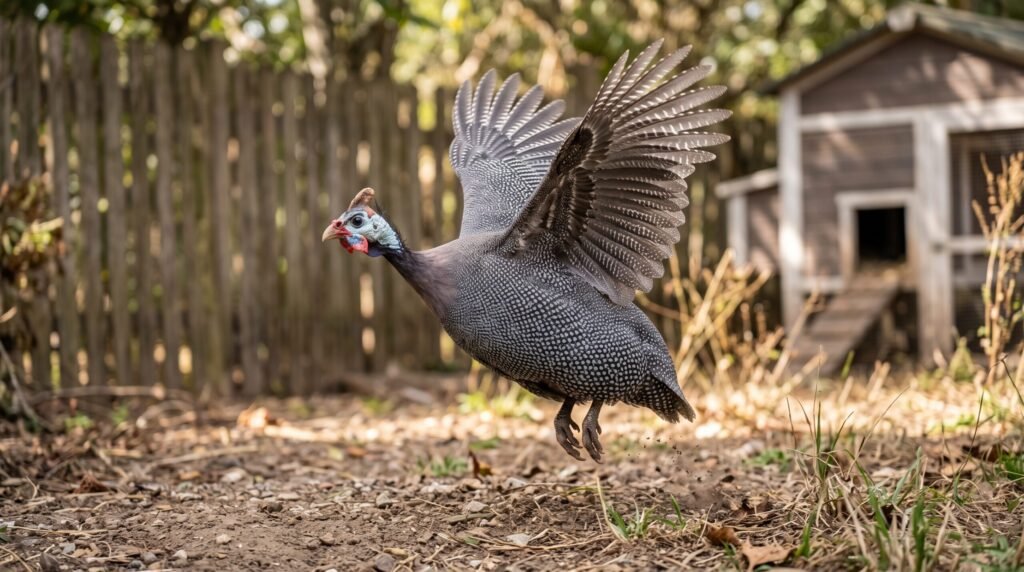
Yes, guinea fowl fly, and they’re a lot better at it than most backyard poultry. They can’t cross a county the way a hawk can, but they can clear a six-foot fence without much effort, and a startled guinea will happily launch itself onto your roofline or into the nearest tree.
I found this out the hard way in my first year keeping them, when a delivery truck backed into our driveway and half my flock went straight up and over the run like they’d been shot out of a cannon. Two of them didn’t come down until the next morning, roosting on the neighbor’s barn.
If you’re wondering whether your guineas are about to disappear over the fence line, here’s what’s actually going on with their flying, and what’s worked for me and other keepers to keep a flock grounded and close to home.
Guinea fowl are strong, low fliers built for short bursts rather than distance. A few things to know before you start troubleshooting:
- They typically fly no more than a few hundred feet at a stretch, but they can gain real altitude — high enough to clear fences, land on rooflines, or roost 20 feet up in a tree.
- Flight is mostly a panic response. A startled or cornered guinea will fly first and think later.
- Keets (baby guineas) can’t fly at all until they’re several weeks old and fully feathered.
- Wing clipping, full-coverage netting, and simply keeping guineas content at home are the three most reliable ways to stop them from leaving for good.
- A guinea that flies off isn’t necessarily gone forever — but new, unsettled, or spooked birds are the most likely to fly away and not return.
Why Guinea Fowl Fly So Readily
Guinea fowl haven’t been bred down for domestication the way most chicken breeds have. They’re closer to their wild West African ancestors in both body shape and temperament, which means they kept the light frame, strong pectoral muscles, and instinct to take to the air that most chicken breeds lost generations ago.
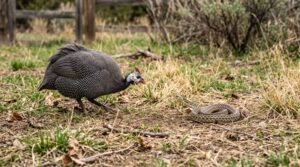
In the wild, flight is survival. A flock on the ground is vulnerable to foxes, snakes, and other ground predators, so guineas default to launching upward the moment something feels wrong. That same wiring is still fully intact in the birds in your run today, whether they were hatched on your property or shipped in as adults.
Flying also isn’t just a fear reflex. Guineas roost off the ground at night by instinct, and if your coop doesn’t offer a roost that feels high and secure enough, they’ll look for their own — a tree branch, a shed roof, a fence post — and fly up to it every evening whether or not that’s where you want them.
How Far and How High Can Guinea Fowl Actually Fly?
Guinea fowl aren’t built for sustained, long-distance flight the way waterfowl are, but they’re stronger fliers than most people expect from a bird in the chicken family. In short bursts, they can cover roughly a hundred meters or more at a time, and according to the University of Maine Cooperative Extension, they’re capable of flying up to roosting heights of 20 feet or higher — well above a standard fence or coop roofline.
That combination is exactly what makes them hard to contain with an open-top run. A fence that would stop a heavy-bodied chicken breed does very little against a guinea that decides to go up and over. Their flight isn’t about endurance — it’s a quick, powerful escape mechanism, and then they’re back on the ground, walking and running the rest of the way.
When Do Guinea Keets Start Flying?
If you’re raising guineas from keets, you get a grace period. Newly hatched keets have no real flight feathers and can’t fly at all — they’re entirely dependent on you for warmth and protection during this stage, which is worth knowing more about in our guide to raising guinea keets week by week.
Flight ability shows up gradually as the keets feather out, usually becoming noticeable somewhere between six and twelve weeks of age, depending on the individual bird and how it’s been raised. You’ll typically notice short, clumsy hops and flutters before they manage any real controlled flight — it looks more like bad landings than actual flying at first.
This window matters because it’s your best opportunity to shape lifelong habits. Guineas raised from keets in the coop where you want them to stay are far less likely to try to leave permanently than adult birds purchased and relocated later, simply because home is the only home they’ve ever known.
Why Guinea Fowl Fly Away — And Why Some Never Come Back
Not every flight is the same, and understanding the difference matters for how you respond.
- Startle response: loud noises, sudden movement, or a predator sighting can send the whole flock airborne at once, scattering in different directions.
- Roosting instinct: guineas prefer to sleep somewhere high, and if your coop doesn’t feel high enough or safe enough, they’ll fly up to find their own spot — a tree, a roofline, a barn rafter.
- New or relocated birds: guineas moved to an unfamiliar property haven’t yet built a sense of home, so their instinct is to keep moving rather than circle back.
- Surplus males: unpaired males will sometimes fly off in search of a mate elsewhere, particularly in a flock with an uneven male-to-female ratio.
- Overcrowding: flocks that get too large under one roof can fracture, with smaller groups splitting off and relocating.
A guinea that flies over the fence to peck around the yard for an hour usually wanders back on its own. The riskier flights are the ones that happen because a bird has been startled far from home, or because it’s a newer bird that hasn’t yet learned this property is where it belongs.
How to Keep Guinea Fowl from Flying Away
None of these methods make a guinea flightless completely on their own, but layered together, they dramatically cut down on birds going missing.
1. Clip One Wing
Wing clipping is the fastest, most direct way to limit flight, and it doesn’t hurt the bird when it’s done correctly.
- Have someone hold the guinea firmly and securely, tucking it against their body so it can’t struggle loose.
- Gently extend one wing fully and identify the primary flight feathers — the longest ten or so feathers at the outer edge of the wing.
- Using sharp, clean shears, trim only those primary feathers, cutting roughly half their length.
- Clip only one wing, not both. Trimming just one side throws off the bird’s balance in flight, which is what actually keeps it grounded — clipping both wings evenly leaves the aerodynamics balanced enough that some birds can still fly.
- Stop well short of the blood-filled shaft near the base of a feather that’s actively growing in; if you’re unsure whether a feather is still growing, leave it and clip the ones around it instead.
Because feathers are dead keratin past the growing stage, a proper clip doesn’t cause pain any more than cutting hair does. It does grow back after the next molt, though, so plan on repeating this once or twice a year for birds that free-range.
2. Cover the Run
A run with open sky above it is really just a very large launch pad for a bird that can clear 20 feet of altitude. Overhead netting, aviary wire, or a fully roofed run closes that gap entirely, and it solves two problems at once — it keeps your guineas in, and it keeps aerial predators like hawks and owls out, which matters more for guineas than for most poultry since they’re just as likely to be hunted from above as they are to escape upward.
For flocks you want to free-range during the day but confine at night, a covered night pen with open daytime access strikes a workable middle ground. Just be sure any daytime range area is fenced high enough, or accept that some flying over the fence line is part of the deal.
3. Keep Them Home from the Start
Guineas raised on your property from keets bond to that location far more reliably than adult birds brought in from elsewhere. Hatchery guides consistently warn that recently purchased growing or mature birds are the most likely of all to fly off the moment they get the chance, so if you’re starting with adults or half-grown birds, don’t skip the confinement step.
Keep new arrivals shut in the coop for at least two weeks before giving them any outdoor access, so the coop itself registers as home base rather than just a stopover. After that, some keepers let birds out gradually — one or two at a time over several days — since guineas are reluctant to leave flockmates behind and tend to stay close to whoever’s still confined.
4. Provide Roosts That Actually Satisfy Them
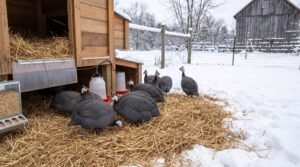
Guinea fowl want to sleep up high, and if your coop can’t offer that, they’ll find height somewhere else. Installing roosting bars near the top of the coop — higher than you’d typically set them for chickens — gives your flock a legitimate reason to stay inside at night instead of eyeing the treeline.
If you’re building or renovating a coop with this in mind, our guide to guinea fowl housing and coop setup walks through roost height, ventilation, and layout in more detail.
5. Feed and Water Near Home
Guineas that have to return to a specific spot for food are far less likely to wander off permanently. Keeping feeders and waterers inside or right next to the run — rather than scattered where they free-range — gives the flock a daily reason to circle back, which reinforces the habit of returning even after a startled flight sends them temporarily off course.
6. Manage Flock Size and Sex Ratio
Guinea flocks that grow too large can fracture, with subgroups splitting off to establish their own territory. Keeping flock numbers reasonable relative to your available coop and run space, and avoiding a heavy surplus of unpaired males, reduces the odds of birds deciding there isn’t enough room — or enough mates — where they are.
What to Do If a Guinea Fowl Flies Away
If a bird clears the fence, resist the urge to chase it. Guineas panic further when pursued, and a chase can turn a short flight into a long one. In my experience, the fastest way to get a spooked guinea back is to stay calm, keep the rest of the flock visible and audible near the coop, and simply wait — guineas are strongly flock-oriented and usually work their way back toward the sound of the others within a few hours.
Leaving food out near the coop at dusk helps too, since a hungry, disoriented bird will often follow its stomach home even when it won’t follow you. If a bird doesn’t return by dark, check nearby trees and rooflines at first light; that’s typically where you’ll find it waiting out the night.
FAQ
Can guinea fowl fly over a 6-foot fence? Yes, easily. A healthy, unclipped guinea can clear a fence several times that height without much effort. Fence height alone won’t contain them — you need overhead coverage or wing clipping to reliably stop it.
Does clipping a guinea fowl’s wings hurt them? No, not when done correctly. You’re trimming the same dead, non-sensitive part of the feather that grows back naturally, similar to a haircut. Pain only becomes a risk if you cut into a feather that’s still actively growing in, which will have a visible blood supply at the base.
Will guinea fowl fly away permanently if I don’t clip their wings? Not necessarily. Plenty of keepers run flightier, unclipped flocks successfully by focusing on secure roosts, consistent feeding near home, and raising birds from keets on the property. Clipping just removes one major variable, especially for newer or more skittish birds.
Do guinea keets need their wings clipped? No. Keets can’t fly until they’re several weeks old and fully feathered, so there’s nothing to clip early on. Wait until you actually see them attempting flight before considering it.
Guinea fowl are always going to be flightier than your average backyard chicken — that’s simply part of who they are. But between a well-timed wing clip, a covered run, and roosts that actually meet their instinct to sleep up high, you can keep almost all of that flying confined to your own property. Have you had a guinea take an unexpected trip over the fence? I’d love to hear how you got them back.
Hi, I’m Rayyan. I raise guinea fowl and share practical, research-backed guides for backyard keepers and homesteaders. I combine hands-on flock experience with trusted poultry management and university extension resources to help you raise healthier, more productive birds — with confidence, not guesswork.