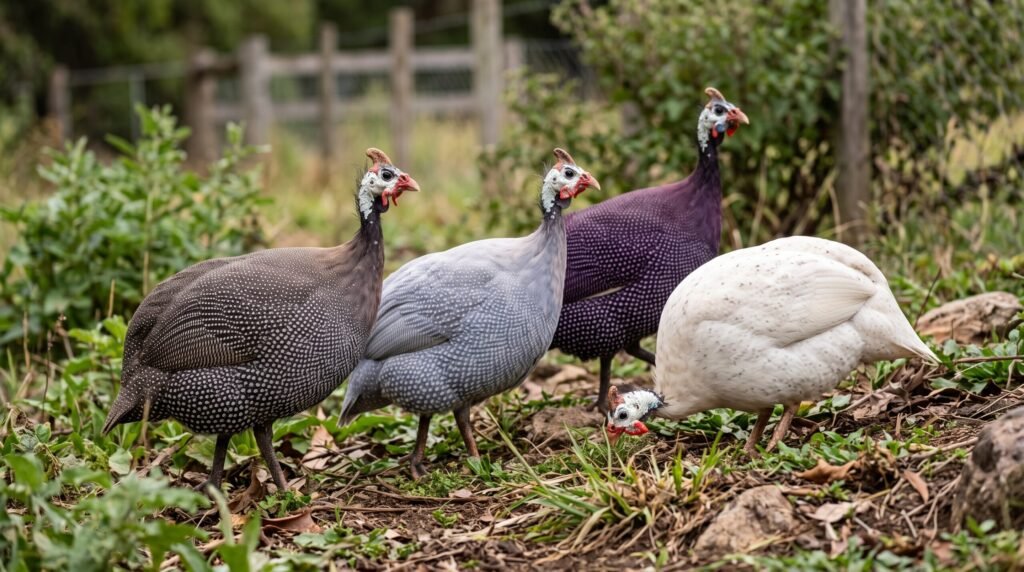
Guinea fowl come in more than a dozen recognized color varieties, from the classic dark-and-white speckled Pearl to solid Chocolate, pale Lavender, and striking Royal Purple — and most of them start life as a completely different-looking keet before molting into their adult pattern.
I’ve hatched pearl grays, lavenders, and a few pieds that surprised me by feathering out nothing like I expected, and if there’s one thing I’ve learned, it’s that guinea coloring is genuinely confusing until you know what to look for. This guide walks through the most common varieties, how to tell them apart as adults, and why the keets almost never match the grown bird.
Here’s what a quick side-by-side looks like before we get into the details.
The chart below covers the varieties you’re most likely to encounter, whether you bought an “assorted” hatchery box or you’re trying to sort out a mixed flock.
| Variety | Adult Appearance | Pearling Level |
|---|---|---|
| Pearl (Pearl Gray) | Dark gray body with white dot pearling overall | Fully pearled |
| White | Solid white, no markings | None |
| Lavender | Pale gray-blue with white pearling | Fully pearled |
| Royal Purple | Near-black with purple sheen, light spotting on wings/flanks | Semi-pearled |
| Coral Blue | Light gray-blue with white lacing at feather edges | Semi-pearled |
| Chocolate | Deep brown with a few white spots on wings | Semi-pearled |
| Buff / Buff Dundotte | Tan to light orange body | Semi to faintly pearled |
| Slate | Steel gray with cream highlights on shoulders | Faintly pearled |
| Violet (Mulberry) | Deep purple-black, minimal spotting | Faintly pearled to solid |
| Pied | Any base color plus irregular white patches | Varies |
Where All These Colors Come From
Every domestic guinea fowl color traces back to one wild ancestor: the helmeted guinea fowl of West and Central Africa. Its natural coloring — dark gray with white speckles — is what we now call Pearl, and it’s still the most common variety kept worldwide.
The pearl grey pattern is the natural color of the helmeted guinea ancestors, showing a dark gray body covered in hundreds of white speckles. Everything else — the lavenders, chocolates, buffs, and blues — came later, through selective breeding for color mutations that occasionally popped up in flocks. Breeders and researchers generally agree these variations come from combinations of a handful of different genes, though the genetics haven’t been mapped out in detail the way chicken color genetics have.
That gap in the research is worth knowing upfront. Guinea color genetics is nowhere near as well-documented as it is in chickens, and you’ll find hatcheries, breed clubs, and keepers using slightly different names for what may be the same or very similar colors. If you’ve ever tried to match a keet to an online color chart and come up short, this is why — study and identification of specific guinea coloring is an under-researched area, and there isn’t one single, universally accepted naming system. If you’re brand new to the birds themselves and want the full picture before diving into colors, my beginner’s guide to guinea fowl farming is a good place to start.
The Three Show-Recognized Varieties
If you’re raising guineas purely for the backyard, this section may not matter much. But if you ever plan to exhibit birds, it matters a lot.
The American Poultry Association recognizes guinea fowl in three varieties: Lavender, Pearl, and White, and these standards were formally admitted to the APA in 2004. Every other color you’ll read about below — Royal Purple, Coral Blue, Chocolate, Buff, and the rest — is a real, breedable variety that hatcheries sell and keepers love, but none of them currently have an official show standard.
For the three recognized varieties, judges look for specific traits:
- Pearl — Even, distinct white speckling over the entire body with no white patches or bare spots.
- Lavender — The same pearled pattern as Pearl, but with a light gray or lavender ground color instead of dark gray.
- White — Completely solid white with no patterning at all; any yellow tinge in the feathers is considered a major fault.
Disqualifying faults include any white feathers showing up in a Pearl or Lavender bird, or any colored feathers appearing on a White bird. Outside the show ring, none of that matters for egg production, meat, or tick control — so don’t let it stop you from keeping whatever colors you like.
Common Guinea Fowl Color Varieties (Adult Identification)
This is the part most people actually want: how to tell one adult guinea from another at a glance. I’ll go through the varieties roughly from most common to least common.
Pearl Gray

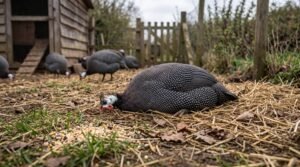
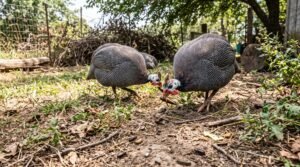
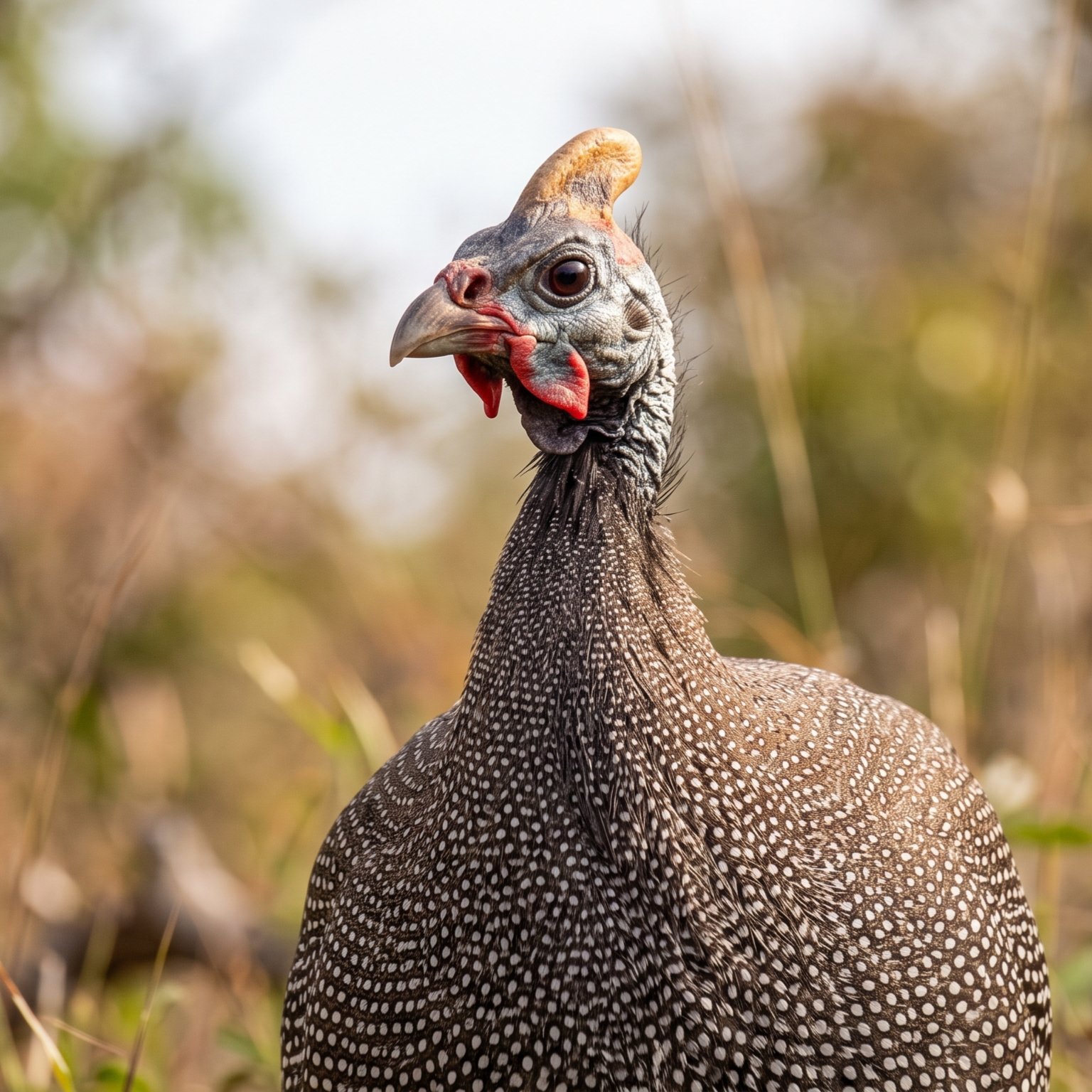
Pearl is the variety you’ll see most often, and it’s usually the default when someone pictures “a guinea fowl” in their head. It has a dark gray body covered in hundreds of small white speckles, a blue-gray bare head, and the same helmet and wattle structure shared across all the color varieties. If you’re buying an “assorted” box from a hatchery, expect Pearl to dominate the batch most years.
White

Solid white from head to tail, with no speckling anywhere. White is one of the two original common varieties alongside Pearl, so it’s not a newer novelty color — it’s been around as long as guineas have been domesticated in the West. A well-bred White should look clean and bright, not cream or yellow-tinged.
Lavender

Lavender is one of the varieties I get the most questions about, because it’s easy to confuse with Coral Blue or Slate at a distance. The easiest tell: Lavender has a pale blue ground color with white dots, and it reads noticeably lighter overall than a standard Pearl bird. Up close, the pearling covers the whole body, unlike some of the semi-pearled varieties below that only show spotting on the wings and flanks.
Royal Purple

Royal Purple is one of the more striking varieties, and in good light it genuinely shows a purple sheen across the chest and neck. In some regional surveys, Royal Purple has actually shown up more commonly than the pied pattern, which surprises people who assume Pearl and White dominate everywhere. The base color is dark black with an iridescent purple cast, and the wing feathers carry light white spotting rather than dotting over the full body.
Coral Blue

Coral Blue is genuinely rare and tends to command higher prices when you can find a true breeding pair. It shows a darker gray-blue coloration with distinctive white or gray lacing around the edges of the feathers, which sets it apart from Lavender’s more uniform dotting.
Chocolate

Chocolate guineas darken with age. Keets start out light and gradually deepen into a dark brown color by the time they’re fully grown, with a scattering of white spots and bars on the wings. If you’ve got a bird that looked tan as a juvenile and is now a rich, even brown, chocolate is a safe bet.
Buff and Buff Dundotte

Buff is exactly what it sounds like: a warm tan-to-orange bird, similar in tone to a Buff Orpington chicken. It’s a familiar color to anyone who’s kept buff-colored chicken breeds. Buff Dundotte is a closely related but distinct variety — Dundottes tend to have much fainter head striping as keets, while standard Buffs show darker, more defined stripes, though this distinction is easier to see before the birds fully feather out.
Slate

Slate is a steel-gray variety with a subtle sheen and cream-toned highlights across the shoulders and back. It’s faintly pearled rather than fully spotted, which gives it a smoother, more uniform look than Pearl or Lavender from a distance.
Violet (Mulberry)

Violet, sometimes called Mulberry, is a deep purple-black variety with minimal spotting — it can look almost solid in low light and only reveal its purple undertone in direct sun, similar to Royal Purple but darker overall.
Pied

Pied isn’t a standalone color — it’s a pattern that can layer onto any of the varieties above. Pied guineas show white feathering in varying amounts, from just a few feathers on the chest to a full white chest and wings, on top of whatever the base color is. Pied is one of the most prevalent patterns worldwide and is considered one of the dominant color genes in the species. A Pied Pearl is by far the most common combination you’ll come across.
Why Keets Rarely Match Their Adult Color
This is the part that trips up almost everyone new to hatching guineas, myself included the first time around. Guinea keets hatch in colors and patterns that often look nothing like what they’ll grow into, and the confusion gets worse because several different adult colors can start out looking nearly identical as chicks.
The most reliable way to sort keet colors is to look at the pattern on top of the head first, then check the body, belly, and wing coloring. Breeders generally group keets into four pearling categories that predict how the adult will eventually look:
- Fully Pearled — Spots will cover the entire adult body (Pearl, Lavender).
- Semi-Pearled — Spotting will appear mainly on the lower wings and flanks (Royal Purple, Coral Blue, Chocolate, Buff).
- Faintly Pearled — Adult spotting will be very hard to see (Slate, some Violets).
- Solid — No markings at all as adults (White).
A few real examples of how different keets and adults connect:
- Pearl Gray keets hatch brown with black stripes and markings and a tan underside, then darken into the familiar dark gray, white-dotted adult.
- Lavender keets are light blue with dark blue stripes and markings and a light blue belly — noticeably cooler-toned than Pearl keets from day one.
- Royal Purple keets come out brown with small, irregular black striping on the back and crown, with a white face, neck, belly, and wings, which looks almost nothing like the deep purple-black adult they’ll become.
- Coral Blue keets show light blue coloring with dark blue irregular striping on the back, a dark blue striped crown, and a white face, front neck, belly, and wings.
- Buff Dundotte keets are a light tan color with darker tan striping on the back and head, and a light tan underside.
One practical note if you’re trying to identify partially-pearled varieties (Royal Purple, Coral Blue, Chocolate, Buff) while they’re still young: these keets are heavily pearled as juveniles and can look almost identical to the fully-pearled varieties at that stage — the extra pearling only fades away after a few molts. In other words, don’t lock in an ID based on a three-week-old keet’s pattern. Give it time.
If you’re incubating a mixed-color batch yourself and want the full week-by-week rundown on what to expect, my guide on raising guinea keets from hatch through maturity covers the brooding side in more detail, and how to hatch guinea fowl eggs successfully is worth a look if you’re setting up your own incubation.
Quick Reference: Telling Similar Colors Apart
A few varieties get mixed up constantly, so here’s a fast way to separate the ones that look alike:
- Lavender vs. Coral Blue — Lavender has even white dotting across the whole body; Coral Blue shows lacing specifically at the feather edges and tends to run darker.
- Pearl vs. Slate — Pearl has bold, distinct white dots on a dark gray base; Slate is smoother and steelier, with only faint spotting and cream shoulder highlights.
- Royal Purple vs. Violet — Royal Purple shows visible light spotting on the wings and flanks; Violet is closer to solid, with the purple sheen being the main giveaway in both.
- Buff vs. Buff Dundotte — Nearly identical as adults; the clearest difference shows up in keets, where Dundottes have much fainter head striping than standard Buffs.
Beyond Color: Other Guinea Fowl Species Worth Knowing
Everything above covers the domestic helmeted guinea fowl, which is what almost every backyard keeper raises. But it’s worth knowing the helmeted guinea isn’t the only guinea fowl species out there. There are a handful of other wild guinea fowl species, including the Plumed Guinea Fowl, known for its shy nature and blue-black plumage with elongated feathers on its upper back, and the White-breasted Guinea Fowl, a forest-dwelling species from West Africa. The White-breasted Guinea Fowl is notable for its red throat pouch and its lack of a helmet or wattles, and it currently carries an IUCN vulnerable status due to habitat loss and hunting pressure. These species aren’t something you’ll find at a hatchery, but they explain why “guinea fowl” as a category is broader than the speckled birds most of us keep.
Frequently Asked Questions
What’s the rarest guinea fowl color? Coral Blue is widely considered one of the hardest colors to find, and true breeding pairs often sell for a premium. Some newer or regionally uncommon colors, like certain Violet or Sky Blue lines, can be even harder to source depending on where you live.
Can two different-colored guineas produce keets of a third color? Yes. Because guinea color genetics involve multiple interacting genes, crossing two colored varieties can produce offspring in a color that matches neither parent exactly. Royal Purple, for example, is sometimes produced by pairing a Chocolate male with a Coral Blue hen.
Do color varieties affect temperament, egg-laying, or meat quality? No. Color is purely cosmetic. All the varieties covered here come from the same domestic helmeted guinea fowl and behave, lay, and dress out the same way regardless of plumage color.
Is Pied a color or a pattern? It’s a pattern, not a color on its own. Pied describes irregular white patches layered over any base color — Pied Pearl, Pied Chocolate, and Pied Lavender are all possible.
I still get caught off guard by a keet that hatches looking nothing like what I expected, and honestly, that’s part of the fun of raising an assorted flock. If you’ve hatched a color you couldn’t identify at first, or you’ve got a favorite variety in your own flock, I’d genuinely like to hear about it. And if you’re just getting your flock started and haven’t settled on which colors to raise, my guide on choosing the best guinea fowl breeds for meat and egg production can help you decide what to prioritize beyond looks.
Hi, I’m Rayyan. I raise guinea fowl and share practical, research-backed guides for backyard keepers and homesteaders. I combine hands-on flock experience with trusted poultry management and university extension resources to help you raise healthier, more productive birds — with confidence, not guesswork.