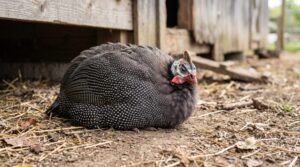
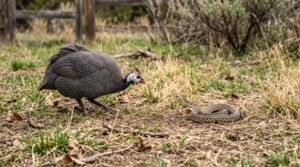
The easiest way to catch a guinea fowl without stress is to do it at night, while the bird is roosting and can barely see you, then support its body and wings firmly the moment you have hold of it. Daytime catches are possible too, but they take patience, the right tools, and a plan.
If you’ve ever tried to corner a guinea fowl in broad daylight, you already know the punchline: guineas can outrun, outfly, and outsmart most attempts at a grab. I learned this the hard way during my first year keeping them, chasing a hen around the run for twenty minutes before giving up, sweaty and outwitted, while she watched me from the fence rail. Since then I’ve picked up a handful of methods that actually work, and just as importantly, ways to handle a guinea once you’ve got it so nobody — bird or keeper — ends up hurt.
In this guide, I’ll walk you through why guineas are so hard to catch, the best times and tools to use, step-by-step handling technique, and what to do if a bird needs to be caught regularly, like for treating parasites or a vet visit.
- Catch guineas at night whenever possible — they’re calm, disoriented, and easy to lift straight off the roost.
- If you must catch during the day, use a net or a funnel-style catch cage rather than chasing them by hand.
- Always secure the wings first, then the legs, and hold the bird firmly against your body.
- Never grab a guinea by the neck, head, or a single leg — this can cause serious injury.
- Keep daytime sessions short, quiet, and calm to avoid panicking the rest of the flock.
Why Guinea Fowl Are So Hard to Catch
Guinea fowl aren’t like chickens. Chickens have been bred for generations to tolerate close human contact; guineas, even after decades in domestic flocks, still carry a lot of their wild instinct. They’re fast on the ground, quick to take to the air, and hyper-aware of anything unusual happening near them.
According to extension guidance on small and backyard poultry flocks, guinea fowl are best captured by locating them on the roost after dark and firmly securing the wings and legs, since daytime catching tends to be far more stressful for the bird. A few traits make catching guineas uniquely tricky:
- They flock and flee together. Spook one guinea and the whole group usually bolts, which turns a single catch attempt into a full flock panic.
- They’re strong fliers for their size. Unlike a heavy-bodied chicken, a guinea can clear a low fence or fly up into a tree without much effort.
- They rarely bond the way chickens do. Most guineas stay wary of hands-on contact even with keepers they see daily, so treats and gentle approach only go so far during the day.
- They have excellent hearing and eyesight in daylight — but very poor night vision, which is exactly why nighttime catching works so well.
- They’re natural fliers. If wing clipping is something you’re considering to keep your flock closer to home, it’s worth reading up on whether and how guinea fowl fly before you decide.
Understanding this behavior is really the foundation of catching them calmly. You’re not fighting the guinea’s instincts; you’re working around them.
The Best Time to Catch a Guinea Fowl
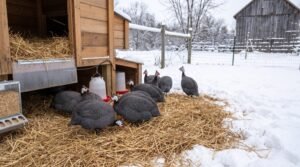
The most reliable window is after guineas have settled onto the roost for the night, working with as little extra light as you can manage. Once they’re on the roost, guineas are half-asleep and effectively blind in the dark, which makes them far easier — and far less stressed — to handle than a bird you’ve been chasing across the yard.
Here’s how I approach a night catch:
- Wait until well after dusk, once the flock has been quiet and settled for at least 20–30 minutes. Going in too early, while they’re still fidgeting on the perch, undoes the advantage.
- Use a dim flashlight or red-light headlamp rather than a bright white light. Keeping the light as dim as you can get away with helps you see without jolting the birds fully awake.
- Move slowly and quietly into the coop. Sudden noise or fast movement is what triggers a panicked flush off the perch.
- Approach one bird at a time. Bring both hands over the bird’s wings and body at once rather than grabbing a leg first — guinea feathers are notoriously close and slippery, so you need a firm, confident hold from the start.
- Lift and secure immediately. Don’t hesitate once you’ve made contact; a half-hearted grip is how you end up with a handful of feathers and a wide-awake, furious guinea.
Night catching does mean accepting some trial and error the first few times. It gets easier with practice, and it’s still far gentler on the bird than a daytime chase.
Catching Guinea Fowl During the Day
Sometimes a night catch isn’t practical — maybe you need to isolate a sick bird right away, or you’re catching guineas that free-range too far from the coop to corner after dark. During the day, chasing is off the table; it just teaches the flock to associate you with panic. Instead, lean on tools that do the work for you.
Use a Net
A net with fine mesh reduces the risk of injury to a guinea’s feathers and limbs compared to wider netting that can snag a wing or a head. A few pointers if you go this route:
- Approach calmly and swing the net in one smooth, confident motion rather than several jabbing attempts.
- Once the bird is netted, get your hands on it and support its body immediately — a guinea left thrashing in a net for too long can injure itself.
- Expect the rest of the flock to scatter when they see the net; plan for that reaction rather than being surprised by it.
Use a Catch Cage or Funnel Trap
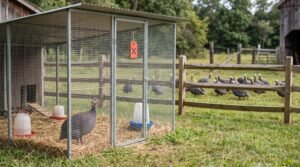
A wire pet crate or a homemade funnel trap, baited with scratch grain, is often the lowest-stress daytime option because it doesn’t involve chasing at all. Set the trap where the flock already forages, bait it, and let the guineas walk in on their own — the same scratch grains that work well as part of a regular guinea fowl feeding routine make good bait here too. A funnel-style entrance channels birds into the cage on their own, and once inside, you can simply reach in and take the one you need. This method takes more setup time, but it causes noticeably less flock-wide panic than netting.
Confine Them First
If you know in advance that you’ll need to catch a bird, temporarily confining the flock to a smaller run the night before makes daytime catching far more manageable the next day. A smaller space means less room to sprint and fewer places to hide, without the stress of an open chase across the whole property. This is also where a well-planned guinea fowl coop and run setup pays off — a design with a smaller, closable section built in makes future catches far easier.
How to Hold a Guinea Fowl Properly
Once you’ve got hold of a guinea, how you carry it matters just as much as how you caught it. Poor handling in these first few seconds is where most injuries — to bird and handler alike — actually happen.
The general sequence:
- Secure the wings first. Guinea fowl have powerful wings for their size, and an unsecured wing is the main source of injury during handling.
- Bring the bird against your body. Holding it snug against your torso, facing backward, gives it a sense of stability and cuts down on struggling.
- Support the legs with your other hand, keeping them together rather than letting them splay or cross, which can cause pain or injury to the bird.
- Keep the bird upright. Poultry handling guidance consistently notes that carrying a bird upside down or inverted for any length of time is stressful for it, so avoid flipping a guinea onto its back or holding it by the legs alone for more than a moment.
- Move calmly and set the bird down gently, feet-first, once you’re done.
This general approach — secure the body, keep the bird upright, avoid grabbing fragile parts — lines up with the handling guidance poultry extension programs give for chickens and other domestic fowl, since the underlying anatomy and stress responses are similar across species.
A few things to never do, regardless of the situation:
- Never grab or carry a guinea fowl by the neck, head, or tail.
- Never dangle a bird by a single leg — this can dislocate joints or cause serious pain.
- Never chase a guinea fowl through the run in a panic; it raises the injury risk for the bird and makes every future catch harder.
If you need to carry more than one bird at a time, keep them separated by hand and avoid stacking or crowding them together, since guineas that are already stressed can injure each other in a confined carrier.
Signs a Guinea Fowl Is Too Stressed
Even with good technique, it’s worth knowing what over-stress looks like so you can ease off before it becomes a real problem. Watch for:
- Open-mouth or labored breathing
- Limp or unusually still behavior after a struggle
- Repeated, frantic wing-flapping that doesn’t settle once secured
- A bird going completely rigid or unresponsive
If you see any of these, set the bird down gently in a quiet, enclosed space and give it time to recover before attempting to handle it again.
Why Low-Stress Handling Actually Matters
It’s tempting to treat a quick catch as no big deal, but rough handling has real consequences beyond the moment. Stressed birds are more prone to injury during the struggle itself, and repeated bad experiences make every future catch harder, since guineas remember and generalize fear quickly across the whole flock. On my own farm, I noticed that after a few calm night catches, the flock barely reacted the next time I came into the coop after dark — but one clumsy daytime chase set that trust back for weeks.
If you’re catching a guinea for a specific health reason, such as treating external parasites, keeping the process calm also matters for accuracy. A bird thrashing in your hands is harder to inspect properly, and you’re more likely to miss something or cause an injury while trying to treat it. This matters even more if you’re checking for symptoms tied to one of the more common guinea fowl diseases, where a careful, calm inspection can catch a problem early.
FAQ
Can you tame a guinea fowl enough that it won’t need to be “caught”? Some individual guineas raised from keets alongside people will tolerate being picked up with minimal fuss, but as a flock, guineas generally stay warier of handling than chickens do, even with regular contact. Building trust through calm presence and treats helps, but don’t expect the same hands-off ease you’d get with a friendly hen.
Is it safe to catch guinea fowl by hand during the day if I move slowly enough? It’s possible with a patient, cornering approach in a small space, but for most keepers a net or catch cage is far more reliable and less stressful for the bird than a slow hand-chase, which still tends to end in a sprint.
How often do backyard keepers actually need to catch their guineas? For most flocks, it’s occasional — health checks, parasite treatment, moving birds to a new pen, or introducing new guinea fowl to an existing flock. Guineas that free-range well typically don’t need regular handling otherwise.
Will catching one guinea upset the rest of the flock? Usually, yes, at least briefly. Guineas are highly flock-oriented and tend to react as a group to any disturbance. This is another reason night catching is preferable — the rest of the flock is asleep and far less likely to be disrupted.
Getting comfortable catching and handling guinea fowl really is a skill that improves with practice and a little patience. Start with a night catch if you can, keep your movements slow and deliberate, and always support the bird’s body fully once you’ve got hold of it. If you’re just getting your flock established, it’s worth pairing this with a broader look at everyday guinea fowl behavior so you know what’s normal versus what’s a stress signal. Have you found a catching method that works particularly well for your flock? I’d love to hear about it in the comments.
Hi, I’m Rayyan. I raise guinea fowl and share practical, research-backed guides for backyard keepers and homesteaders. I combine hands-on flock experience with trusted poultry management and university extension resources to help you raise healthier, more productive birds — with confidence, not guesswork.