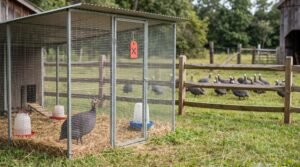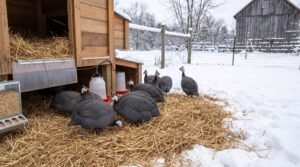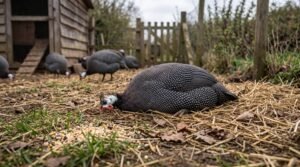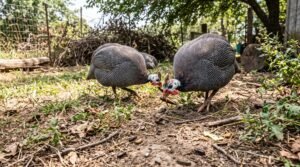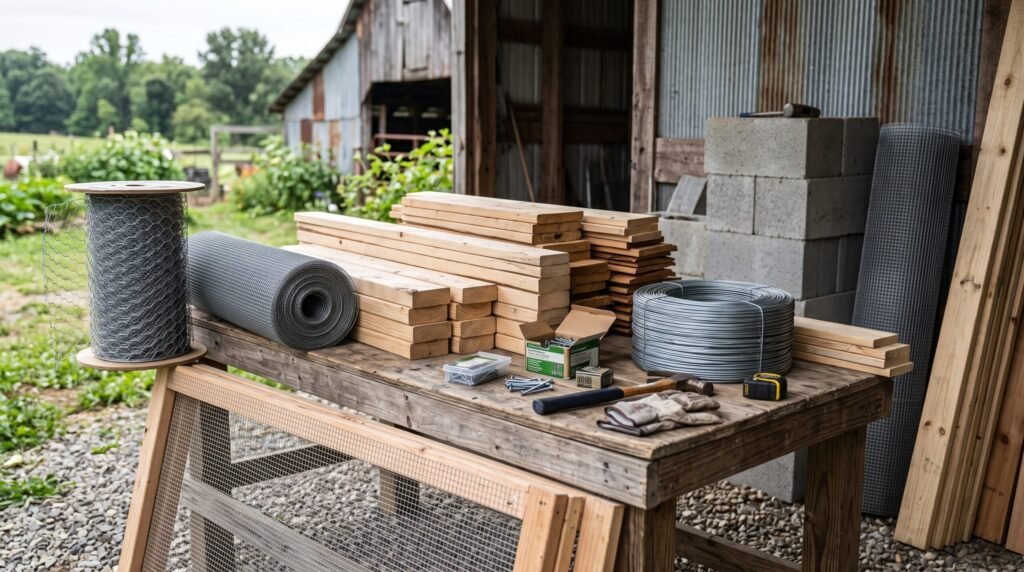
You need weather-rated framing lumber, exterior-grade plywood or siding, half-inch hardware cloth (not chicken wire), a roosting bar made from rough 2x4s or tree branches, roofing material rated for your climate, and hardware like galvanized screws, hinges, and secure latches. Beyond the frame and wire, you’ll also need bedding, nest box materials, and a plan for ventilation that doesn’t compromise security.
I learned most of this the hard way, buying the wrong wire twice before I got it right. If you’re about to start your own build, this list should save you a trip back to the hardware store.
Guinea fowl aren’t as forgiving as chickens when it comes to housing. They fly higher, they panic more, and they’re more sensitive to a damp, stuffy coop. If you haven’t nailed down your overall setup yet, it’s worth reading through a guinea fowl housing guide before you buy anything, since your layout decisions will shape exactly which materials and how much of each you’ll need. For now, here’s a quick look at what actually matters on the supply side and why.
| Category | What to buy | Why it matters for guineas |
|---|---|---|
| Framing | Pressure-treated or cedar 2x4s | Resists rot where moisture and ground contact are unavoidable |
| Walls & roof | Exterior-grade plywood, metal roofing or shingles | Withstands weather; avoids particleboard, which attracts mites |
| Wire | Half-inch hardware cloth, 19-gauge or heavier | Chicken wire won’t stop raccoons, hawks, or weasels |
| Roosts | Rough 2x4s (narrow side up) or tree limbs | Guineas prefer natural, non-slip perches set high |
| Fasteners | Galvanized screws, washers, hinges, slide-bolt latches | Rust-resistant; screws hold wire far better than staples |
| Flooring/bedding | Wood shavings, straw, or packed dirt | Absorbs moisture and droppings between cleanings |
| Ventilation | Screened vents, ridge vents | Removes ammonia without leaving gaps predators can use |
Framing lumber: the coop’s skeleton
Start with the frame, since everything else attaches to it. Pressure-treated lumber is the standard choice for anything touching the ground — sill plates, corner posts — because it resists rot and insect damage where moisture collects. For the rest of the frame, standard construction-grade 2x4s work fine as long as the structure is protected from direct rain by siding and roofing.
If you want to skip the chemicals in pressure-treated wood, cedar or cypress are naturally rot-resistant and hold up well outdoors, though you’ll pay more for them. I framed my first coop with plain untreated pine because it was what I had on hand, and I regretted it within two years when the base boards started going soft. Spend the extra money on the bottom plates even if you cut corners elsewhere.
Walls, siding, and roofing
For exterior walls, plywood rated for outdoor use is worth the higher price tag. Skip particleboard and oriented-strand board (OSB) — their porous, layered structure gives mites an easy place to hide and multiply, which is the last thing you want in a coop full of guineas that are already prone to parasites.
For the roof, you’ve got a few solid options:
- Galvanized metal roofing — lightweight, sheds rain and snow well, and holds up especially well on coops that sit in shade through the summer months.
- Asphalt shingles — more labor to install, but they blend in with a house or shed roof if that matters to you.
- Corrugated polycarbonate panels — lets in natural light, which guineas need to regulate their day-night rhythms, though it won’t insulate against heat the way metal with a radiant barrier does.
Whatever you pick, make sure the roof pitches enough to shed water and that the edges are sealed tight. Guinea fowl are strong fliers and will find any weak seam eventually — not to escape, usually, but because hawks and owls will find it first.
Hardware cloth: the supply you can’t skimp on
If there’s one item on this list worth spending real money on, it’s the wire. Chicken wire — the twisted hexagonal mesh most people picture — flexes easily and looks secure, but a motivated raccoon, dog, or fox can rip through it without much trouble. This is really just one piece of a bigger picture; if predator pressure is a real concern where you live, it’s worth reading up on how to protect your flock from predators more broadly, since fencing and coop placement matter just as much as the wire itself.
Hardware cloth is the real answer. It’s built from a heavier-gauge metal than chicken wire, and remember that with wire, a lower gauge number actually means a thicker, sturdier strand. For guinea fowl housing, look for:
- Half-inch openings for most walls, vents, and windows
- Quarter-inch openings in any spot where weasels or snakes are a known problem, since they can squeeze through gaps larger than that
- 19-gauge or heavier wire, galvanized after welding for the best rust resistance
Buy more than you think you need. You’ll use it on windows, vents, the run, and possibly buried around the coop’s perimeter to stop diggers. Guidance from Oregon State University Extension recommends burying fencing at least six inches to a foot into the ground to stop digging predators like raccoons and foxes, and that same rule of thumb holds up well for guinea fowl housing.
One installation note that saved my flock a scare: don’t staple hardware cloth to your frame. Staples pull loose under repeated pressure from a clawing predator. Use galvanized screws and fender washers instead to clamp the wire down properly.
Roosting bars
Guinea fowl like to perch high, often six to eight feet up, and they’re pickier about footing than chickens. Skip anything slick — PVC pipe is too slippery to grip, and metal tubing is both slippery and cold to the touch in winter, which can be hard on their feet.
Your best options:
- Rough-cut 2×4 lumber, installed narrow-side up, which is the most common roost choice for backyard coops generally
- Natural tree limbs of a comfortable diameter, which come closest to what guineas would choose on their own in the wild
- Large closet dowels, roughened up with sandpaper first so the birds can actually grip them
If you’re building for a small starter flock, plan on roughly 8 to 10 inches of roost space per bird, spaced across a couple of different heights since guineas will sort out their own flock hierarchy and seating on their own.
Nest boxes and interior fittings
Guineas aren’t fussy about nest box design — standard chicken nest boxes work fine — but you’ll want a few on hand if you plan to collect eggs regularly rather than let the flock hide them in the brush (which they will absolutely try to do). A box roughly 12 inches deep, wide, and tall suits most flocks, mounted slightly below roost height so birds don’t sleep — and mess — in them instead of on the perch. Some keepers skip built-in boxes altogether and rely on a dedicated nesting area instead, since guineas don’t always take to boxes the way chickens do.
You’ll also need basic feeder and waterer setups, plus hooks or brackets to mount them off the ground. Keeping feed and water elevated a few inches keeps bedding out of both and cuts down on the mess guineas are famous for kicking up.
Flooring and bedding
For flooring, you have three realistic choices: packed dirt, a wood floor, or concrete. Dirt is the cheapest and works well in dry climates, but it needs to be paired with predator-proofing underneath, since a solid floor won’t stop something that digs. A wood floor keeps things drier but needs a layer of bedding on top to manage moisture — plan to swap in fresh straw or shavings roughly once a month, sooner if it gets wet or starts to smell.
Wood shavings, chopped straw, or hay all work as bedding material. Whichever you choose, buy enough to keep a few inches of dry litter in place at all times — damp bedding is one of the fastest ways to end up with a respiratory problem in the flock. Pairing the right bedding with a realistic cleaning routine will do more for air quality than any single material choice.
Ventilation materials
It’s tempting to think of ventilation as something you design rather than something you buy, but you’ll still need supplies: screened vent covers, ridge vent strips, or simple framed openings covered in hardware cloth. The goal is airflow near the roofline that doesn’t create a draft at bird level.
Skip insulation altogether. Extension research on poultry housing has found that insulating a coop tends to trap moisture inside the structure, and that trapped moisture is what actually drives respiratory trouble in housed birds — not the cold air itself. A well-ventilated, uninsulated coop is the safer build in most climates.
Doors, latches, and fasteners
Last on the list, but not least important: the small hardware that keeps everything shut. Raccoons can work open simple hook-and-eye latches, so spring-loaded or slide-bolt latches are worth the extra couple of dollars each. It also helps to hang doors so they swing inward and use windows that slide rather than swing outward, since that makes them much harder to force open from outside.
Stick with galvanized screws and hinges throughout. Regular steel hardware will rust within a season or two of exposure to coop humidity, and a rusted hinge is exactly the kind of weak point a predator will eventually find.
Full supply checklist
Here’s the condensed version to take with you to the store:
- Pressure-treated or cedar 2×4 lumber for framing
- Exterior-grade plywood or siding for walls
- Galvanized metal roofing, shingles, or polycarbonate panels
- Half-inch (or quarter-inch, if needed) galvanized hardware cloth, 19-gauge or heavier
- Galvanized screws, washers, hinges, and slide-bolt or spring latches
- Rough 2×4 lumber or natural branches for roosts
- Nest boxes (or materials to build your own)
- Feeder and waterer with mounting brackets
- Wood shavings, straw, or hay for bedding
- Vent covers or framed screened openings
If you’re still working out how big to build before you buy materials, it’s worth running the numbers first — our coop size calculator can help you figure out square footage based on flock size before you start your supply list.
FAQ
Can I use chicken wire instead of hardware cloth for a guinea fowl coop?
You can, but it’s not recommended. Chicken wire is too flexible and too easily torn for guinea fowl housing — it works for keeping birds contained but does very little to keep predators out. Hardware cloth costs more upfront but prevents far more losses over the life of the coop.
Do I need pressure-treated wood for the whole frame?
Not necessarily. It’s most important for anything in direct contact with soil or moisture, like sill plates and corner posts set into the ground. Above that, standard lumber protected by siding and a good roof will hold up fine, especially if you’ve chosen a naturally rot-resistant species like cedar.
What size hardware cloth openings should I use?
Half-inch openings handle most common predators, including raccoons, dogs, and hawks. If you’ve had trouble with weasels or snakes getting into coops in your area, drop down to a quarter-inch mesh, since guinea keets and even adult birds are vulnerable to anything that can squeeze through a wider gap.
Is insulation a good idea for a guinea fowl coop?
Generally, no. Insulation traps moisture inside the structure, which raises the risk of respiratory illness in the flock. A well-ventilated, uninsulated coop with dry bedding manages temperature and air quality better than a sealed, insulated one.
Once you’ve got your materials together, the actual build moves fast — most of the real decision-making happens at the supply stage. If you’re still finalizing your layout, take a look at our coop design ideas for a few tested layouts before you start cutting wood. And if you’ve built one already, I’d love to hear what you’d do differently next time.
Hi, I’m Rayyan. I raise guinea fowl and share practical, research-backed guides for backyard keepers and homesteaders. I combine hands-on flock experience with trusted poultry management and university extension resources to help you raise healthier, more productive birds — with confidence, not guesswork.