Guinea fowl can handle real cold, but only if you give them a dry, draft-free place to roost, extra calories to fuel their own body heat, and water that isn’t frozen solid. Get those three things right and a healthy flock will shrug off a hard winter with barely a hiccup in how they act or lay.
I remember the first cold snap I kept guineas through. I’d assumed that since they’re tougher and rangier than my chickens, they’d just figure winter out on their own. They didn’t. My guineas wanted to roost in the pine tree at the edge of the yard, snow or no snow, and I spent three frozen evenings herding stubborn birds back toward the coop before they got the hint. That stubbornness is the real challenge of guinea fowl winter care — not the cold itself, but convincing a semi-wild bird to accept the shelter you’ve built for it.
This guide covers everything I’ve learned since, backed up by what poultry extension research and experienced keepers recommend: how to prep the coop, what to feed, how to stop frostbite before it starts, and how to read the signs that a bird is struggling in the cold.
Here’s the winter care checklist I run through every year before temperatures drop:
- Shelter: Dry, draft-free, and ventilated but not insulated — moisture is the real enemy, not cold air itself.
- Roosting: Train birds to roost inside before the first hard frost; guineas default to trees otherwise.
- Space: 3–4 sq. ft. per bird minimum inside the shelter for weeks of confinement.
- Feed: Boost energy-dense feed like scratch grains and increase overall intake as temperatures fall.
- Water: Use a heated waterer or check multiple times a day to keep it from freezing.
- Frostbite watch: Check wattles, combs, and feet daily once temperatures drop below freezing.
- Free-range days: Only let birds out on calm, dry days — skip it during ice, deep snow, or high wind.
Why Winter Is Harder on Guinea Fowl Than You’d Expect
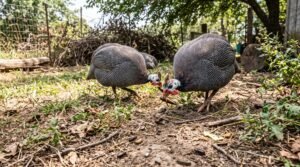
Guinea fowl trace back to the savannas of West Africa, and it shows the moment the first snow falls. Their long, featherless legs and exposed wattles are especially vulnerable to cold in a way that a fluffy-shanked chicken breed simply isn’t. They’re not built for ice and biting wind, and they know it — you’ll see it in how reluctant they are to walk on snow at all.
What makes it trickier is temperament. Guineas stay closer to their wild instincts than most poultry, and that includes a strong pull to roost high in trees, a habit that turns dangerous fast once a winter storm rolls in. Mine would rather huddle under a pine bough than walk into a coop that’s actually warmer and safer. That’s why so much of guinea winter care isn’t really about fighting the cold directly — it’s about managing frostbite risk, respiratory illness, and the metabolic strain of a bird working overtime just to stay warm.
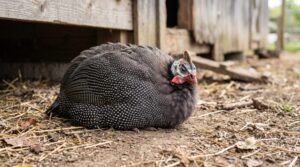
The birds themselves will tell you when they’re struggling. Watch for huddling in tight groups, one foot tucked up against the body, or feathers puffed out further than usual — these are the same cold-stress signals seen across poultry species, and guineas are no exception.
Preparing the Coop for Cold Weather
Your shelter is the single biggest factor in how well your flock handles winter. Get this right and most other problems take care of themselves.
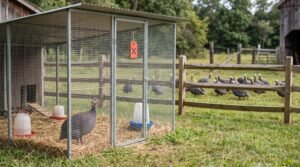
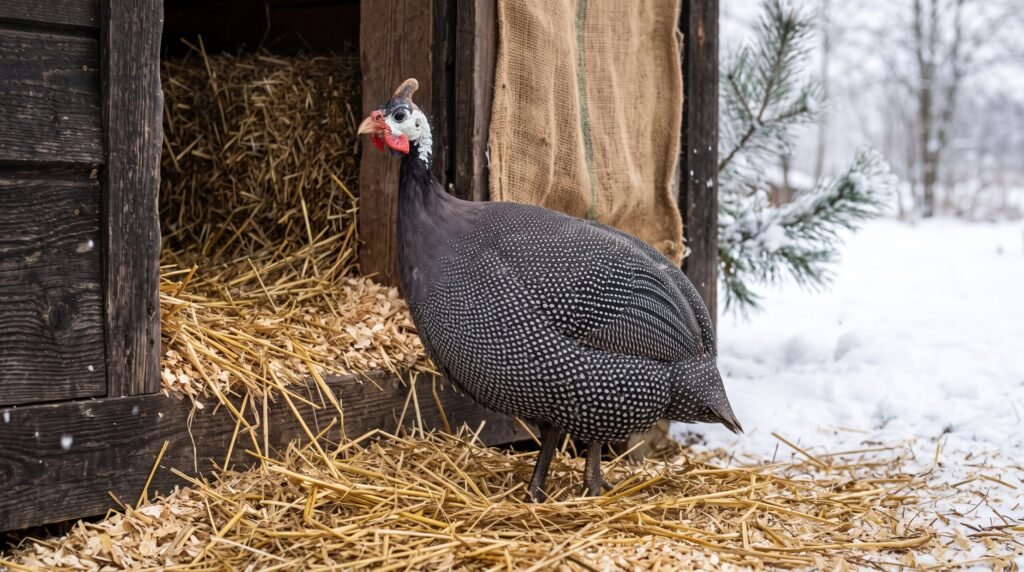
Keep it dry and draft-free, but not sealed tight. It sounds contradictory, but a properly built guinea shelter should limit drafts at bird level while still allowing some airflow near the roofline. Guinea fowl are extremely susceptible to frostbite and cold-related illness, and both are made worse by dampness and moisture — trapped humidity from droppings and respiration is often more dangerous than the outside temperature. Counterintuitively, an uninsulated shelter is often preferable, since insulation tends to trap moisture in the air and raises the risk of respiratory infections.
Don’t skimp on space. Once the ground ices over, your birds may be confined to their shelter for days or even weeks at a stretch. Adult guineas need three to four square feet of floor space per bird under normal conditions, and that space should factor in whatever room nesting boxes, roosting bars, and shelving take up. Crowded birds get stressed, and stressed birds start pecking at each other out of boredom.
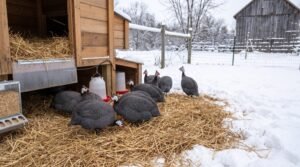
Add deep bedding. A thick layer of straw does double duty — it insulates the floor from cold ground and gives birds something to scratch through when they can’t free-range. Refresh it regularly, since damp bedding undermines everything else you’re doing to keep the coop dry.
Pick the right structure. A shelter with a lower roof, like a shed rather than a tall barn, holds body heat better and keeps the interior noticeably more comfortable than the outdoors. If you’re still finalizing your setup, our guinea fowl housing guide walks through coop requirements in more depth, and these coop design ideas are worth a look if you want layouts built with weather in mind.
Getting Guineas to Actually Roost Inside
This is the part that trips up most new keepers, myself included. Guinea fowl would rather sleep in a tree than a coop, and birds that roost outdoors are far more vulnerable to nighttime predators, since guineas can’t see well in the dark and make easy targets for owls, hawks, and raccoons.
Start training your flock before winter arrives, not after the first freeze. A few things that worked for me:
- Close them into the coop at dusk for several weeks running, even on mild nights, so it becomes routine.
- Keep a consistent feeding schedule that ends near the coop, so birds naturally wander back that direction at dusk.
- Clip flight feathers if birds are roosting on structures you can’t secure, though this only slows them down rather than solving the problem outright.
- Accept that a few holdouts may need to be physically carried in for the first week or two — mine did.
Once temperatures hover near or below freezing consistently, this stops being optional. In weather cold enough to produce regular frost, guineas need to be kept inside at least overnight, and once the ground is covered in ice and snow they may need to stay inside full time, especially if temperatures don’t climb back above freezing.
Feeding Guinea Fowl in Cold Weather
Cold weather burns calories fast, and your flock’s feed needs to reflect that. Birds that are cold are working harder just to hold their body temperature steady, which means less energy left for laying, growing feathers, or fighting off illness if you don’t compensate.
A chicken’s body loses more heat than it produces during cold stress, and prolonged cold stress can reduce performance and, in serious cases, lead to death — the same principle holds for guinea fowl, which are lighter-bodied and less insulated than most chicken breeds. Feed intake can climb as much as 25 percent during cold weather, so it’s worth keeping extra feed on hand and topping off feeders more often than you would in summer.
A few practical adjustments I make once the temperature drops:
- Keep the base feed complete. Don’t swap out their balanced ration entirely — treats should supplement it, not replace it.
- Add cracked corn or scratch grains in the evening. Digesting grain generates internal heat, so a handful before roosting helps birds stay warmer through the night.
- Watch protein, especially during a fall molt. Regrowing feathers takes real protein, and guineas that molt going into winter need the extra support.
- Offer grit year-round. Without access to the ground for scratching, birds relying on grain need grit to digest it properly.
If you want a more detailed breakdown of daily nutritional needs, our feeding and nutrition guide covers the basics that still apply in winter, and the feed calculator can help you estimate how much extra to budget for during a hard freeze.
Keeping Water From Freezing
Water is easy to overlook until it’s a crisis. Guineas won’t eat much if they can’t drink, and a flock that goes even a day without water gets stressed fast.
Access to fresh water at all times helps prevent respiratory problems and pneumonia during winter, so it’s worth changing water frequently to keep it clean and free of bacterial buildup on top of keeping it thawed. A heated poultry waterer is the simplest fix if you’re dealing with regular hard freezes — if your birds’ water keeps freezing over, a heated waterer, water heater, or a fountain that keeps water circulating is worth the investment. If you’re not ready to buy one, plan on checking and breaking ice at least twice a day, morning and evening.
Frostbite: What It Is and How to Prevent It
Frostbite is the injury I worry about most once temperatures drop into the teens or lower. It targets the parts of a guinea’s body with the least protection — wattles, and to a lesser extent, feet.
Frostbite happens when fluid freezes in the cells of the comb, wattles, or toes, cutting those cells off from oxygen. Catch it early and the tissue often recovers; miss it and you can lose part of the wattle permanently.
What to look for:
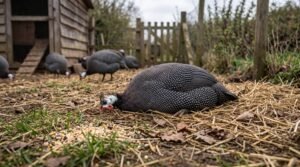
Frostbitten wattles and combs typically start out looking gray, while affected feet tend to darken toward red first. Check your flock daily during a cold snap, ideally right after they come off the roost in the morning when circulation to the extremities is lowest.
Petroleum jelly is a mixed bag. You’ll see it recommended constantly, and it’s not useless — but it’s not a fix-all either. Vaseline freezes at a temperature slightly below the point at which cells in a comb or wattle freeze, so it can protect those tissues down to around 32°F, but once temperatures drop lower for any real length of time, the petroleum jelly itself freezes and stops helping. Some research goes further and suggests it can create a false sense of security that leads keepers to skip more effective precautions. I still use it on nights near freezing, but I don’t treat it as protection once temperatures fall well below that.
What actually helps more:
- A genuinely dry, draft-free coop, since damp conditions are what turn cold into frostbite.
- Deep, dry bedding so feet aren’t standing on frozen or damp flooring overnight.
- Good hydration, since dehydrated birds have poorer blood flow to their extremities.
- Watching the forecast and confining birds fully once temperatures head into single digits.
If you spot frostbite: warm the affected area gradually — dampen a cloth in about 100°F water and hold it against a frozen comb or wattle for around 15 minutes, rewarming the cloth as needed, or soak a foot in 100°F water for about 20 minutes. Never use a heat lamp, heating pad, or other direct heat source, since warming the tissue too quickly increases pain and can cause further damage. If a bird seems to be in serious distress or the tissue looks badly damaged, it’s worth a call to a vet experienced with poultry. For a fuller rundown of cold-weather illnesses beyond frostbite, take a look at our guide to common guinea fowl diseases.
Should You Use a Heat Lamp?
Short answer: usually not. Guinea fowl are hardier than people give them credit for, and the common helmeted guinea fowl copes well with snow, cold, and ice without needing a heated coop in most climates.
The bigger issue is fire risk. Heaters in poultry housing come with real hazards, most notably fire — and depending on where your shelter sits relative to your house, a heater fire might not be caught in time to save the birds, or even the house itself. If a heat source feels genuinely necessary, say for a small or elderly flock during a severe cold snap, mount it securely well away from bedding and anything flammable, and shield both the bulb and the birds with a wire guard.
For most keepers in most climates, a well-built, dry, draft-free shelter does the job without adding that risk to the barn.
Letting Guineas Out in Winter
Guineas hate being cooped up, and honestly, so does the flock’s mood. On the right day, a little time outside is good for them.
On a calm day without weather warnings or hazardous conditions, it’s fine to let them out for exercise and fresh air, even with snow on the ground. Skip it during active storms, deep snow, ice, or high wind — guinea feet aren’t built for prolonged contact with ice, and the risk of frostbite climbs fast in those conditions. I keep an eye on the forecast and use free-range days as the exception during a hard winter, not the rule.
If predator pressure is also a concern once snow limits your birds’ ability to spot danger early, our guide on protecting guinea fowl from predators covers precautions worth layering on top of winter housing.
Quick Reference: Winter Care by Temperature
| Temperature Range | What to Do |
|---|---|
| Above 40°F | Normal free-range access on calm days; standard feed and water routine |
| 32°F–40°F | Begin evening confinement training; watch for ice on waterers |
| 20°F–32°F | Confine overnight minimum; apply petroleum jelly to wattles if desired; increase evening grain |
| Below 20°F | Full confinement likely necessary; check for frostbite daily; consider a heated waterer if not already using one |
Final Thoughts
Guinea fowl can handle a real winter without much drama, but only when the basics are dialed in — a dry, draft-free coop, enough space to avoid stress, more calories to cover what the cold burns off, and water that isn’t a solid block of ice by 9 a.m. The stubborn streak that makes them want to roost in a tree instead of a coop is honestly the hardest part to manage, more so than the temperature itself.
Start the coop-training habit before the first hard frost, check wattles and feet during cold snaps, and resist the urge to over-insulate or add a heat lamp you don’t really need. Do that, and most flocks come through winter in the same shape they went into it.
How does your flock handle the cold where you are — do your guineas take convincing to roost inside, or did yours figure it out faster than mine did? If you’re still working out the rest of your setup, our getting started guide is a good place to fill in any gaps before the temperature drops.
FAQ
Can guinea fowl stay outside all winter? They can tolerate cold well in a well-built shelter, but once temperatures drop into the teens or ice and deep snow set in, they need to be confined to shelter rather than left to range freely.
Do guinea fowl need a heated coop? Most don’t. A dry, draft-free, well-ventilated shelter is usually enough. Heat lamps add fire risk and aren’t necessary for most climates guinea keepers deal with.
How cold is too cold for guinea fowl? Healthy adult guineas in a solid shelter generally do fine down to around freezing without extra intervention. Below that, especially into the teens and single digits, frostbite risk rises sharply and full confinement becomes important.
Will guinea fowl still lay eggs in winter? Guinea hens typically lay far less or stop entirely during winter months regardless of cold-weather care, since egg-laying in this species is heavily tied to daylight length rather than temperature alone.
Hi, I’m Rayyan. I raise guinea fowl and share practical, research-backed guides for backyard keepers and homesteaders. I combine hands-on flock experience with trusted poultry management and university extension resources to help you raise healthier, more productive birds — with confidence, not guesswork.